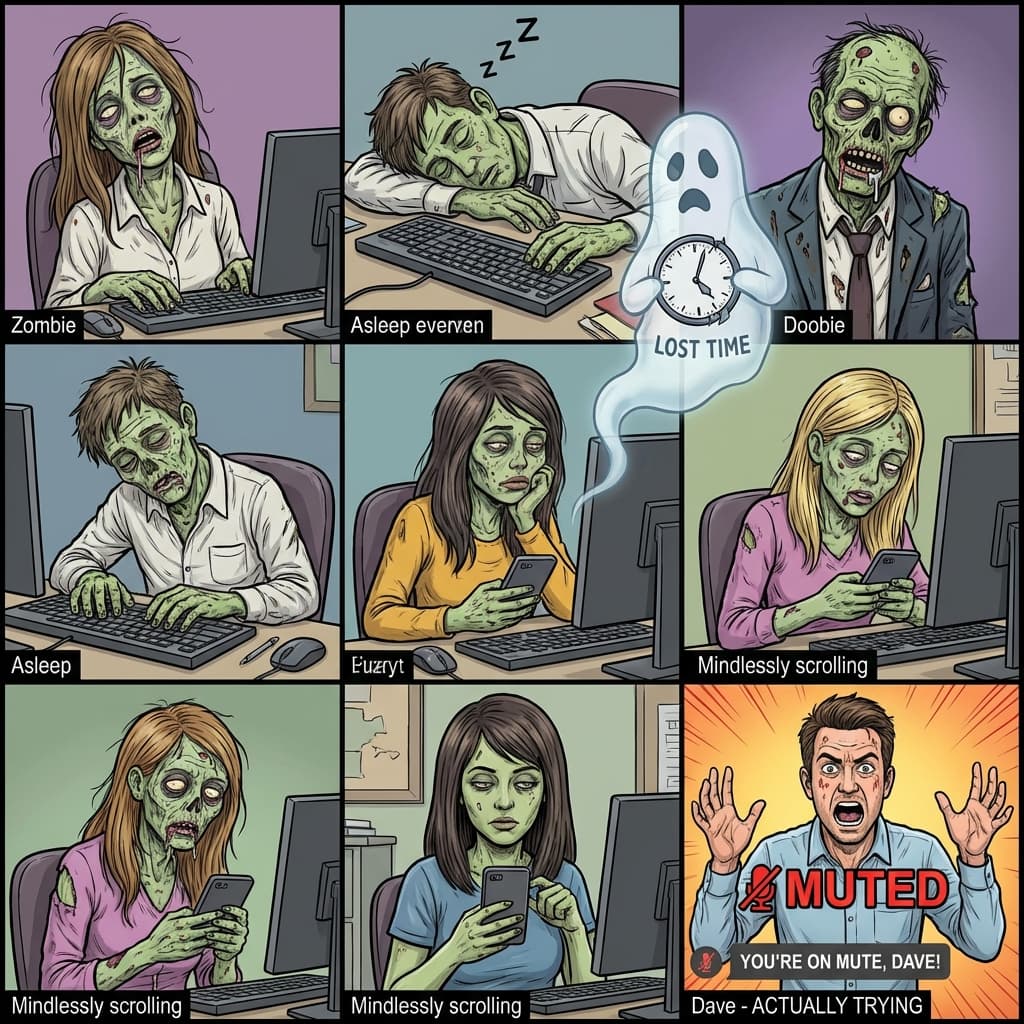
It happens every morning. 9:00 AM (or 10:00 AM). The team shuffles into a Zoom room or a physical circle. They are barely awake. They hold a coffee cup like a lifeline.
The Scrum Master asks the Three Questions:
1. What did you do yesterday?
2. What will you do today?
3. Any blockers?
And then, the lies begin.
"Yesterday I... uh... worked on the API ticket. Today I will... continue the API ticket. No blockers."
Multiply this by 8 people. It takes 20 minutes (it never takes 15). Nobody listens to anybody else. The Frontend dev zones out while the Backend dev talks about database migrations. It is a ritual of compliance, not a tool for collaboration. So we killed it.
The Cost of Synchronous Interruptions
The problem isn't the 15 minutes. The problem is the Anchor.
If you have a standup at 10:00 AM, you can't start "Deep Work" at 9:00 AM. You feel the meeting coming. You answer emails. You slack. You wait.
Then the meeting ends at 10:20 AM. You need 20 minutes to recover and get back into flow. Effectively, the morning is gone.
For a team of 10 engineers with an average salary of $150k (roughly $75/hr), a 20-minute daily meeting costs the company $65,000 a year in direct salary costs. The opportunity cost of lost focus is probably 5x that.
The Performative Nature of Standups
Standups quickly devolve into "Proof of Work."
I have seen engineers make up tasks just to sound busy. "I was researching the library documentation." (Translation: I doom-scrolled Twitter for 4 hours).
When you force people to justify their existence every 24 hours, you incentivize micro-tasks over macro-progress. You incentivize "looking busy" over "being effective."
The Replacement: Async Geekbot
We switched to an asynchronous model using a Slack bot (like Geekbot or Standuply).
The New Rules:
- At 9:00 AM, the bot asks you: "What is your main focus today?" and "Are you stuck?"
- You answer whenever you want, as long as it's before 11:00 AM.
- You can type "Same as yesterday." That is a valid update.
Why this is better:
1. It's Searchable and Written.
If I miss the Zoom standup, that knowledge is gone. If I miss the Slack thread, I can read it later. It creates a written log of progress that is invaluable for retrospectives.
2. It Respects Time Zones.
We are a distributed team. 9 AM in New York is 2 PM in London and 6 AM in San Francisco. A synchronous standup forces someone to be miserable. Async lets the London dev update before they leave, and the SF dev see it when they wake up.
3. It Threads Discussions.
In a Zoom standup, if Alice and Bob start debating an API implementation, 8 other people have to sit there and watch. "Let's take this offline," says the Scrum Master.
In Slack, if Alice posts an update, Bob replies in a thread. They have the discussion there. The rest of the team is not notified. The signal-to-noise ratio is perfect.
But what about "Team Bonding"?
This is the most common defense. "Standup is the only time we see each other!"
If the only time you see your team is during a status report meeting where you are forced to speak, your culture is already broken.
We replaced valid "Bonding Time" with:
- Fika (Coffee Break): Optional 15-minute Zoom hangouts twice a week. No work talk allowed.
- Pair Programming: Actual collaboration on code.
- Gaming Hours: Friday afternoon Among Us or Gartic Phone sessions.
Bonding should be fun, not mandatory admin work.
The Unexpected Benefit: Managers actually read updates
When I was an Engineering Manager, I admit I zoned out during standups too.
With the Async model, I scan the channel at 11:00 AM. I can see clearly: "Oh, Sarah has been stuck on this API integration for 3 days. I need to intervene." I can analyze the text patterns.
It made me a better manager because I was reacting to written data, not spoken vibes.
Conclusion
The Daily Standup is a ritual from the XP (Extreme Programming) days of the 1990s, when teams sat in the same physical room and didn't have Slack, Jira, or GitHub.
In 2026, we have a dozen tools that broadcast our status automatically. If you push code, I get a notification. If you move a Jira card, I get a notification.
We don't need a meeting to tell us what we just emailed each other. Kill the standup. Reclaim your mornings.
Your developers will thank you. (After they sleep in an extra 30 minutes).
Written by XQA Team
Our team of experts delivers insights on technology, business, and design. We are dedicated to helping you build better products and scale your business.