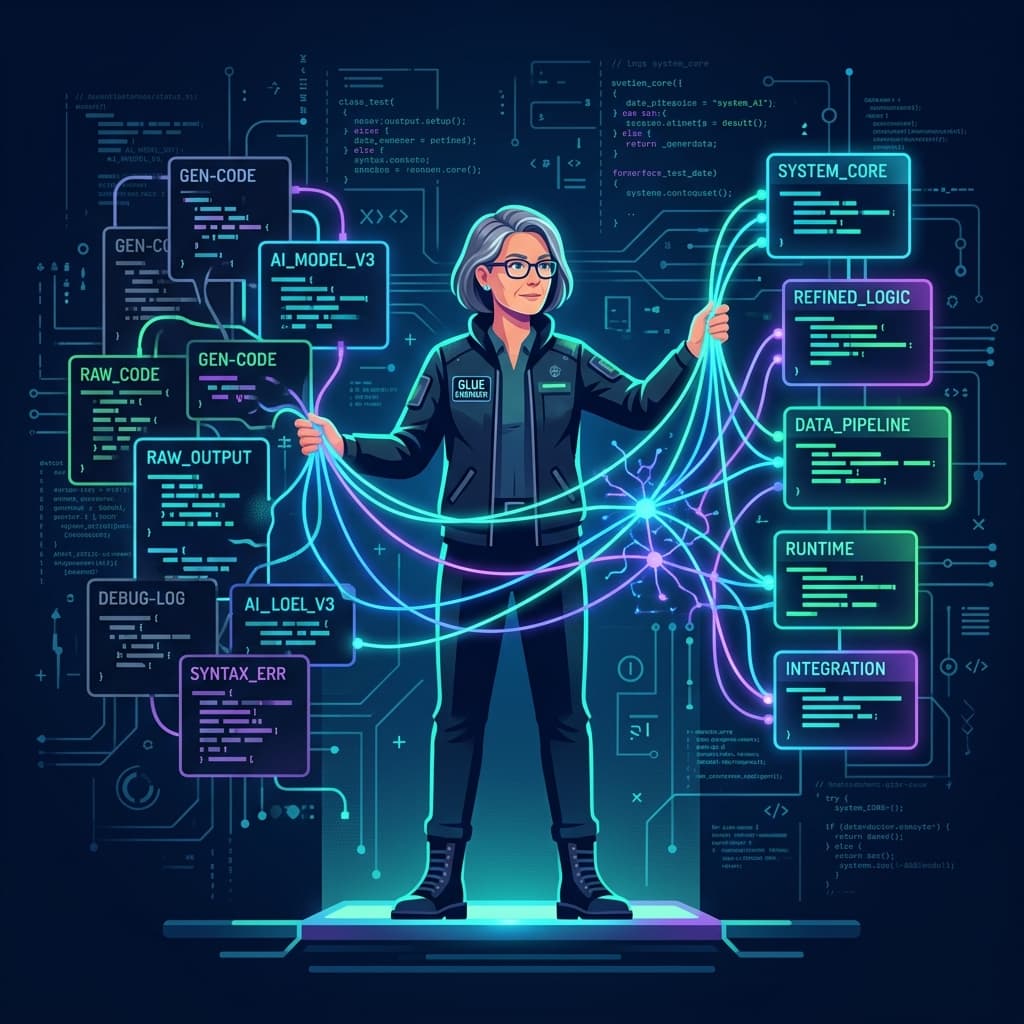
For the past decade, the software industry worshipped the "10x Developer"—the heads-down, headphone-wearing coder who could churn out thousands of lines of pristine React or Go in a single weekend. But in 2026, raw code generation has been thoroughly commoditized. A junior engineer armed with an advanced AI agent can now produce 5,000 lines of syntactically correct boilerplate in an afternoon. Code is no longer the bottleneck. The new bottleneck is cohesion.
I manage an engineering department of 45 developers. Over the last two years, as we integrated autonomous AI coding agents into our CI/CD pipelines, our raw output metrics skyrocketed. Pull requests were being opened, merged, and deployed at unprecedented velocity. Yet, our product wasn't getting fundamentally better. We were shipping more bugs, experiencing more downtime, and dealing with an increasingly fragile architecture.
The heroes who saved our platform weren't the ones generating the most code. In fact, our most highly compensated engineers are now the ones who write the least amount of original code. They are what the industry is starting to call "Glue Engineers." This is an exploration of why the Glue Engineer is the most critical role in the AI era, the specific skills they possess, and how to transition your career from code generator to system stabilizer.
The Commoditization of Syntax
To understand the rise of the Glue Engineer, you have to understand what AI is actually good at. Generative AI models are phenomenal at local syntax. If you need a Python function to parse a specific date format, or a React component to render a modal, or a SQL query to join three tables, an AI can do it faster and often more accurately than a human.
But AI models suffer from severe spatial and temporal myopia. They cannot hold the entire state of a massive, legacy distributed system in their context window. They do not understand that changing the shape of a JSON payload in a microservice will break a seemingly unrelated cron job maintained by a different team three repositories over.
When you arm a team of junior and mid-level developers with AI agents, the result is an explosion of isolated, locally optimized features that clash violently when brought together. It is like having a hundred brilliant bricklayers building a cathedral without a blueprint or a foreman. You get a lot of very nice walls that do not connect to form a roof.
What is a Glue Engineer?
The Glue Engineer is the foreman. They are the senior or staff-level developer whose primary job is to provide the global context that AI lacks. They are the human immune system for the codebase.
A typical week for a Glue Engineer does not involve pulling a feature ticket from Jira and writing it from scratch. Instead, their work falls into three critical categories:
1. Architectural Translation and Prompt Architecture
Before an AI agent can write useful code, the problem must be scoped perfectly. Glue Engineers act as translators between business requirements and the strict, bounded context required by AI models. They design the interfaces, define the data contracts, and set up the scaffolding. They tell the AI, "Implement this interface, using only these allowed libraries, and do not mutate global state." They bound the AI's creativity to prevent it from inventing entirely new design patterns for every pull request.
2. Forensic Debugging and Hallucination Hunting
When an AI generates 500 lines of code, 498 lines might be perfect, and 2 lines might contain a subtle, devastating logical error—a hallucinated method, an off-by-one error in a loop, or a race condition in asynchronous state management. Glue Engineers are elite forensic investigators. Because they didn't write the code, they have to read and audit code written in a style that is foreign to them. Reading AI code requires a different mental muscle than writing code; it requires extreme skepticism and a deep understanding of edge cases.
3. Dependency and Technical Debt Management
AI models love to introduce dependencies. If an AI needs to format a string, it might seamlessly import a massive 2MB library to do it, because it saw that pattern in its training data. Glue Engineers act as the gatekeepers. They review AI-generated PRs and reject them, saying, "No, we don't need a new library for this. Rewrite this to use our internal utility function." They aggressively refactor the bloated, repetitive code that AI tends to produce, constantly pruning the technical debt before it becomes systemic.
The Metrics of Glue
Traditional engineering metrics (lines of code, PRs merged, story points completed) actively penalize Glue Engineers. If you look at a Git contribution graph, a Glue Engineer might look like your lowest performer. We had to completely restructure our performance reviews to measure what actually matters in an AI-assisted environment.
| Metric | Traditional Developer (Pre-AI) | AI-Assisted Junior Dev | The Glue Engineer |
|---|---|---|---|
| Lines of Code Added | High | Extremely High | Negative (They delete code) |
| PR Review Time | Low (Self-focused) | Low (Relies on AI tests) | Very High (Audits everything) |
| System Downtime | Moderate | High (Unintended side-effects) | Low (Prevents bad merges) |
| Cross-Team Communication | Low | Low | Extremely High |
We realized that our most valuable employee was an engineer named Sarah. Over a three-month period, Sarah only merged two feature tickets. However, she reviewed 140 PRs generated by other team members (and their AI agents), rejected 40 of them for severe architectural flaws, deleted 12,000 lines of redundant AI-generated boilerplate, and wrote the system contracts that allowed three different microservices to communicate safely.
If we had evaluated Sarah based on raw code output, we would have fired her. Instead, we promoted her to Staff Engineer and increased her compensation by 30%. Without her glue, the high output of the rest of the team would have literally collapsed our database.
How to Become a Glue Engineer
As AI continues to improve, the demand for pure code generators will diminish. If your entire value proposition to an employer is "I can write a React component really fast," your job is at risk. To secure your career and command a premium salary, you must transition into a Glue Engineer.
Here are the skills you need to cultivate:
1. Master Code Reading Over Code Writing
Stop practicing writing code from a blank screen. Start practicing reading large open-source repositories. Learn how to quickly trace execution paths through a codebase you didn't write. The future of programming is 80% reading and auditing, and 20% prompting.
2. Deepen Your Understanding of Systems Architecture
AI struggles with the macro level. You need to understand how systems scale, how databases lock, how networks fail, and how memory leaks happen. Study distributed systems, database internals, and network protocols. The AI will write the microservice; you have to design the message bus that connects them.
3. Become an Expert Communicator
Glue Engineers spend a massive amount of time talking to product managers to clarify ambiguous requirements (which AI cannot handle) and mentoring junior developers on why their AI-generated PR was rejected. Soft skills, technical writing, and the ability to explain complex technical concepts simply are no longer optional "nice-to-haves"—they are your primary tools.
4. Embrace Deletion
The best Glue Engineers take pride in deleting code. They understand that every line of code is a liability. Learn to identify over-engineered AI solutions and replace them with simpler, native implementations. The less code your organization maintains, the faster it can move.
Conclusion
The AI revolution in software development did not eliminate the need for senior engineers. It elevated them. The industry is realizing that generating code is easy, but building reliable, maintainable, cohesive software products remains incredibly hard.
If you want to thrive in the next decade of tech, don't try to out-type the machine. Let the AI generate the bricks. Your job is to be the mortar. Become the Glue.
Written by XQA Team
Our team of experts delivers insights on technology, business, and design. We are dedicated to helping you build better products and scale your business.