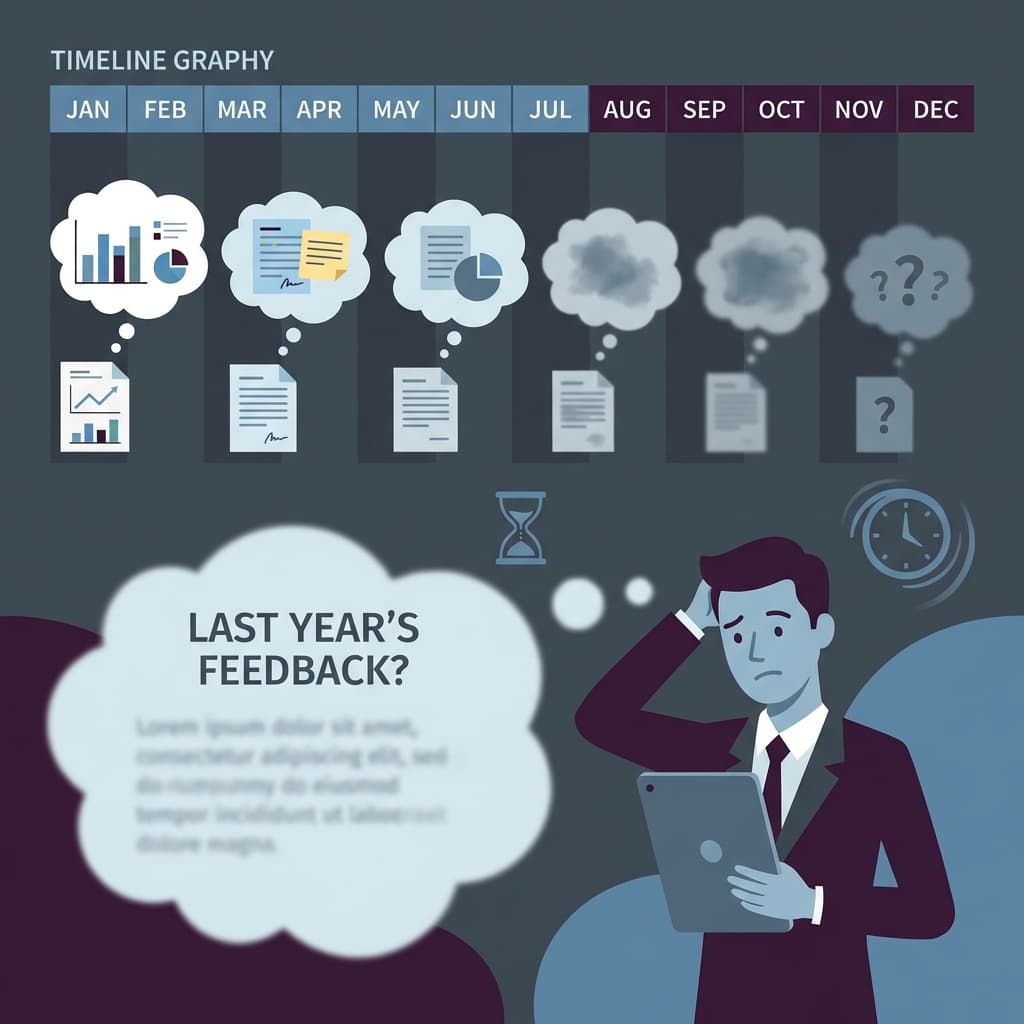
"In January, you made a decision that negatively impacted the team."
It was December. The employee had no idea what decision I was referring to. Neither did I, really—I'd written that note 11 months ago. We were both reconstructing history from fragments.
This is annual performance review theater.
The Memory Problem
Recency bias: Managers remember the last 2 months vividly. Everything before is fuzzy. An employee who crushed Q1-Q3 but had a slow Q4 gets rated lower than one who coasted and then sprinted at the end.
Peak-end bias: We remember peaks (big wins or big failures) and endings. Steady, consistent performance becomes invisible.
Narrative construction: By review time, we've already decided how we feel about someone. We find evidence to support that feeling. The "review" is post-hoc justification.
What Employees Hear
Employees receive feedback about behavior from months ago. They can't connect it to anything specific. The feedback feels arbitrary or unfair because:
- They've already forgotten the context
- They've already changed (maybe improved, maybe not)
- They can't do anything about it now
Actionable feedback requires context and timeliness. By month 11, both are gone.
The Document Frenzy
Review season meant:
- 2 weeks of managers writing reviews instead of managing
- Frantic searching through Slack, emails, and git logs for evidence
- Self-assessments that everyone hates writing
- Peer reviews that become political tools
- Calibration meetings that devolve into horse-trading
Engineering velocity dropped 30% during review season. Everyone was writing about work instead of doing work.
What We Do Now
Weekly 1:1 feedback: Managers give feedback in real-time. Good thing? Say it this week. Bad thing? Address it now, not in 6 months. Written notes kept, but the conversation happens immediately.
Monthly reflection: 15-minute self-assessment. What went well? What didn't? What do you need? Simple, fast, keeps a running log.
Quarterly calibration: Leadership aligns on performance expectations. Not individual ratings—just "are we applying consistent standards?" This takes 2 hours, not 2 weeks.
Annual compensation review: We still adjust pay annually. But it's based on 12 months of documented feedback, not a single review document constructed from memory.
The Results
- Feedback response rate: Up 4x (people act on timely feedback)
- Surprise ratings: Down 90% (no more "I had no idea")
- Review season productivity loss: Eliminated
- Manager satisfaction with review process: 3.1/5 → 4.4/5
The Cultural Shift
Moving from annual reviews to continuous feedback requires cultural change:
- Managers must give hard feedback in real-time, not save it
- Employees must accept feedback as normal, not alarming
- Everyone must keep brief notes (we use a simple form)
This is harder than writing one big document per year. It's also much more effective.
Feedback is perishable. Deliver it fresh or throw it away. By month 11, it's already rotten.
Written by XQA Team
Our team of experts delivers insights on technology, business, and design. We are dedicated to helping you build better products and scale your business.