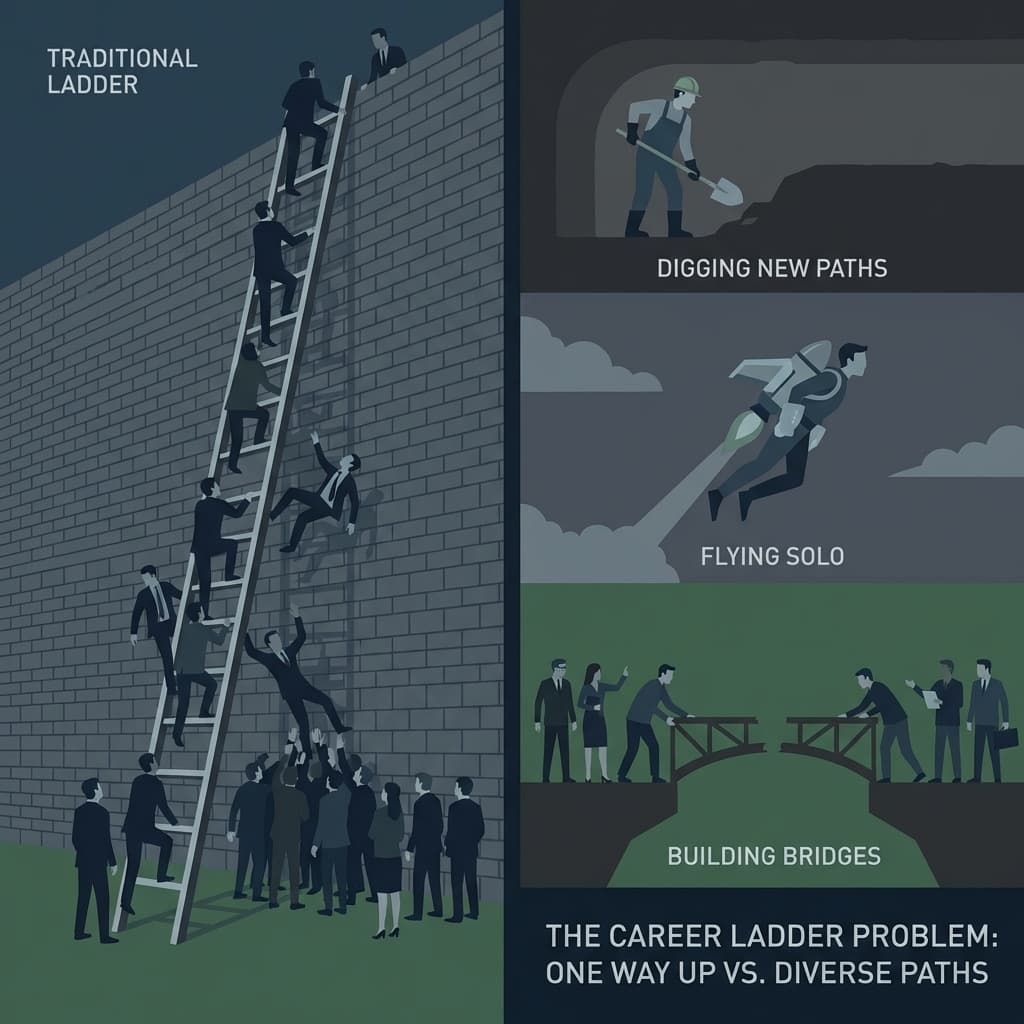
The standard career ladder: Junior → Mid → Senior → Staff → Principal → Distinguished. Linear. Clear. Everyone knows where they stand and where they're going.
Also: completely broken.
What We Observed
Our best Senior engineer shipped more impact than 90% of our Staff engineers. But she didn't want to "lead initiatives" or "influence across the organization"—the Staff requirements. She wanted to write code. She hit the ceiling.
Another Senior desperately wanted Staff. He started organizing meetings, writing docs, mentoring—all the "Staff behaviors." His shipping velocity dropped 60%. He got promoted. We lost a great coder and gained a mediocre coordinator.
A third Senior became Staff by leading a major migration. The migration finished. What does a Staff engineer do when there's no migration to lead? Invent migrations? That's what happened. Make-work to justify the title.
The Ladder's Hidden Assumptions
Career ladders assume:
- Linear progression is desirable. Everyone should want to climb. Not climbing means stagnation.
- Higher = broader. Advancement means more scope, more influence, more coordination. Technical depth plateaus; breadth expands.
- Titles indicate capability. A Staff engineer is "better" than a Senior engineer. Full stop.
All three assumptions are wrong for many engineers. Some want to go deep forever. Some want to oscillate between depth and breadth. Some want completely lateral moves into different domains. The ladder doesn't accommodate any of this.
The Replacement: Impact Zones
We replaced the 7-level ladder with 3 zones:
Zone 1: Learning (1-3 years typically)
You're ramping up. Taking direction. Building skills. Compensation grows with demonstrated competency. No title progression—everyone here is "Engineer."
Zone 2: Established (unlimited tenure)
You're fully productive. Delivering consistently. Might specialize deeply, might broaden, might mentor, might not. Compensation is competitive. Title is "Senior Engineer" and stays that way. You can be here forever with no stigma.
Zone 3: Amplified (invitation only)
You're multiplying others' output somehow. Could be technical leadership, could be exceptional individual output, could be mentorship, could be architectural work. Compensation premium. Title varies by role.
How It's Different
No pressure to climb. Zone 2 is explicitly a legitimate terminal state. We have 10-year Senior Engineers who are among our most valued people. No performance improvement plans for "lack of progression."
Multiple paths in Zone 3. You don't need to become a pseudo-manager. Deep technical experts, prolific shippers, and force-multiplier mentors all qualify. The criterion is amplification, not coordination.
Easier lateral moves. Want to switch from backend to ML? You're still Zone 2. No demotion panic. No title loss. Your zone reflects your impact trajectory, not your domain tenure.
Honest compensation. Zone 2 pay is genuinely competitive. We're not artificially suppressing it to incentivize climbing. If you're productive and happy, why should you earn less than someone "higher" who's less productive?
The Results
After 2 years with impact zones:
- Attrition of Senior ICs: Down 40%. They stopped feeling stuck.
- Satisfaction with career growth: Up from 3.1/5 to 4.2/5.
- Average shipping velocity: Up 15%. People optimizing for impact, not ladder behaviors.
- "I want to be Staff" conversations: Almost eliminated. Replaced by "I want to have more impact in X way"—a more useful discussion.
The Objection: "People Need Clear Goals"
Fair. The ladder gave clear goalposts. Impact zones feel vaguer.
Our answer: goals should be personal and role-specific, not generic ladder checkboxes. Your manager works with you to define what "more impact" means for YOUR situation. It's more work for managers. It's also more honest and more effective.
Ladders make everyone climb the same wall. Some people are great at climbing. Others are great at digging, building, or flying. Let them.
Written by XQA Team
Our team of experts delivers insights on technology, business, and design. We are dedicated to helping you build better products and scale your business.