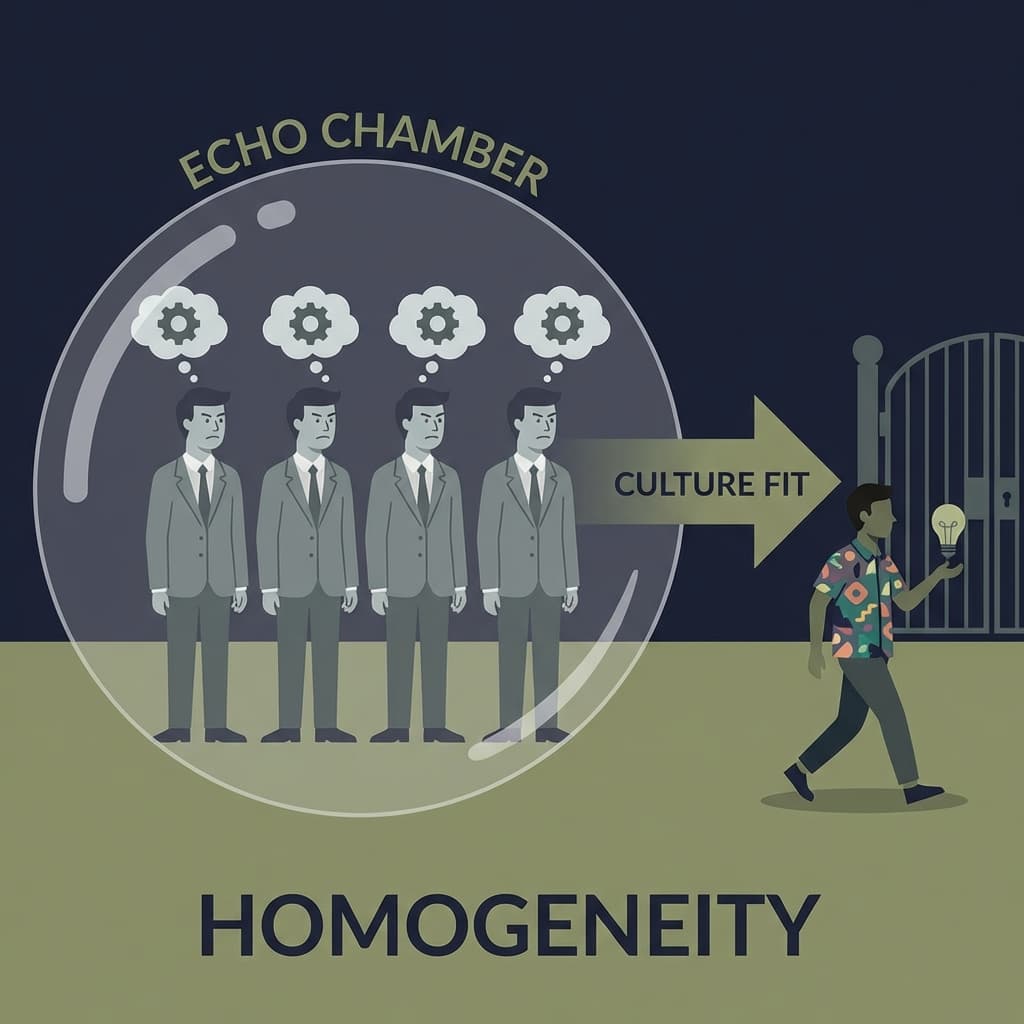
"Would you want to grab a beer with this person?" That was our unofficial culture fit test. If the answer was yes, they passed. If there was something vaguely off—they didn't quite fit—we rejected them. It felt like protecting our culture.
Three years later, we looked around the room at an all-hands meeting. Same backgrounds. Same universities. Same references. Same thinking. We'd built a team that agreed with each other about everything—which meant nobody challenged bad ideas. Our culture fit interviews had created a monoculture.
This is the story of how culture fit became culture cloning, why that hurt our company, and what we do instead. The alternative isn't chaos—it's structured evaluation of what actually matters.
How Culture Fit Started
Culture fit interviewing started with good intentions. We'd all experienced toxic work environments. Teams where people didn't trust each other, didn't communicate, didn't help each other. We wanted to prevent that.
The logic seemed sound: hire people who share our values, who communicate similarly, who we'd enjoy working with. Chemistry matters in collaboration. It's not just about skills—it's about the person.
We added a "culture fit" interview to our process. It was explicitly non-technical. Talk about interests. Talk about work style. Talk about past experiences. Get a sense of the person. The evaluation was subjective: "Would they thrive here? Would they get along with the team?"
For five years, this felt like it was working. We had low conflict. People liked each other. The office was harmonious. We congratulated ourselves on hiring well.
We didn't notice what we weren't seeing.
The Data That Changed Everything
A new head of People Operations ran an analysis of our last 100 hires. She looked at demographics, backgrounds, and interview outcomes. The results were disturbing.
Who We Were Hiring
| Demographic | Hiring Rate | Industry Benchmark |
|---|---|---|
| Top 20 university graduates | 85% | 40% |
| Previous company overlap with interviewers | 40% | ~5% |
| Extroverts (self-reported) | 80% | 50% |
| Similar hobbies to interviewers | 70% | Random |
| Age within 10 years of team median | 90% | ~60% |
We were hiring people who reminded us of ourselves. Not consciously—nobody was deliberately filtering for similar backgrounds—but the "culture fit" evaluation was doing it implicitly.
Who We Were Rejecting
More concerning: we analyzed candidates who passed technical interviews with strong scores but were rejected for "culture." Common notes in their feedback:
- "Seemed quiet, might not speak up in meetings"
- "Different communication style, concerned about collaboration"
- "Hard to read, couldn't tell if they were excited about the company"
- "Not sure they'd fit the team energy"
- "Smart, but something felt off"
These were descriptions of introverts, of people from different cultural backgrounds, of neurodiverse candidates, of people who express enthusiasm differently. We were rejecting qualified candidates because they weren't like us.
The Performance Data
Here's the kicker: we tracked how candidates performed after being hired. Guess what correlated with performance?
Technical interview scores: Strong correlation with job performance. Unsurprising—technical ability predicts the ability to do technical work.
Culture fit scores: Zero correlation with performance, retention, or peer feedback. Literally random. High culture fit scores didn't predict who would excel, stay, or be good teammates.
Culture fit interviewing was adding noise, not signal. And that noise had systematic biases baked in.
The Consequences of Homogeneity
Beyond the ethical problems with hiring bias, homogeneity was hurting our business.
Echo Chambers
When everyone thinks similarly, bad ideas go unchallenged. We launched a product direction that three major customers told us they didn't want. Nobody internally questioned it because we all thought it was brilliant. We'd lost the ability to hear dissent—there was nobody to dissent.
In postmortem, we realized that someone with a different perspective—maybe someone from sales, or someone with a different background—would have caught the obvious misalignment with customer needs. But we hadn't hired those perspectives. We'd hired people who thought like us.
Blind Spots
Our product served a global market, but our team was from a narrow slice of the population. We built features assuming everyone worked like we did. We missed accessibility issues—nobody on the team used screen readers. We missed internationalization problems—nobody on the team had experience with right-to-left languages. We missed workflow assumptions—everyone on the team worked the same way.
Users complained. We were confused. Of course the product worked this way—it worked for all of us! The homogeneity had created blind spots we couldn't see because we were all standing in the same place.
Stagnation
Diverse teams produce more innovative solutions. This isn't feel-good rhetoric—it's documented research. When people approach problems from different angles, they find solutions that homogeneous teams miss.
Our team didn't argue enough. Disagreements were rare. This felt pleasant but produced mediocre outcomes. We'd converge quickly on solutions that felt right to everyone—because everyone thought the same way—but those solutions often weren't the best ones.
The Replacement: Values Alignment
We didn't abandon non-technical evaluation. We replaced "culture fit" with "values alignment"—and crucially, we made it structured instead of subjective.
Define Values Explicitly
First, we articulated what our culture actually was—not "we're fun people" but specific behavioral values:
- Intellectual honesty: Say what you believe, even when it's uncomfortable. Acknowledge mistakes. Change your mind when presented with evidence.
- Customer focus: Decisions prioritize customer value over internal convenience. Spend time understanding actual user needs.
- Collaborative disagreement: Disagree openly and respectfully. Debate ideas, not people. Commit once decided, even if you disagreed.
- Continuous learning: Seek feedback. Seek to improve. Help others improve. Be comfortable not knowing things.
Notice what's NOT in our values: extroversion, similar communication styles, shared hobbies, same educational background. Those aren't values—they're demographics.
Structured Behavioral Questions
Instead of vibes-based conversation, we interview with structured behavioral questions tied to each value:
For intellectual honesty: "Tell me about a time when you changed your mind about something important at work. What was the evidence that convinced you?"
For customer focus: "Describe a situation where internal priorities conflicted with what customers wanted. How did you navigate it?"
For collaborative disagreement: "Tell me about a conflict with a colleague over a technical or product decision. How was it resolved?"
For continuous learning: "What's something you've learned in the last year that changed how you work?"
These questions have right-ish and wrong-ish answers. Someone who can't describe ever changing their mind lacks intellectual honesty. Someone who always prioritized internal politics over customers lacks customer focus. The answers reveal values, not personality types.
Structured Scoring
Interviewers score each value on a 1-4 scale with specific rubrics:
- 1: Demonstrated behaviors inconsistent with this value
- 2: No evidence of this value (neutral)
- 3: Some evidence of this value
- 4: Strong evidence of this value
We require written justification for each score, citing specific examples from the interview. "Good vibes" isn't a valid justification. "Described changing their approach after customer feedback, specifically mentioned [example]" is valid.
Interviewer Training
All interviewers go through training on bias recognition. We explicitly cover:
- Similarity bias: Preferring candidates who remind you of yourself
- Communication style bias: Penalizing different (but equally valid) ways of expressing ideas
- The halo effect: Letting one positive impression color everything
- Gut feel traps: When "something feels off" often means "this person is different from me"
Interviewers are required to evaluate against the rubric, not against their intuition. If their gut says reject but the rubric says hire, the rubric wins. The gut is too easily corrupted by bias.
The Results
Two years after eliminating culture fit interviews:
| Metric | Before | After |
|---|---|---|
| Employees from non-traditional backgrounds | 15% | 40% |
| Introverts (self-reported) | 20% | 45% |
| Diversity of previous company backgrounds | Low | High |
| Product accessibility issues found by team | 2/quarter | 12/quarter |
| Major direction pivots from internal challenge | 0/year | 3/year |
| Employee satisfaction with team dynamics | 7.2/10 | 8.1/10 |
Counterintuitively, team satisfaction went UP despite more disagreement. People felt more respected because their different perspectives were valued. The discomfort of an occasional argument was outweighed by the sense that their voice mattered.
Business Impact
The new diversity of thought translated to better business outcomes:
- We caught a major product pivot failure before launch (saved ~$2M)
- We entered a new market segment because a team member from that industry recognized the opportunity (generated $5M ARR)
- We fixed accessibility issues that were blocking government contracts ($3M in new deals)
The homogeneous team was leaving money on the table we couldn't see. The diverse team saw opportunities everywhere.
Objections We Heard
"But chemistry matters!" Yes—but chemistry doesn't require similarity. Effective teams can be made of very different people who respect each other and share values. In fact, those teams tend to be more effective than teams of similar people who get along easily but don't challenge each other.
"We need people who get along." Getting along is about shared values and mutual respect, not shared backgrounds. Two people can have wildly different personalities and still collaborate beautifully if they both value intellectual honesty and collaborative disagreement.
"Some people really are bad culture fits." True—some candidates genuinely don't share our values. The values alignment interview catches them. Someone who never admits mistakes, or who talks only about their own credit, or who dismisses user feedback—they fail the values interview. We're not saying ignore culture. We're saying evaluate it rigorously.
"This seems bureaucratic." Structured interviewing takes more explicit effort than vibes. It's also fairer, more accurate, and produces better outcomes. The "bureaucracy" is the scaffolding that prevents bias from corrupting your hiring.
How To Do It Yourself
- Eliminate "culture fit" as a concept. The term is too vague and becomes a container for unconscious bias.
- Define 3-5 behavioral values explicitly. What specific behaviors do you want? Not "we're fast-moving" but "we prefer reversible decisions and quick iteration over prolonged analysis."
- Create behavioral interview questions for each value. Questions should elicit stories about past behavior. Past behavior predicts future behavior.
- Build scoring rubrics. What does a great answer look like? A mediocre answer? A concerning answer? Write it down.
- Train interviewers. Bias training isn't optional. Everyone thinks they're objective. Nobody is.
- Require written justification. "I liked them" isn't feedback. "They described three instances of changing their approach based on user research" is feedback.
- Audit outcomes. Who are you hiring? Who are you rejecting? Look for patterns. If all your hires look the same, your process is broken.
Culture fit sounds reasonable but becomes culture cloning. Hire for shared values, not shared backgrounds. Your company will be better for it—and so will the people you hire.
Written by XQA Team
Our team of experts delivers insights on technology, business, and design. We are dedicated to helping you build better products and scale your business.