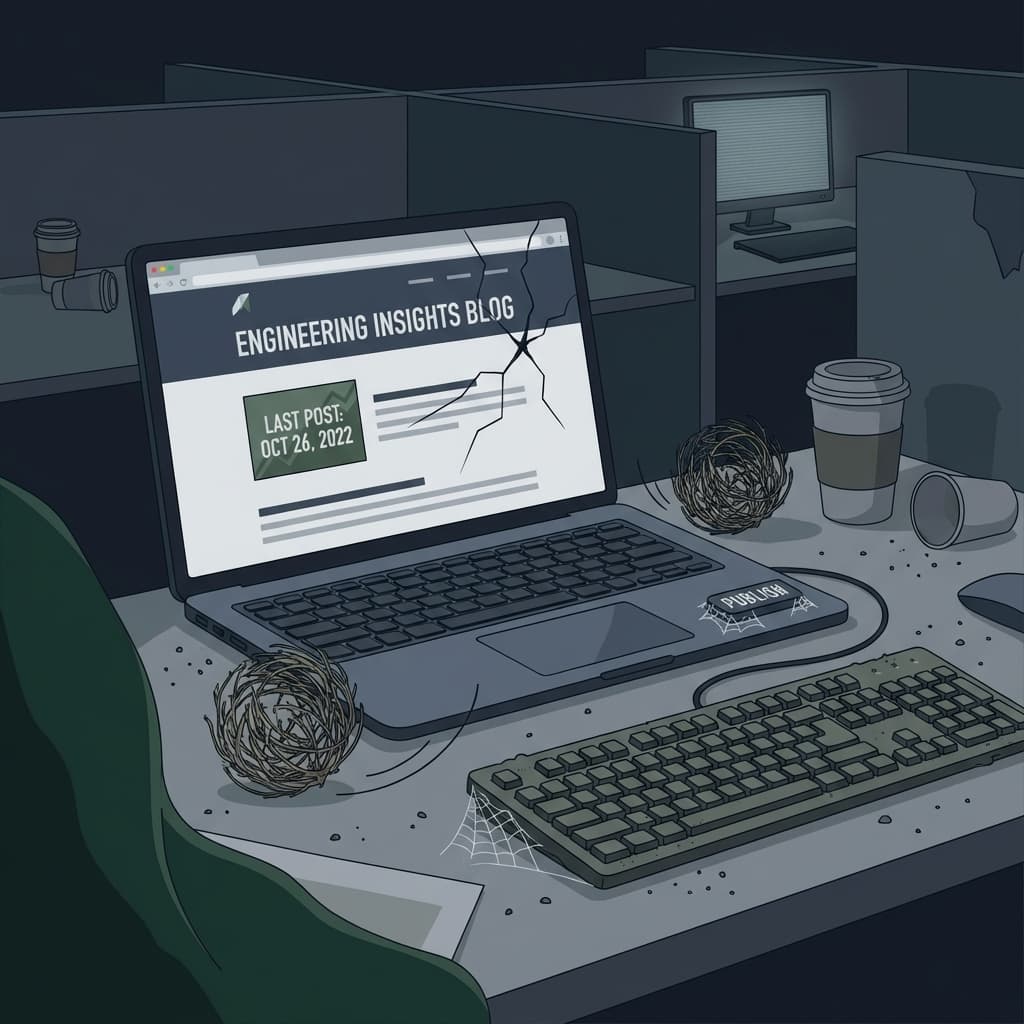
"We need an engineering blog! It'll attract talent! Show our technical depth! Build our brand!" The VP of Engineering was excited. The recruiting team was excited. Everyone agreed this was exactly what we needed. We built the blog infrastructure, designed a beautiful template, and announced the launch with fanfare.
Then we waited for posts. And waited. And waited.
Year one: 3 posts. Year two: 1 post. By year three, the blog hadn't been updated in 18 months. It became an embarrassment—visitors saw "Last updated: March 2024" and drew conclusions about our engineering culture. The blog meant to showcase our talent was actively hurting our brand.
This is the story of why engineering blogs fail, why forcing engineers to write doesn't work, and what we do instead that actually generates external technical visibility.
The Dream vs. Reality
The dream was simple: engineers would write about interesting technical problems they'd solved. Candidates would read these posts, be impressed by our technical depth, and want to work with us. The blog would pay for itself in reduced recruiting costs and better candidate quality.
We looked at successful engineering blogs as inspiration. Netflix's tech blog. Stripe's engineering blog. Uber's engineering blog. If they could do it, surely we could too.
What we didn't see behind those successful blogs: massive teams (Netflix has thousands of engineers), full-time content teams (Stripe has dedicated technical writers), and organizational cultures built over decades that normalized technical writing as part of the job.
We had 60 engineers, no technical writers, and a culture where shipping code was valued above all else. Writing a blog post was extra work that didn't help anyone's performance review.
Why Engineers Didn't Write
We surveyed our engineering team to understand the resistance. The answers were illuminating and, in hindsight, obvious.
The Time Investment Was Enormous
A good technical blog post takes 8-16 hours to write. That's not an exaggeration—it's a realistic estimate for a quality piece that includes code examples, diagrams, and clear explanations.
First, you need to pick a topic that's interesting enough to write about but not so proprietary that legal will reject it. Then you need to outline, write a draft, revise, get code examples working, create diagrams, get peer reviews, address feedback, revise again, and finally publish.
Engineers looked at that time investment and asked: "What's in it for me?" The honest answer was: not much. Blog posts weren't part of performance criteria. They didn't count toward promotion. They were invisible to managers evaluating impact. Writing a blog post meant 8-16 hours of project work not done, with no compensating credit.
People do what they're incentivized to do. We incentivized shipping code, not writing about it.
The Review Gauntlet Was Soul-Crushing
We established a review process to ensure quality and avoid legal/PR problems. Every post went through:
- Technical review: An engineering lead verified accuracy
- Security review: Checked for accidentally disclosed vulnerabilities or internal system details
- Legal review: Verified we weren't disclosing things we shouldn't
- Marketing review: Ensured consistent brand voice and messaging
- Final edit: Professional copyediting for grammar and style
The process took 3-4 weeks. By the time a post was published, the author had lost enthusiasm. Worse, the review process often stripped out personality and edge, leaving bland corporate-speak that read like documentation.
One engineer wrote a funny, self-deprecating account of a production incident and what they'd learned. Legal flagged it as "potentially positioning the company negatively." Marketing rewrote sections to be more "upbeat." By publication, it was unrecognizable—and the author vowed never to write again.
Topic Anxiety Paralyzed People
Engineers are trained to be precise and correct. Writing for public consumption triggers anxiety about being wrong in public. Common refrains we heard:
"Is my topic interesting enough? There are thousands of posts about Kubernetes already. Who cares what I have to say?"
"What if I get something wrong? People will judge me. It'll be there forever."
"The really interesting work I do is proprietary. The stuff I can write about is boring."
"What if my code examples have bugs? What if someone smarter than me points out a better approach in the comments?"
This anxiety wasn't irrational. Engineers had seen colleagues criticized on Hacker News for minor errors in blog posts. The potential downside (public embarrassment) felt larger than the potential upside (vague brand benefit).
There Was No Reward
We asked managers: "When someone writes a blog post, how does that factor into their performance review?"
The answers ranged from "It doesn't" to "I guess it's nice but it wouldn't affect their rating" to "I didn't even know they wrote a post."
Compare this to shipping a feature, which has clear metrics, visible impact, and direct career benefit. Writing was positioned as "extra" work for people who had finished their "real" work—except nobody ever finished their real work because there was always more to ship.
The Posts We Actually Got
Over two years, we published four posts. Looking back, they followed predictable patterns:
The Tech Stack Announcement: "We use Kubernetes!" Cool, so does everyone. No unique insight. No reason for anyone to care. These posts exist because they're easy to write and hard to reject, not because they provide value.
The Hiring Post in Disguise: "Our amazing engineering culture (and we're hiring!)" Transparently self-promotional. Candidates see through it. Often written by recruiting with an engineer's byline, which engineers resented.
The One Person Who Likes Writing: One staff engineer genuinely enjoyed writing. They wrote two thoughtful posts that were actually good. But they left the company, and the blog died with their enthusiasm.
The Forced Assignment: A manager volunteered their team to write a post. The resentment was palpable. The result was perfunctory. It met the requirement of being a blog post, but added nothing to the conversation.
None of this built brand. None of it attracted candidates. It was content for content's sake—worse than having no blog at all because it demonstrated we had nothing interesting to say.
The Survey That Changed Everything
Before killing the blog, we surveyed the engineering team: "How would you prefer to share technical knowledge externally?"
The results surprised us:
Conference speaking: 65% interested. Engineers who wouldn't write a blog post wanted to give conference talks. Speaking is performance—there's an audience, immediate feedback, travel to interesting places. It's social in a way that solo writing isn't. The same engineers who dreaded writing were excited about the idea of presenting at a conference.
Open source contributions: 70% interested. Code speaks louder than words. Engineers wanted to contribute to open source projects, maintain libraries, and release internal tools as open source. This felt like "real work" to them. It was impact they could point to—"I maintain this library that has 5,000 GitHub stars."
Podcasts and videos: 40% interested. Conversation is easier than writing. Engineers who struggled with blank page syndrome were comfortable talking through ideas. The barrier to entry felt lower, even if the actual effort was similar.
Blog posts: 15% interested. A small minority genuinely enjoyed writing. These were often former English majors or people with personal blogs. They wrote regardless of whether we had a company blog to publish on.
We'd been optimizing for the 15% while ignoring the 70% who wanted to do something else entirely.
The Pivot: Meeting Engineers Where They Were
We killed the mandatory blog program and redirected resources to what engineers actually wanted to do.
Conference Speaking Program
We created a formal speaking program with real support:
- CFP (Call for Papers) support: A rotating engineer helped colleagues craft abstracts and structure proposals. Our acceptance rate tripled.
- Presentation coaching: We brought in a speaking coach twice a year for workshops. Engineers could get 1:1 feedback on practice runs.
- Time allocation: Talk preparation was treated as legitimate work. Engineers got explicit time allocation—typically 20-40 hours for a 30-minute talk.
- Conference budget: Full coverage for travel, hotel, and conference fees. No questions asked for relevant conferences.
- Recognition: Conference speakers were celebrated. Internal announcements. LinkedIn features. Shoutouts in all-hands.
The result: Year one had 4 external conference talks by company engineers. Year two had 12. Year three had 18. Engineers who said they'd never write a blog post were giving talks at major conferences.
Open Source Contributions
We made open source work visible and supported:
- 20% time for OSS: Engineers could spend one day per week on open source work—contributing to dependencies we used, maintaining projects we'd released, or building new tools.
- Internal to external pipeline: We created a process for releasing internal tools as open source. Legal pre-cleared the process so it wasn't a bureaucratic nightmare.
- Maintainer credit: Being a maintainer of an OSS project was explicitly included in performance criteria. It counted toward impact.
Within two years, we had engineers maintaining several moderately popular open source projects. Our GitHub org had thousands of followers. Candidates mentioned our OSS work in interviews. The recruiting team reported that engineering candidates increasingly came in knowing about our tools.
The Optional Blog
The blog still exists. We just stopped pretending everyone should write for it.
No content calendars. No mandatory contributions. No quotas. The 15% who enjoy writing still write. They don't need encouragement or coercion—they have a platform when they want it. Posts appear sporadically, driven by genuine enthusiasm rather than obligation.
The quality improved dramatically. Posts written by people who wanted to write are better than posts written by people who were forced to write. Shocking, right?
The Results
| Metric | Blog Era | After Pivot |
|---|---|---|
| External technical content/year | 4 blog posts | 18 talks + 12 OSS projects + 6 blog posts |
| Engineer participation | 3 people | 30+ people |
| Inbound candidate mentions | "Never heard of you" | "Saw your talk at X" / "Use your library" |
| Engineer satisfaction with external program | 2.1/5 | 4.3/5 |
| Recruiting source diversity | Mostly recruiters | 40% inbound from technical visibility |
By every metric, the pivot worked. More content, more participation, better candidate quality, happier engineers.
Why Talks and OSS Work Better Than Blogs
Several factors explain the difference:
Social motivation: Talks have audiences, deadlines, and live feedback. There's applause (or silence). The social stakes drive completion. Writing is solitary and deadline-flexible—easy to indefinitely postpone. Speaking commitments create accountability.
Skill alignment: Engineers are trained to build things. Open source is building things. Writing is a different skill that many engineers never developed and don't particularly want to develop. OSS contributions feel like extensions of their core work.
Signal quality: Anyone can write a blog post. Speaking at a prestigious conference requires passing a selection committee. Maintaining a popular OSS project requires building something people actually use. The signals are harder to fake and therefore more credible.
Compounding effects: Conference talks get recorded and shared on YouTube for years. OSS projects get starred, forked, and contribute to GitHub profiles. Blog posts have a short visibility window and then vanish into the archive. The ROI per hour of effort is higher for talks and OSS.
Career portability: An engineer with conference speaking experience and OSS maintainer credits can leverage that in their next job search. An engineer who wrote posts for their company's blog has less portable credibility—the brand benefit accrued to the company, not the individual.
When Engineering Blogs Work
Not every engineering blog fails. The successful ones share characteristics:
Writing-positive culture: Some companies (Stripe, for example) have cultures where technical writing is valued and normalized from day one. Engineers are hired partly for communication skills. Writing is part of the job, not extra work.
Full-time content support: Technical writers who work with engineers to develop and polish posts. The engineer provides technical knowledge; the writer handles the craft. The burden on engineers is drastically reduced.
Strategic integration: Blogs tied to developer relations, documentation, or marketing functions with dedicated resources. Not a side project that engineering is supposed to do in their spare time.
Small, consistent commitment: One quality post per quarter is more sustainable than ambitious content calendars that immediately slip.
We had none of these. We expected engineers to write because we asked nicely. That doesn't work.
Advice for Engineering Leaders
If you're considering an engineering blog, ask yourself:
- Do your engineers want to write? Survey them. If less than 30% are interested, don't force it. You'll get resentful compliance at best.
- Are you providing real support? Time allocation, writing help, streamlined review process? Or just asking for free labor?
- Is writing integrated into performance evaluation? If it doesn't count, it won't happen.
- Have you considered alternatives? Talks? OSS? Podcasts? Different engineers prefer different formats.
If you already have a failing blog, give yourself permission to kill it. A dead blog hurts your brand more than no blog. Redirect the energy to formats your team actually wants to engage with.
The Blog Isn't Universal
We still have engineers who love writing. They still post. The difference: we don't pretend everyone should write. We let natural writers write and natural speakers speak. We support people in their preferred formats rather than forcing a single channel.
The goal was never "have a blog." The goal was "build external technical visibility." Blogs are one means to that end, and not even the best one for most engineering teams.
Stop forcing blog posts. Ask what your engineers actually want to do externally. Support that instead. You'll get more participation, better quality, and happier engineers.
Written by XQA Team
Our team of experts delivers insights on technology, business, and design. We are dedicated to helping you build better products and scale your business.