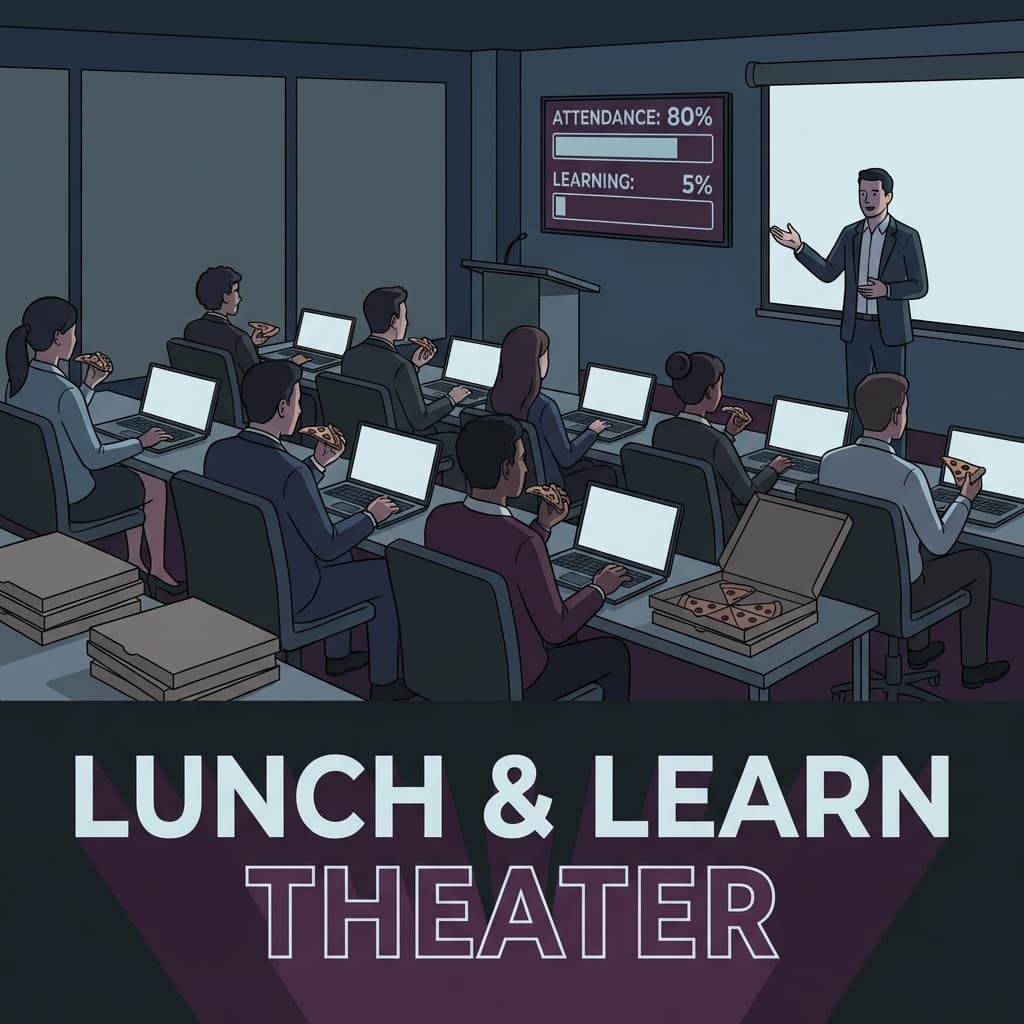
Lunch and Learns were supposed to be the perfect knowledge-sharing mechanism. Combine education with free food. Everyone shows up for pizza, stays for the learning. No additional time commitment—you're eating anyway. It should be a win-win.
We ran weekly Lunch and Learns for three years. Attendance was excellent—80% on average. We congratulated ourselves on our learning culture. Engineers were absorbing knowledge while enjoying catered meals.
Then we started measuring learning outcomes.
We surveyed attendees after sessions: "What did you learn?" The answers were sobering:
- 40% couldn't name the topic (after eating in the room for 45 minutes)
- 35% could name the topic but not describe any key points
- 20% could describe one or two superficial takeaways
- 5% had genuinely learned something actionable
80% attendance. 5% meaningful learning. We had built an expensive pizza delivery program disguised as education.
We observed sessions more carefully. Half the "attendees" had laptops open, working on code or Slack. They were physically present but mentally elsewhere. The food was the draw; the learning was background noise.
We killed Lunch and Learns. We replaced them with optional deep-dive sessions—no food, no lunch hour, purely for people who wanted to learn. Attendance dropped to 20%. Learning quality jumped dramatically. Here's why.
Section 1: The Incentive Mismatch—Food vs. Learning
Lunch and Learns create a fundamental incentive problem: the primary draw is food, not education.
What Attendees Are Optimizing For
When you offer free lunch, people attend for the lunch. This is obvious in retrospect, but we convinced ourselves otherwise because... we wanted to believe our learning culture narrative.
An employee's calculus:
- I need to eat lunch anyway
- Free food is better than buying lunch
- I can multitask during the session
- Net benefit: free food + partial work time + some background noise that might be occasionally useful
This calculus leads to attendance but not to learning. The employee is optimizing for food and time efficiency, not for knowledge acquisition.
The Multitasking Reality
We observed 10 Lunch and Learn sessions and counted behaviors:
- 55% of attendees had laptops open at some point
- 40% were actively typing (working, not taking notes)
- 30% checked phones multiple times
- 15% left early (after eating but before content finished)
The format signals "this is casual, multitasking is fine." You're eating. Others are eating. The presenter is eating (sometimes). The message is: this is lunch with learning on the side, not learning with lunch on the side.
The Quality Tradeoff
Presenters know the audience is partially checked out. They adapt by making content lighter, more "entertaining," less demanding. Deep dives get avoided because they require focused attention that won't be given.
We analyzed our Lunch and Learn topics:
- 70% were "intro to X" or "overview of Y"—surface-level content
- 20% were project demos—entertaining but not educational
- 10% were genuinely deep technical content
The format drove the content toward shallow. Deep content doesn't work when half the audience is responding to Slack messages.
Section 2: The Presenter Burden—Low Reward, High Effort
Lunch and Learns also failed our presenters.
The Preparation Tax
A good 45-minute presentation takes 4-8 hours to prepare. That's significant engineering time sacrificed for the session.
Return on that investment: an audience that's half-present, gives polite applause, and forgets everything within a week.
Our best engineers stopped volunteering to present. The ones who did were often junior (eager to build visibility) or had content they were presenting anyway (recycled conference talks). The unique, senior-insight sessions declined over time.
The Feedback Void
In a real workshop or conference talk, you get feedback. Questions reveal whether content landed. Post-session conversations indicate interest. You can tell if people learned.
In Lunch and Learns, questions were rare (people were eating), post-session conversations were about where to put empty pizza boxes, and there was no genuine signal about whether the content was valuable.
Presenters got no feedback, so they couldn't improve. The sessions stayed mediocre because there was no mechanism for quality iteration.
The Burnout Pattern
We had a few dedicated internal presenters who carried the program. Over time, they burned out. They'd presented everything they knew. They'd gotten no recognition beyond a "thanks for presenting!" email. They stopped volunteering.
The program became increasingly reliant on external speakers (expensive, less relevant to our work) or recycled content.
Section 3: The Replacement—Opt-In Deep Dives
We replaced Lunch and Learns with a different format: optional deep-dive sessions at non-meal times with no food provided.
The Format
- Timing: 3-4 PM on Thursdays (not lunch, not end of day)
- Duration: 60-90 minutes (longer than Lunch and Learns)
- Food: None (removes the wrong incentive)
- Attendance: Completely optional (no pressure, no guilt)
- Topic depth: Technical deep-dives only (no surface overviews)
- Audience expectation: Active engagement required (questions encouraged, laptops closed)
The Selection Effect
When you remove free food and make attendance purely optional during work hours, who shows up?
Only people who genuinely want to learn the topic.
Attendance dropped from 80% to 20%. But the 20% who came were fully engaged. No laptops. Active questions. Post-session discussions that went 30 minutes over time.
Learning conversations transformed. Rather than a presenter talking to a room of people eating pizza, we had interactive workshops where the audience contributed, challenged, and built on ideas.
The Quality Improvement
Presenters noticed the audience quality change and adapted. They went deeper. They assumed baseline knowledge. They prepared harder because the audience would notice if content was shallow.
Topics shifted:
- Before: "Intro to Kubernetes"
- After: "Debugging Kubernetes Networking: A Deep Dive into CNI Failures"
The same presenters delivered dramatically better content when they knew the audience cared.
Recognition for Presenters
We added recognition mechanisms:
- Post-session surveys asking "How valuable was this session?"
- Quarterly "best presenter" awards based on survey scores
- Preparation time explicitly counted toward engineering work
- Presenting count toward promotion visibility
Suddenly, presenting was an investment with returns, not a volunteer obligation. Senior engineers started signing up again.
Section 4: Handling the Pushback
Killing Lunch and Learns was controversial. People were attached to the free food. Here's how we handled the objections.
"But We Need Free Food for Culture"
We separated the concerns. Free food is a perk. Education is a learning investment. Combining them weakened both.
We kept free food—as spontaneous team lunches, celebration meals, and kitchen snacks. We just removed the pretense that eating pizza together was education.
"Attendance Will Drop and It'll Look Bad"
Attendance did drop. But engagement increased dramatically. We stopped measuring the vanity metric (attendance) and started measuring outcomes (learning, application, presenter satisfaction).
20 engaged learners > 80 distracted lunch-eaters.
"Lower-Performing Employees Won't Attend"
True. The employees who attended Lunch and Learns only for food didn't attend opt-in deep dives. We decided this was fine.
Learning can't be forced. Mandatory attendance creates resentment and theater. Optional attendance creates genuine engagement from those who want it.
For employees who needed to learn specific skills, we created targeted training programs—different from general knowledge sharing.
"What About Cross-Team Visibility?"
Lunch and Learns provided a venue for cross-team exposure. But the exposure was shallow—hearing a team name during lunch doesn't create real understanding.
We replaced cross-team visibility with:
- Monthly architecture review sessions (2 hours, deep dive into one team's system)
- Written architecture decision records (ADRs) shared company-wide
- Team rotation programs (actually work on another team for a sprint)
These mechanisms create real understanding, not superficial exposure.
Conclusion: Optimize for Learning, Not Attendance
Lunch and Learns optimize for attendance. High attendance looks good. It signals a vibrant learning culture. It makes organizers feel successful.
But attendance ≠ learning. Bodies in seats ≠ knowledge transferred. Pizza consumed ≠ skills acquired.
Real learning requires:
- Genuine interest: The learner must want to learn
- Active attention: Not multitasking, not eating, not distracted
- Appropriate depth: Challenging enough to be valuable, not so basic it's boring
- Engaged presenters: Who prepare because the audience will notice
These conditions are incompatible with "show up for pizza and maybe listen."
If you want people to learn, create conditions for learning. Remove the conflicting incentives. Make attendance meaningful by making it optional. Depth over breadth. Engagement over headcount.
Your Lunch and Learns might have great attendance. That tells you people like free lunch. It tells you nothing about whether they're learning.
Measure learning outcomes, not pizza consumption. You might be surprised how little the two correlate.
Written by XQA Team
Our team of experts delivers insights on technology, business, and design. We are dedicated to helping you build better products and scale your business.