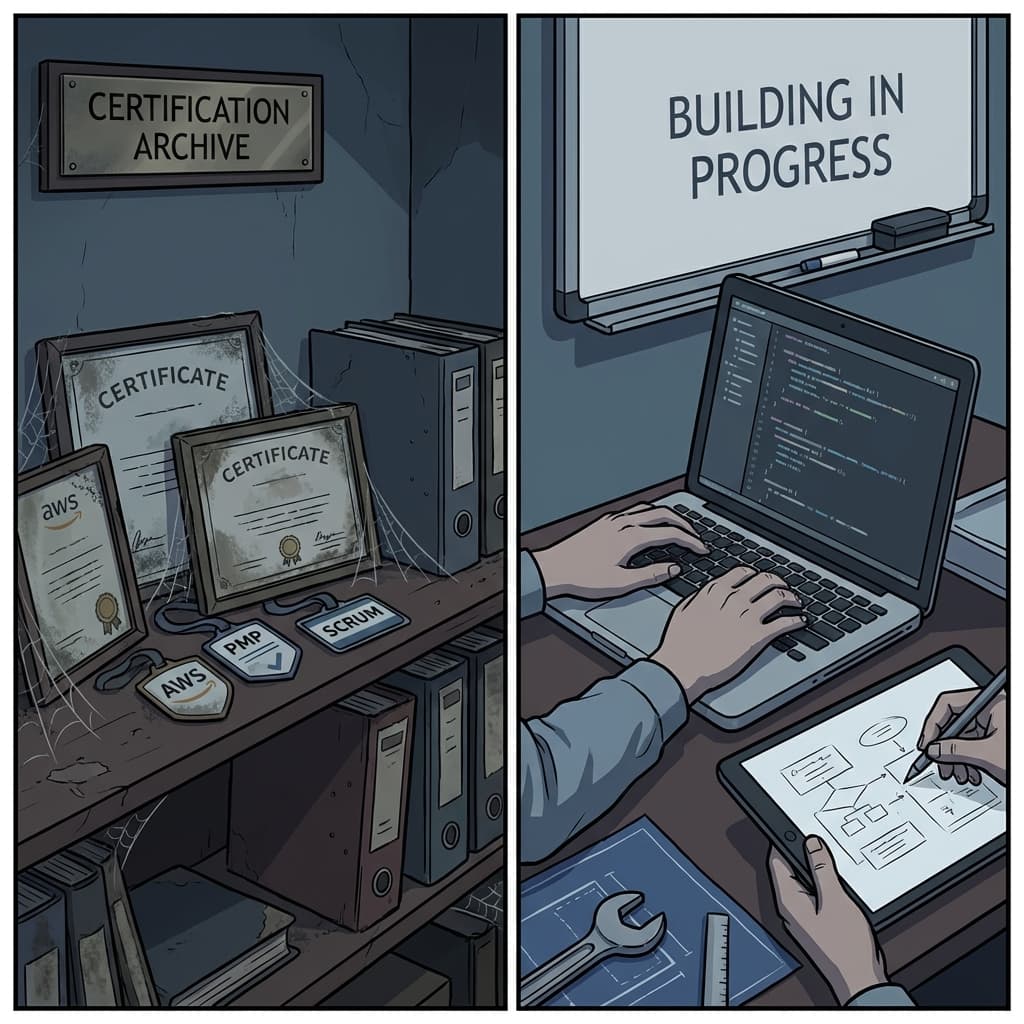
For five years, our job postings read like certification bingo cards. AWS Solutions Architect required. PMP preferred. Scrum Master certification a plus. Kubernetes Administrator strongly desired. Every role accumulated more credential requirements as hiring managers confused certifications with competence.
The results were predictable but not in the way we expected. We hired candidates with impressive certification portfolios who couldn't architect reliable systems, manage real projects, or facilitate effective sprints. Meanwhile, we rejected candidates with deep practical experience but no paper credentials.
In 2023, we eliminated certification requirements from every job posting and replaced them with practical skill assessments. The transformation in our hiring outcomes has been remarkable. Here's what we learned about the gap between credentials and capabilities, and why certification requirements often hurt more than they help.
The Certification Industrial Complex
The IT certification industry generates approximately $45 billion annually, and it's not hard to see why. Certifications promise a standardized measure of competence in a field where evaluating skills is genuinely difficult. They give hiring managers a checkbox, candidates a resume line, and certification vendors a business model.
But certifications answer the wrong question. A certification proves that someone can pass an exam on a particular topic at a particular point in time. It doesn't prove that someone can apply that knowledge to novel problems, work effectively with a team, or deliver business value.
The study-to-exam pipeline creates perverse incentives. Candidates optimize for passing tests rather than understanding deeply. Brain dumps and exam prep services proliferate. Certifications that once signaled expertise become participation trophies as pass rates climb and vendors prioritize volume.
We watched this dynamic play out repeatedly. Candidates with multiple AWS certifications couldn't design cost-effective architectures because they had memorized service features without understanding trade-offs. PMPs quoted PMBOK chapter and verse but couldn't adapt their plans when reality diverged from documentation.
The Certification Paradox
Our data revealed a troubling pattern: certification count correlated weakly with job performance and moderately with interview success. Candidates with more certifications were better at interviewing—they had practiced communicating technical concepts and had talking points prepared. But once hired, their certification portfolio didn't predict their contributions.
Some of our best engineers had zero relevant certifications. They had learned by doing—building systems, debugging production issues, and solving customer problems. Their knowledge was tacit, experiential, and immediately applicable. They couldn't recite AWS service limits from memory, but they could architect robust systems that stayed under budget.
Conversely, some heavily certified candidates struggled with ambiguity. They had learned from structured curriculums and expected real problems to match exam scenarios. When requirements were unclear—as they always are in practice—they became paralyzed, asking for specifications that nobody could provide.
The paradox extended to career development. Engineers who spent their evenings pursuing certifications had less time for open-source contributions, side projects, or deep reading. The certification treadmill consumed the time that might otherwise have built genuine expertise.
The Filtering Problem
Certification requirements don't just select for the wrong skills—they actively filter out valuable candidates. The certification landscape is not equally accessible. Exams cost hundreds of dollars, training courses cost thousands, and study time requires schedule flexibility that not everyone has.
A senior engineer supporting a family might have decades of experience but no time to study for certification exams. A self-taught developer from a non-traditional background might have built sophisticated systems but never encountered the certification industrial complex. A career changer might have deep domain expertise but recent technical skills.
These candidates fail our credential checklist and never get interviewed. Meanwhile, candidates who can afford boot camps, have employers who pay for certifications, or simply prioritize resume-building over skill-building sail through our filters.
We analyzed our rejection data and found that candidates rejected for certification gaps had, on average, more years of relevant experience than candidates we advanced. We were systematically favoring credentials over capability, and our filtering was reinforcing existing inequities in tech hiring.
Case Study: The AWS Solutions Architect Requirement
Our cloud team had required AWS Solutions Architect certification for three years. Every new hire was expected to hold the credential, and internal promotions were blocked without it. The policy seemed reasonable—we were an AWS shop, and the certification validated AWS knowledge.
The reality was less encouraging. Engineers spent weeks preparing for the exam, time that could have been spent on actual project work. The certification content emphasized breadth over depth—knowing about every AWS service rather than mastering the services we actually used.
Worse, the certification created a false sense of competence. Certified architects sometimes over-engineered solutions, using services they had learned about in exam prep rather than simpler alternatives that fit our context. One certified architect designed a system using seven AWS services when three would have sufficed, adding operational complexity that haunted us for years.
When we removed the requirement, we started hiring cloud engineers based on practical assessments. Candidates received a realistic scenario and designed a solution, explaining their trade-off reasoning. We could evaluate their actual architectural thinking rather than their exam preparation.
The quality of our cloud architecture improved. Engineers who understood our context and constraints made better decisions than engineers who had memorized a certification study guide. Mentorship became more effective because we were teaching practical judgment rather than exam content.
The PMP Paradox
Project Management Professional certification was our most entrenched requirement. Every project manager role required PMP certification, and we treated the credential as proof of project management capability. PMI's marketing had convinced us that PMP meant professional.
Our PMP-certified project managers shared a disturbing pattern: they managed documentation rather than projects. They created elaborate project plans, risk registers, and status reports. They followed PMBOK processes meticulously. But project outcomes didn't improve, and teams often felt over-managed.
The best project managers we ever hired didn't have PMPs. They had shipped products, navigated organizational politics, and delivered with imperfect information. Their skills came from battle scars, not study guides. They knew when to follow process and when to improvise.
PMPs optimized for auditable compliance. Every project had the required artifacts. Every decision was documented. Every stakeholder was formally managed. But the overhead consumed time that could have been spent solving problems, and the formality created friction with agile teams.
When we stopped requiring PMP, we started evaluating project management candidates through scenario simulations. We presented realistic project challenges—scope changes, team conflicts, deadline pressure—and observed how candidates navigated them. Some PMPs excelled. Many did not. And some candidates without any certification demonstrated remarkable project management intuition.
Scrum Master Certification Theatre
Scrum Master certification may be the starkest example of certification-as-theatre. You can obtain Certified Scrum Master designation through a two-day class and a brief exam. The certification proves you attended training and passed a basic assessment, nothing more.
Yet we required CSM for every Scrum Master role, treating the certification as a meaningful gate. Candidates with decades of agile experience but no CSM were rated below candidates with CSM credentials and no real facilitation skills.
Our CSM-certified Scrum Masters varied wildly in effectiveness. Some were excellent facilitators who helped teams continuously improve. Others were "ceremony police" who enforced daily standup timing while ignoring team dysfunction. The certification predicted nothing.
The deeper problem was that Scrum Master effectiveness depends on skills that certification doesn't measure: emotional intelligence, conflict resolution, organizational influence, and coaching ability. These skills come from experience and intentional development, not two-day trainings.
We replaced the CSM requirement with a facilitation exercise. Candidates facilitated a mock retrospective with actual team members, navigating the interpersonal dynamics of surfacing and addressing team issues. The exercise revealed facilitation capability in thirty minutes better than any certification.
The Continuous Certification Treadmill
Certifications expire. AWS certifications are valid for three years. Kubernetes certifications for two. PMPs require ongoing professional development credits. The certification model assumes (or pretends) that credentials must be continuously renewed to remain valid.
This creates a perpetual certification treadmill that consumes significant engineering time. Our engineers were spending weeks per year maintaining certifications rather than deepening their actual expertise. The renewal content often repeated the original certification material rather than advancing knowledge.
The treadmill dynamics also create resume-building incentives that distort career development. Engineers accumulated certifications across multiple domains—cloud, security, project management, agile—to create impressive-looking resumes. This breadth came at the cost of depth, producing generalists who could pass exams but couldn't solve expert-level problems.
We calculated that our certification maintenance consumed approximately 4,000 engineering hours per year. That time, redirected to either project work or genuine skill development, would generate far more value than the credential maintenance it replaced.
Designing Skill-Based Assessment
Removing certification requirements created a vacuum that we needed to fill with better evaluation methods. We couldn't just eliminate credential requirements without creating alternative signals of competence. The solution was practical skill assessment tailored to actual job requirements.
For technical roles, we designed take-home projects and live coding exercises that mirrored real work. Candidates built small systems, debugged provided code, or designed solutions to realistic problems. We evaluated their actual technical capability rather than their certification portfolio.
For project management and leadership roles, we created scenario-based assessments. Candidates navigated simulated project challenges, making decisions and explaining their reasoning. We observed how they communicated, prioritized, and adapted to changing conditions.
For agile roles, we evaluated facilitation through mock ceremonies with real team members. Candidates demonstrated their actual facilitation skills in realistic settings. Team feedback informed our assessment alongside interviewer observations.
These assessments took more time than checking certification boxes. But they provided far richer signal about candidate capability. A well-designed practical assessment in one hour revealed more than a collection of certifications accumulated over years.
The Results One Year Later
One year after eliminating certification requirements, we analyzed hiring outcomes:
Performance ratings: New hires in the post-certification era received higher average performance ratings (3.7 vs 3.3 on our 5-point scale) than certification-required cohorts. The practical assessments better predicted job performance than certification checks.
Time to productivity: New engineers reached full productivity faster (average 8 weeks vs 12 weeks) because we were selecting for practical rather than theoretical knowledge. They could apply what they knew rather than translating exam content to practice.
Diversity metrics: Our engineering demographics improved measurably. Candidates from non-traditional backgrounds, bootcamps, and self-taught paths were no longer filtered out by credential requirements. Our pipeline diversified as certifications stopped gating access.
Hiring satisfaction: Hiring managers reported higher satisfaction with candidate quality. The practical assessments created confidence that candidates could do the work, replacing the false confidence that certifications had provided.
Retention: Early retention (first-year attrition) improved by 20%. Better selection meant better fit, and candidates who succeeded in practical assessment were more likely to succeed in the role.
The Exception Cases
Not all certifications are equally problematic. Some credentials genuinely signal capability or are legally required for certain roles:
Regulatory requirements: Some roles require specific certifications by law or contract. Healthcare IT, government work, and financial systems often mandate particular credentials. These requirements are non-negotiable regardless of our hiring philosophy.
Safety-critical domains: Certifications for specialized equipment, hazardous materials, or safety-critical systems often involve hands-on evaluation and recertification. These are closer to licensing than typical IT certifications.
Specialized technical domains: Some advanced certifications in narrow technical areas do signal deep expertise. Cisco CCIE, for example, involves multi-hour hands-on lab exams that genuinely assess networking skills. These are different from typical multiple-choice credential mills.
We maintained requirements for genuinely relevant credentials while eliminating checkbox requirements for general IT certifications. The distinction was whether the certification assessed practical capability or just exam performance.
Supporting Genuine Development
Eliminating certification requirements didn't mean abandoning professional development. Instead, we redirected resources toward learning approaches that actually build capability:
Conference attendance: We increased conference budgets so engineers could learn from practitioners facing similar challenges. The exposure to real-world approaches built practical knowledge that certifications never could.
Internal mentorship: We formalized mentorship programs pairing junior engineers with senior practitioners. Learning from colleagues who understood our context was more valuable than generic certification content.
Project rotation: We created opportunities for engineers to work on different systems and domains within the company. Cross-functional experience built adaptable skills rather than certification-bounded knowledge.
Learning stipends: Engineers received annual learning stipends for books, courses, and resources of their choosing. Self-directed learning aligned with individual interests proved more engaging than mandatory certification tracks.
Community building: We encouraged engineers to present at meetups, write blog posts, and contribute to open source. Teaching forces deep understanding in ways that certification study cannot match.
The shift from credential acquisition to capability building transformed our engineering culture. Engineers invested in becoming better practitioners rather than collecting resume lines.
Advice for Organizations
If you're considering eliminating or reducing certification requirements, here's what we learned:
Audit your actual usage: Review certification requirements across your job postings. Which are legally required? Which are genuine predictors of performance? Which are ritual checkboxes that hiring managers inherited?
Analyze hiring outcomes: Compare job performance between certified and non-certified hires controlling for other factors. You may find, as we did, that certification status predicts interview performance better than job performance.
Design practical assessments: Create evaluation methods that mirror actual job requirements. This investment pays dividends in hiring quality and reduces mis-hires.
Communicate the change: Explain to hiring managers why certification requirements are changing. Provide training on alternative evaluation methods. Address concerns about maintaining hiring standards.
Track the results: Measure hiring outcomes before and after the policy change. Collect data on performance, time to productivity, and diversity metrics. Evidence will reinforce the change or identify needed adjustments.
The Broader Credential Critique
Our certification experience reflects a broader problem with credentialism in professional hiring. Degrees, certifications, and credentials become proxies for capability because evaluating actual capability is hard. But proxies often diverge from the underlying reality they're supposed to represent.
The solution isn't eliminating all signals—it's using signals that actually correlate with what we care about. Practical assessments, work samples, and structured interviews predict job performance better than credentials. They're more work to implement, but they produce better outcomes.
Organizations that invest in genuine evaluation will out-hire competitors who rely on credential filters. Better hiring compounds over time, building teams that deliver more value and attract more talent.
Conclusion
Mandatory certification requirements filtered for the wrong skills, excluded capable candidates, and created compliance theater rather than genuine competence. The certification industrial complex profits from the confusion between credentials and capability, and we had been willing participants.
Practical skill assessment replaced credential checking. We now evaluate what candidates can actually do rather than what exams they have passed. The results—better hires, improved diversity, higher retention—vindicate the change.
If your organization still requires certifications for roles where they don't genuinely predict performance, consider whether you're selecting for skills or for test-taking ability. The badges are impressive. The skills are what matter.
Written by XQA Team
Our team of experts delivers insights on technology, business, and design. We are dedicated to helping you build better products and scale your business.