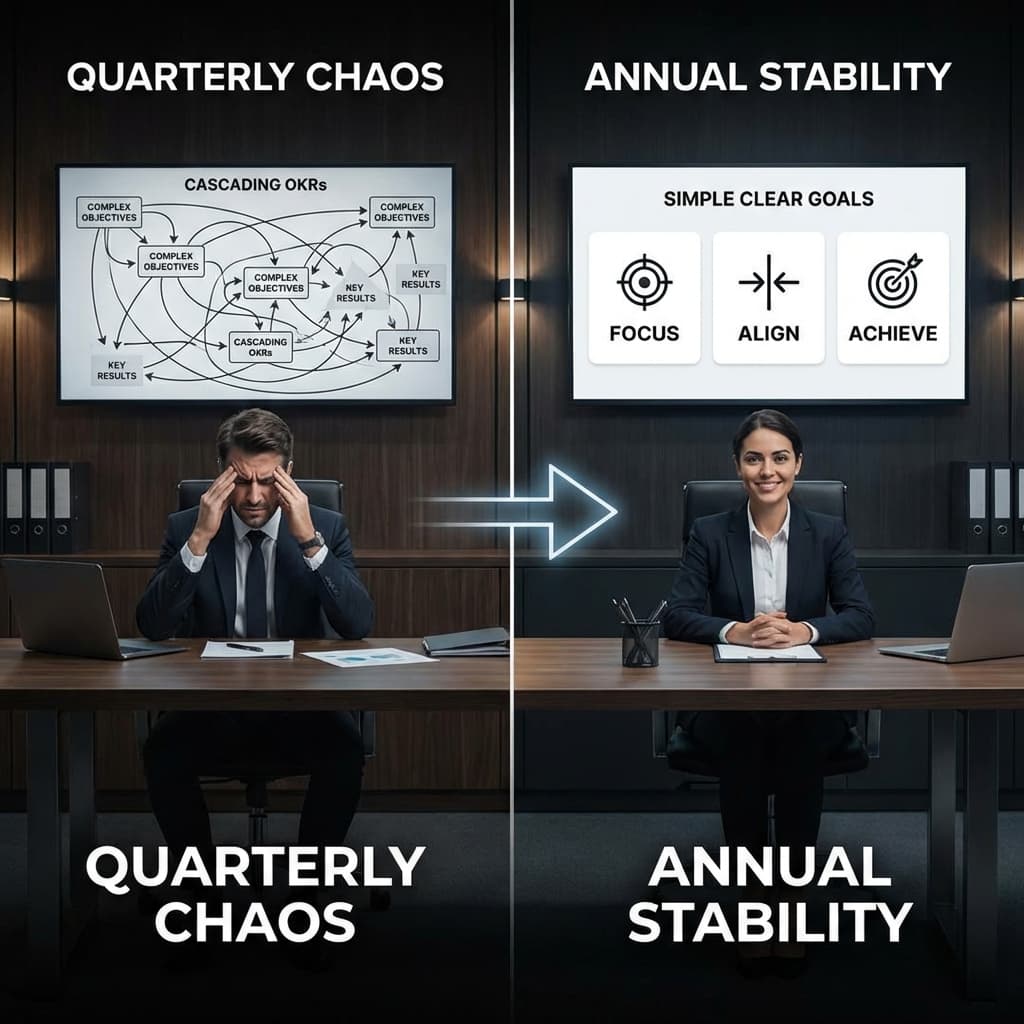
We spent three years trying to make OKRs work. Quarterly planning marathons. Cascading objectives from company to team to individual. Key results with precise metrics. Grading ceremonies that occupied half of engineering for a week. The system promised alignment and focus.
What we got was process overhead masquerading as strategy. Goals changed every quarter faster than work could complete. Key results measured what was measurable rather than what mattered. Teams optimized for OKR grades rather than actual outcomes. The framework designed for focus created its opposite.
We killed OKRs and replaced them with simple, stable goals and direct accountability. The results were immediate: less planning overhead, more consistent execution, and outcomes that actually moved the business. Here's what we learned about why OKRs fail for many organizations and what works instead.
The OKR Promise
OKRs seemed like the answer. Intel used them. Google used them. Every successful tech company seemed to run on quarterly OKRs with precise key results. The framework promised alignment across organizations, clear priorities, and measurable outcomes.
We implemented OKRs by the book. Company-level objectives cascaded to teams. Team objectives rolled up to company. Key results were specific, measurable, achievable, relevant, and time-bound. We bought OKR software. We trained everyone. We committed fully.
The quarterly cycle became ritual. Two weeks of planning at quarter end. All-hands meetings to share new OKRs. Check-ins at mid-quarter. Grading at quarter end. Then immediately into planning for next quarter. The process consumed approximately 15% of engineering time.
Initial enthusiasm was high. People liked having clear goals. The metrics felt objective. The cadence created urgency. We declared OKR success.
Then we looked at what actually happened.
The Quarterly Whiplash
Real work doesn't fit neatly into quarters. Strategic initiatives take longer than 13 weeks. Learning accumulates over years, not months. Customer relationships develop gradually. The quarterly reset created artificial discontinuity.
Every quarter, priorities shifted. Something that was critical in Q1 became deprioritized in Q2 when new objectives emerged. Teams started workstreams that were abandoned mid-flight when quarterly planning redirected focus.
The planning process itself consumed enormous energy. Each quarter, teams spent two weeks debating objectives, negotiating key results, and aligning with adjacent teams. By the time planning finished and work started, six weeks of the quarter remained. Then mid-quarter check-ins further interrupted execution.
Engineers expressed frustration: "I'm halfway through a feature, but it's not in this quarter's OKRs, so now it's deprioritized." The quarterly cadence created starts without finishes, beginnings without endings.
Some important work resisted quarterly framing. Code quality improvements. Technical debt reduction. Team capability building. These ongoing investments didn't fit the OKR model. They got squeezed out by quarter-sized goals that felt more immediate.
The Measurement Trap
Key results needed to be measurable. This created pressure to define metrics for everything—including things that resist quantification.
"Improve code quality" became "Reduce bug count by 15%." But bug count depends on many factors—release frequency, feature complexity, testing investment. The metric was measurable but connected loosely to the actual goal.
Teams became skilled at crafting key results they could hit. The game became setting achievable targets, not pursuing ambitious outcomes. A key result you'd definitely achieve felt safer than one you might miss. Sandbagging became rational.
The things that mattered most were often the hardest to measure. Customer satisfaction, engineering quality, team health, innovation capacity—all important, all resistant to quarterly metrics. The OKR focus on measurability biased toward what could be counted rather than what should be prioritized.
Some key results became performative. Teams would hit their numbers through shortcuts that didn't serve the underlying objective. "Acquire 500 new signups" could be achieved through aggressive marketing that brought low-quality leads. The metric improved; the business didn't.
The Cascading Confusion
OKR orthodoxy says objectives should cascade: company to department to team to individual. This cascade was supposed to create alignment. Instead, it created translation problems.
Company-level objectives were necessarily abstract. "Expand market leadership" or "Improve operational excellence." These needed interpretation at every level. Each translation introduced drift. By the time company objectives reached individual contributors, the meaning had transformed.
Different teams interpreted the same company objective differently. What "improve operational excellence" meant to engineering differed from what it meant to support. The cascade created the appearance of alignment while allowing divergent interpretations.
Bottom-up contribution was a myth. Though the process claimed individual OKRs rolled up to team objectives, the reality was top-down imposition. Company chose objectives, then pressured teams to align. Individual contributors had minimal real input into objectives that shaped their quarters.
The cascade took weeks to complete. Company objectives finalized by week one of January. Department objectives by week two. Team objectives by week three. Individual objectives by week four. A month of the quarter gone before objectives were complete.
The Grading Farce
OKRs are supposed to be scored: 0.0 to 1.0, with 0.7 representing success. Quarterly grading sessions turned into negotiation and justification.
Managers graded their teams generously—failing grades reflected poorly on management. Teams developed narratives explaining why misses weren't their fault. Grading sessions became storytelling exercises rather than honest assessments.
The grades didn't mean much anyway. A 0.5 on an ambitious objective versus a 0.9 on an easy objective—which was better? The scoring system couldn't capture this. Yet we spent hours debating decimal places.
After grading came the amnesia. Once grades were assigned, objectives were forgotten. Teams moved immediately to next quarter's planning. The learning that should have come from reflection didn't happen. We measured and moved on without understanding.
Grades disconnected from reality. A team could score 0.8 while delivering genuinely poor outcomes. Another team could score 0.5 while delivering tremendous value through work that didn't fit OKR framing. The correlation between grades and actual contribution was loose at best.
The Alternative: Simple Stable Goals
We replaced OKRs with something simpler: stable goals with annual horizons and direct accountability.
Longer time horizons: Goals are set annually, not quarterly. This allows work to complete, learning to accumulate, and strategy to develop. Quarterly check-ins happen but don't reset priorities.
Qualitative clarity: Goals describe what success looks like in words, not just metrics. "Make our API the most reliable in the industry" rather than "Achieve 99.95% uptime." The narrative matters.
Fewer goals: Teams have 2-3 major goals, not 5+ objectives with 3-5 key results each. Constraint forces prioritization. With fewer goals, each gets meaningful attention.
Direct accountability: Each goal has an owner—a person, not a team. That person is responsible for outcomes. Accountability is clear and singular.
Progress, not grades: We discuss progress in regular reviews without assigning scores. "How are we doing on making our API the most reliable?" replaces "What's our grade on KR2?"
Flexibility in execution: How teams achieve goals is their business. We don't mandate specific initiatives or metrics. Outcomes matter; methods are delegated.
The Implementation
Transitioning from OKRs required cultural adjustment. People were accustomed to the quarterly cadence. Some found stability disorienting.
We established annual planning in Q4. Company leadership set 3-5 major priorities for the year. These weren't objectives with key results—they were directions with context. "Become the default choice for enterprise customers" with explanation of why this mattered.
Departments set their goals responsive to company priorities. Engineering might set "Build the platform capabilities that enterprise customers require." Each goal had an executive owner accountable for outcomes.
Teams set supporting goals with engineering leadership. Goals were negotiated and agreed—not cascaded and imposed. The conversation was "What can your team contribute to this direction?" not "Here's your allocated objective."
Monthly progress reviews replaced quarterly grading. Leadership asked "How's this going?" rather than "What's your score?" The conversation focused on obstacles, learning, and adjustment—not measurement and justification.
Mid-year, we revisited goals. Some needed adjustment based on changed circumstances. The process allowed adaptation without quarterly whiplash. Stability didn't mean rigidity.
The Results
One year after abandoning OKRs:
Planning overhead dropped dramatically: Time spent on goal-setting and grading decreased by 70%. That time went to actual work.
Execution improved: Without quarterly resets, workstreams completed. Multi-month initiatives that would have been deprioritized mid-stream reached conclusion.
Accountability strengthened: With clear individual ownership, responsibility was unambiguous. No hiding behind team metrics or cascading objectives.
Focus increased: Fewer goals meant deeper investment in each. Teams weren't spread across many partially-achieved objectives.
Satisfaction improved: Engineers reported less frustration with process. The constraint of quarterly OKRs had been a primary complaint; its removal was appreciated.
Outcomes improved: Harder to quantify, but leadership consensus was that strategic progress accelerated. Annual reviews showed more meaningful advancement than the sum of quarterly OKR grades had indicated.
When OKRs Work
OKRs aren't universally wrong. They work in specific contexts:
Early-stage companies: When direction is genuinely uncertain and experimentation is constant, quarterly resets may match reality. The cadence fits companies that pivot frequently.
Performance turnarounds: When urgent change is needed, aggressive quarterly goals can create focus. The pressure is a feature, not a bug, when crisis demands it.
Highly measurable domains: Sales organizations with clear revenue targets fit OKR framing naturally. The metrics match the work.
Organizations that execute them well: Some companies have the discipline to make OKRs work—genuine stretch goals, honest grading, minimal gaming. For them, the system can be valuable.
Our context didn't match these. We had a stable strategy, multi-year initiatives, and work that resisted quarterly metrics. OKRs were wrong for our context, not universally wrong.
Lessons About Goal Systems
Match cadence to work: If your important work takes longer than a quarter, quarterly goals create friction. Choose time horizons that match your actual execution reality.
Quality over quantity: Fewer goals with deeper commitment outperform many goals with scattered attention. Forcing prioritization is a feature of constraint.
Narrative over metrics: Numbers are useful but incomplete. Describing what success looks like—in words—creates shared understanding that metrics can't.
Accountability requires ownership: Team goals diffuse responsibility. Individual owners with clear accountability drive outcomes.
Process should enable, not constrain: Goal systems should help teams achieve outcomes, not consume energy in their own execution. If the process is the problem, change the process.
Conclusion
OKRs created the appearance of alignment while consuming enormous organizational energy. The quarterly cadence disrupted work that needed longer horizons. The metric focus biased toward measurable rather than meaningful. The grading theater distracted from actual accountability.
Simple goals with annual horizons and clear ownership work better for us. Less process, more execution. Less measurement, more judgment. Less ceremony, more accountability.
If your OKR process feels like overhead rather than enablement, if quarterly planning disrupts more than it aligns, if grades don't correlate with outcomes—consider simplifying. The goal framework that works is the one that helps you achieve goals, not the one that famous companies use.
Written by XQA Team
Our team of experts delivers insights on technology, business, and design. We are dedicated to helping you build better products and scale your business.