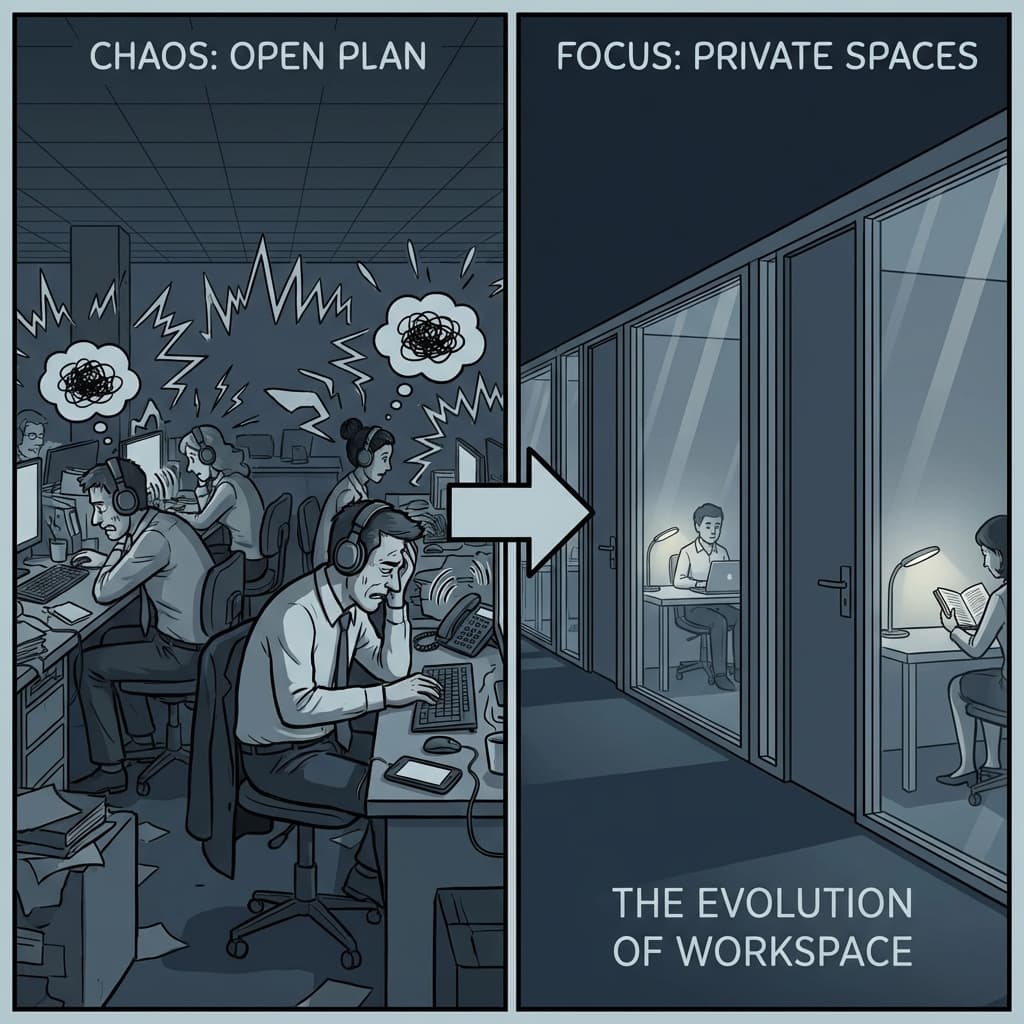
We spent $2.4 million renovating our headquarters into a modern open floor plan. Exposed brick, communal tables, no private offices, minimal walls—the full Silicon Valley aesthetic. The design firm promised it would "break down barriers" and "foster spontaneous collaboration."
Three years later, we spent $1.8 million adding walls back. The open office had failed spectacularly. Productivity had declined, sick days had increased, and our most valuable engineers had left for companies with quiet offices. This is the story of our expensive lesson about workspace design.
The Open Office Promise
The pitch was seductive. Traditional offices with walls and doors were relics of hierarchy and bureaucracy. Modern, flat organizations needed spaces that matched their values. Open plans would democratize the workspace—executives sitting among individual contributors, ideas flowing freely across teams.
The design consultants showed us case studies. Tech companies with famous open offices. Research studies (later debunked) claiming open plans increased collaboration. Renders of our future space: bright, airy, buzzingly productive. We were sold.
The renovation eliminated private offices entirely. Conference rooms remained, but with glass walls. Desks were arranged in clusters—pods of eight engineers sharing communal tables. Phone booths—tiny glass boxes—provided escape for calls. The CEO's desk was in the middle of the floor, visible to everyone.
Opening day felt revolutionary. The space was beautiful. Natural light flooded in. Teams could see each other, wave across the floor, spontaneously gather. We had achieved the open office dream.
Within weeks, the problems began.
The Focus Catastrophe
Software engineering requires deep focus. Complex code demands uninterrupted concentration. Context switching—being pulled from the problem you're solving—devastates productivity. Research consistently shows that recovering from an interruption takes 15-25 minutes.
Our open office was an interruption machine. Engineers wearing headphones—the universal "do not disturb" signal—were interrupted anyway. A tap on the shoulder for a "quick question." Someone's phone call at the next desk. A conversation behind you about last night's game. The constant visual motion of people walking past.
We measured interruption frequency before and after the renovation. Before, in our old office with private and shared offices, engineers experienced an average of 4.2 interruptions per day. After, in the open plan, that number jumped to 17.3 interruptions per day.
The impact on productivity was measurable. Code commits per engineer declined 23%. Bug rates increased 15%. Feature delivery timelines stretched. Engineers reported spending their most productive hours working from home or arriving before 7 AM when the office was empty.
The irony was painful: we had invested millions in an office that made people desperate to work anywhere but the office.
The Noise Problem
Open offices are loud. Even with acoustic panels and white noise machines, the aggregate sound of 200 people working, talking, moving, and existing creates a constant audio backdrop.
Some noise was obviously disruptive—phone calls, animated discussions, impromptu meetings. But even low-level background noise affected cognition. Studies show that ambient noise increases cortisol, impairs memory, and reduces task performance. Our engineers weren't imagining their concentration problems.
Headphones became mandatory. Engineers wore noise-canceling headphones for entire days. But headphones have costs: isolation from legitimate communication, ear fatigue, and the antisocial appearance of an entire floor wearing identical headphones staring at screens.
The phone booths were supposed to solve the noise problem for calls. In practice, they were constantly occupied. Engineers spent five minutes hunting for an available booth for a ten-minute call. The booths were poorly ventilated and uncomfortably warm. People avoided calls rather than dealing with booth logistics.
We tried quiet hours—no talking before 11 AM. It sort of worked but created resentment. Salespeople needed to make calls. Customer support needed to answer phones. The quiet hours policy pitted teams against each other.
The Health Consequences
Open offices are petri dishes. One sick person spreads illness across dozens of colleagues. The density of our open plan meant respiratory infections burned through the engineering team regularly.
Our sick day usage increased 31% after the renovation. HR initially attributed this to seasonal variation, but the pattern persisted across multiple years. When flu season hit, the open office became a contagion vector.
COVID-19 made this viscerally obvious, but even before the pandemic, we were dealing with endemic cold and flu transmission that our old office layout had naturally limited.
Beyond infectious disease, the open office harmed mental health. The constant visibility created low-grade anxiety. Engineers reported feeling watched and judged. Taking a mental break—staring into space, stretching, closing eyes—felt impossible when surrounded by peers. The performative aspect of open offices—always looking busy—exhausted people.
Stress-related symptoms increased. Engineers reported more headaches, sleep problems, and burnout. The correlation between office redesign and these health metrics was too consistent to ignore.
The Collaboration Myth
The central promise of open offices—increased collaboration—turned out to be a myth. Research published in Harvard Business Review found that open offices actually decrease face-to-face interaction by approximately 70%.
We observed the same pattern. In the old office, people walked to colleagues' offices for conversations. Doors signaled availability—open door meant interruptible. These conversations were intentional and productive.
In the open office, people avoided face-to-face communication to avoid disturbing others. Email and Slack usage skyrocketed. Engineers sat next to each other but communicated through chat. The "spontaneous collaboration" we'd designed for didn't happen—people created virtual walls when physical walls disappeared.
When conversations did happen in the open plan, they disturbed everyone nearby. Engineers learned that talking equaled disrupting neighbors. The social pressure to be quiet suppressed the very collaboration we wanted.
The most productive collaboration happened in conference rooms with doors—the spaces we'd minimized in the redesign. These rooms were constantly overbooked. Teams scheduled "working sessions" just to get quiet space, not because they needed to collaborate.
The Talent Drain
Senior engineers have options. They can be selective about working conditions. Many of them had worked in private offices before and understood what they were giving up.
Within 18 months of the renovation, we lost four senior engineers to competitors offering private offices or remote work arrangements. Exit interviews revealed consistent themes: the open office made focused work impossible, the return-to-office mandate (we required four days in-office) was intolerable in the new layout.
Recruiting became harder. Candidates touring the office visibly winced at the open layout. We lost offers to smaller companies that offered better workspace conditions. "Do you have private offices or remote options?" became a common interview question.
The talent we were losing was irreplaceable. Senior engineers with decade of experience, deep system knowledge, and mentorship capacity. The open office was costing us our institutional expertise.
Junior engineers adapted better—they'd never experienced alternative workspace arrangements. But they learned from senior colleagues that focus work required avoiding the office. We were training our future senior engineers that the office was a place to socialize, not to work.
The Executives Got Offices
A revealing pattern emerged after the renovation. The CEO initially sat on the open floor, but after six months, quietly moved to a glass-walled office "for confidential calls." Then the CFO needed "secure space for financial discussions." Then other executives found reasons for private spaces.
Within two years, every VP and above had a private or semi-private office. The open floor plan was for individual contributors. Leadership had quietly exempted themselves from the environment they'd mandated for everyone else.
This hypocrisy didn't go unnoticed. Engineers observed that the people advocating loudest for open collaboration worked in enclosed spaces. The message was clear: privacy and focus were for people who mattered.
When we surveyed employees about workspace satisfaction, the leadership gap was stark. Executives rated workspace satisfaction at 8.2/10. Engineers rated it 4.1/10. The people making workspace decisions weren't living with the consequences.
The Redesign Decision
By year three, the evidence was overwhelming. Productivity metrics had declined. Sick days had increased. Attrition among senior engineers was elevated. Survey data showed workspace dissatisfaction was a top-three complaint.
We commissioned an honest assessment. External consultants surveyed employees, analyzed productivity data, and benchmarked against industry research. Their conclusion: the open office had failed its stated goals and was actively harming the company.
The board approved a redesign budget. Not a full renovation—we couldn't afford to repeat the original mistake—but strategic modifications to create focus spaces.
We added walls, doors, and smaller team rooms. We created quiet zones with strict noise policies. We expanded phone booth capacity. We gave senior engineers private offices and offered them to senior individual contributors, not just managers.
The redesign cost $1.8 million—on top of the original $2.4 million. A $4.2 million lesson in following fads.
The Results
Six months after the redesign, we measured the impact:
Productivity returned: Code commits per engineer increased 31%, exceeding pre-open-office levels. Engineers had learned focus hygiene during the open office era and applied it in the improved space.
Sick days declined: Illness-related absences dropped 24%. Better physical separation reduced transmission.
Workspace satisfaction improved: Survey ratings jumped from 4.1 to 7.3 out of 10. Engineers reported feeling valued and productive.
Retention stabilized: Attrition in engineering dropped to below industry average. Exit interview mentions of workspace conditions disappeared.
Recruiting improved: Offer acceptance rates increased. Candidates commented positively on workspace conditions during tours.
The irony was complete: we'd spent millions to harm productivity, then spent more millions to undo the harm, finally ending up ahead of where we started.
What We Learned About Workspace Design
Different work requires different spaces. Collaborative work needs communal areas. Focused work needs quiet spaces. One-size-fits-all designs fail both. We now have zones optimized for different activities.
Ask the people doing the work. Our original redesign involved executives and consultants but not the engineers who would use the space daily. When we redesigned, we surveyed extensively and incorporated feedback. The workers knew what they needed.
Beware fashion and research cherry-picking. Open offices became fashionable, and consultants cherry-picked research to support them. Rigorous research consistently shows open offices harm focus work. We should have looked at the full evidence base.
Watch what leaders do, not what they say. When executives exempted themselves from the open floor, that was data. The people with the most power and choice weren't choosing the environment they'd mandated. That should have triggered earlier reconsideration.
Status signals matter. Private offices signal that focused work is valued and that employees deserve appropriate conditions. Open plans, especially when executives have offices, signal the opposite. Workspace communicates organizational values.
The Broader Trend
Our experience isn't unique. Many companies that adopted open offices in the 2010s are now reversing course. The pandemic accelerated this—people experienced focused work at home and refused to return to distraction-filled offices.
Some companies have responded by mandating return-to-office in their open plans, hemorrhaging talent to competitors offering remote work or better offices. Others have redesigned for focus, creating activity-based workspaces that provide options.
The open office era is ending. Not because remote work is universally better, but because people discovered that workspace conditions matter. Companies that provide environments conducive to focused work will attract and retain better talent than those clinging to discredited open floor plans.
Conclusion
Our open office experiment was an expensive failure. The promise of collaboration was false; actual collaboration declined. The productivity gains were imaginary; productivity dropped measurably. The modern aesthetic masked an environment actively hostile to the work we needed done.
We've now built spaces that support both collaboration and focus. Team rooms for group work. Private offices and quiet zones for concentrated effort. Phone booths that actually work. A workspace designed for how we actually work, not for how designers imagined we should work.
If your company is considering an open office renovation, reconsider. If you already have an open office and are losing focus, productivity, and talent, know that redesign is possible. Walls and doors aren't relics of hierarchy—they're tools that enable the deep work that creates value.
Written by XQA Team
Our team of experts delivers insights on technology, business, and design. We are dedicated to helping you build better products and scale your business.