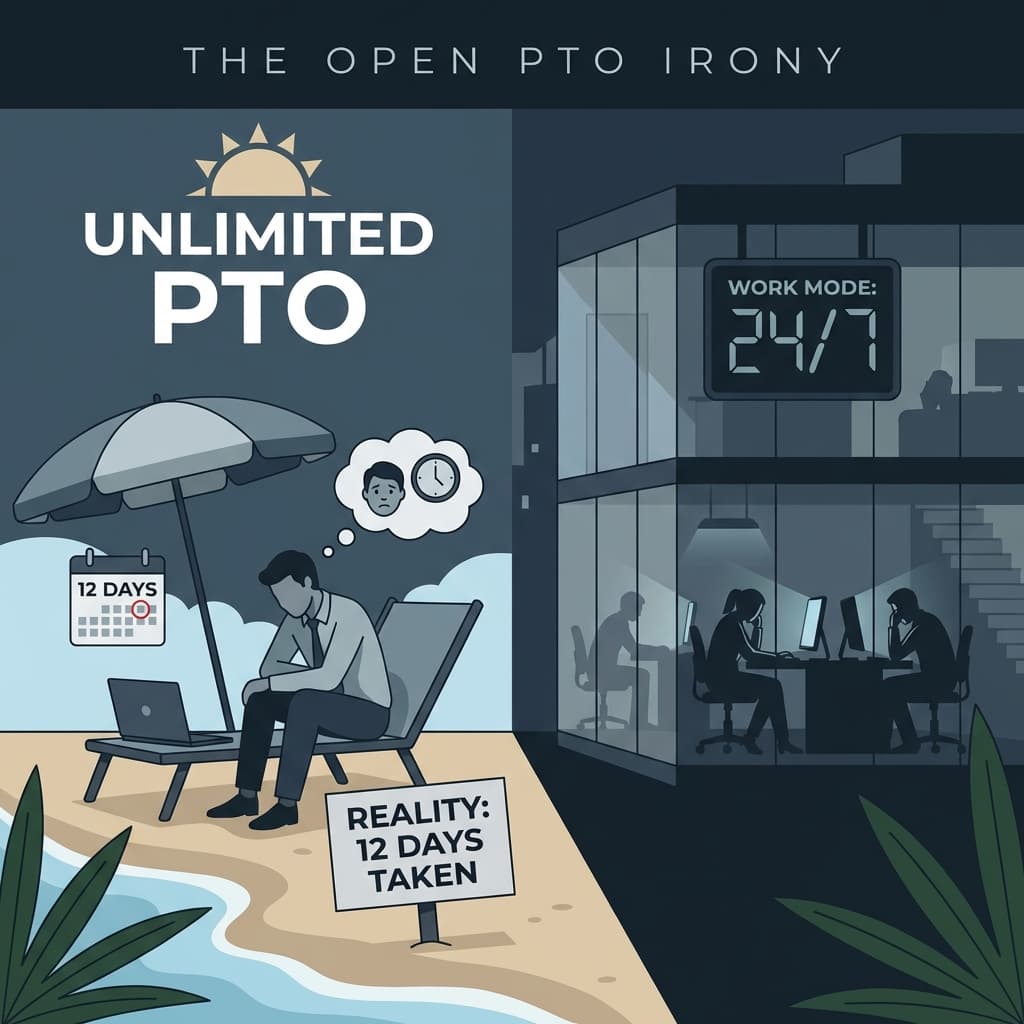
"Open PTO" sounded revolutionary when we implemented it five years ago. No accrual tracking. No limits. Take what you need, when you need it. We trusted our employees. We'd freed them from the tyranny of the PTO spreadsheet.
The reality was different. After three years of open PTO, we analyzed the data. Average vacation days taken: 12 per year. Down from 18 under our previous policy of 20 accrued days.
Our "unlimited" vacation had produced less vacation. People were taking fewer days off, not more. The policy designed to create freedom had created invisible constraints.
When we dug into why, the pattern was clear:
- Guilt: "If I take too much, people will think I'm slacking."
- Manager signals: "My manager never takes vacation. Taking time off feels risky."
- No benchmark: "I don't know what's 'normal.' So I default to less."
- Project pressure: "There's always more work. There's no natural stopping point."
We killed open PTO. We replaced it with a mandatory minimum: 20 days of vacation per year, with automatic tracking and manager accountability for ensuring their reports take time off.
Vacation days taken increased to 22 per year. People actually rested. Here's why open PTO fails and what works instead.
Section 1: The Psychology of Open PTO—Why Unlimited Means Zero
Open PTO operates on a fundamental psychological misunderstanding: that removing limits creates freedom. In a work context, the opposite is often true.
The Social Comparison Problem
When PTO is unlimited, employees look to each other for behavioral norms. "How much is everyone else taking?" becomes the unspoken question.
This creates a race to the bottom:
- Top performers take minimal PTO (they're focused on advancement)
- Others see this and calibrate down ("I should take less than the top performers")
- The norm keeps shifting lower
- Eventually, taking "a lot" of PTO feels like a career risk
We surveyed employees about their PTO decisions. 67% said they considered "how much others are taking" when deciding on vacation. Only 12% said they took what they personally needed without regard to others.
Open PTO doesn't create individual freedom—it creates collective constraint.
The Manager Signal Problem
Manager behavior sets implicit expectations. If your manager is online every day, never takes vacations, and responds to Slack on weekends, you receive a signal about what's expected—regardless of what the policy says.
We had managers who genuinely believed they supported PTO. They said the right things. But they never took vacation themselves. Their reports noticed.
When we asked employees what would make them take more PTO, the #1 answer was: "If my manager took more PTO."
The policy on paper was "unlimited." The policy in practice was "match your manager, minus a few days."
The Indefinite Guilt Problem
With accrued PTO, there's a natural limit. You have 20 days. When you've taken 18, you know you've used your allocation. There's no guilt about taking what you earned.
With open PTO, there's no benchmark. Taking 15 days feels like a lot—or is it? Some people take 30. Some take 5. You never know where you stand.
This ambiguity creates permanent low-grade guilt. Every vacation day is a choice that must be justified. There's no "I've earned this"—there's only "Is this really okay?"
Section 2: The Financial Reality—Why Companies Love Open PTO
Let's be honest about the other side of open PTO: it benefits companies financially.
No PTO Liability
Under accrued PTO policies, unused vacation days are a liability on the balance sheet. When an employee leaves, you owe them cash for unused PTO. At a 200-person company with 10 unused days per person at $250/day average, that's $500,000 in liability.
Under open PTO, there's no accrual. No liability. Employees leave with nothing. The financial incentive for employers is obvious.
Reduced Actual Time Off
As we documented, open PTO reduces vacation taken. That means more productive hours from employees. The company gets more work for the same salary.
This isn't a conspiracy theory—it's just incentive alignment. Open PTO aligns company financial interests (no liability, more hours worked) with a narrative that sounds employee-friendly ("unlimited freedom!").
The Recruiting Advantage
Open PTO sounds great in job descriptions. Candidates see "unlimited vacation" and assume they'll take more time off. They don't learn the reality until they're already employed and observing the cultural norms.
It's a recruiting optimization that doesn't translate to an employee experience optimization.
Section 3: The Replacement—Mandatory Minimum PTO
We replaced open PTO with a structured approach: mandatory minimum vacation with accountability.
The Policy
- Minimum: 20 vacation days per year (not counting holidays)
- Quarterly check: HR flags anyone below pace (< 5 days per quarter)
- Manager accountability: Managers are evaluated on whether their reports take adequate vacation
- No carryover pressure: Days don't expire; they roll over (up to 10 days bank)
- Encouragement, not judgment: Below-pace employees get encouraged, not punished
Why This Works
1. Clear benchmark: 20 days is the expectation. There's no ambiguity about what's "normal." Taking 22 days is clearly fine. Social comparison shifts from "minimize" to "meet the minimum at least."
2. Manager accountability: When managers are evaluated on their team's PTO patterns, they model better behavior. They take vacation. They encourage their reports to take vacation. The incentives align.
3. Permission structure: "You must take at least 20 days" gives explicit permission that "take what you need" doesn't. Employees don't have to justify their vacation—they're meeting a requirement.
4. Proactive outreach: When HR reaches out to below-pace employees, it signals organizational support. "We noticed you haven't taken vacation. Is everything okay? How can we help you plan time off?"
The Results
After 18 months with mandatory minimum PTO:
- Average days taken: 22 (up from 12 under open PTO)
- Below-minimum employees: 8% (flagged and counseled)
- Employee satisfaction with PTO policy: 4.2/5 (up from 3.1)
- Burnout-related attrition: Down 35%
People were resting. They were coming back refreshed. They were staying longer. The policy worked.
Section 4: Implementation Details—Making It Work
Switching from open PTO to mandatory minimum requires careful implementation.
The Announcement
We framed the change honestly: "Open PTO wasn't working. People weren't taking enough vacation. We're fixing it."
Some employees worried: "Is this actually a reduction? 20 days sounds like a limit."
We clarified: "20 is the minimum, not the maximum. You can take more with manager approval. But you must take at least 20."
The framing matters. This isn't about restricting vacation—it's about ensuring rest.
Manager Training
Managers needed guidance on their new role:
- Model good behavior (take your own vacation)
- Proactively schedule team coverage so vacations are possible
- Have quarterly PTO check-ins with each report
- Celebrate vacation rather than implicitly discouraging it
We added PTO health to manager dashboards. If a team is below pace, the manager sees it. Their manager sees it. There's visibility and accountability.
Handling Workaholics
Some employees genuinely want to work all the time. They see rest as weakness. How do you require vacation for someone who resists it?
Our approach: make it about sustainability, not personal preference. "We've seen that people who don't rest burn out. Burnout hurts you and the company. We require vacation because we want you here for the long term."
Some still pushed back. We held firm. By year two, even the workaholics admitted they felt better with forced rest.
International Considerations
Many countries have legally mandated vacation minimums (e.g., 25-30 days in the EU). Our policy was already above US norms and aligned with international standards. This made it easier to implement globally.
Conclusion: Freedom Requires Structure
Open PTO is a well-intentioned policy that fails in practice. By removing structure, it creates anxiety. By eliminating benchmarks, it enables unhealthy norms. By relying on individual judgment, it ignores social pressure.
Real freedom requires structure. A mandatory minimum isn't a restriction—it's permission. It says: "You must rest. It's not optional. We've made the decision so you don't have to carry the guilt of making it yourself."
Employees don't want unlimited ambiguity. They want clear expectations and genuine support. Tell them what's expected. Hold managers accountable. Track and encourage.
When you treat rest as mandatory rather than optional, people actually rest. And rested employees are better employees—more creative, more productive, more likely to stay.
Unlimited PTO is unlimited guilt. Structured PTO is structured permission. Choose permission.
Written by XQA Team
Our team of experts delivers insights on technology, business, and design. We are dedicated to helping you build better products and scale your business.