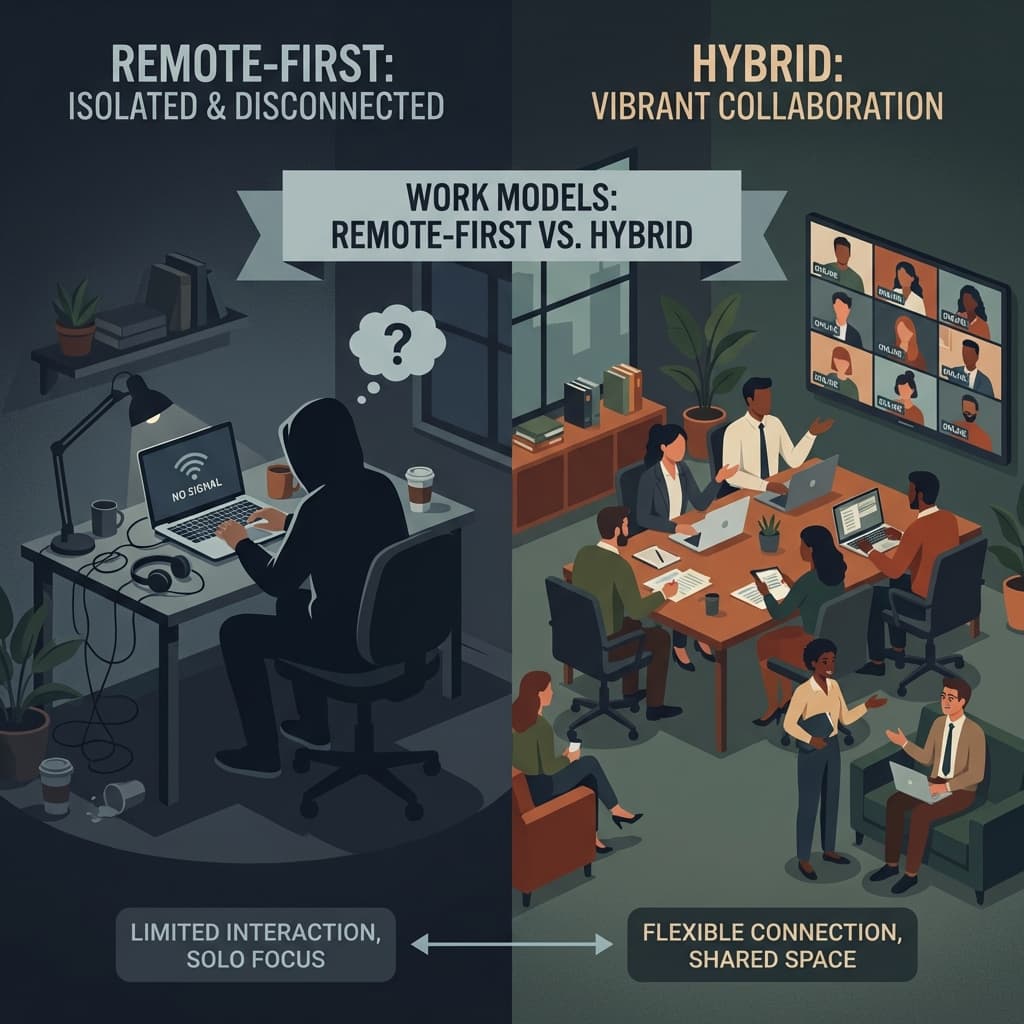
"We're remote-first! Work from anywhere! The office is for people who prefer it, but it's not required!" We announced this in 2020, and it felt progressive. We were ahead of the curve. We trusted our people. We weren't clinging to outdated butts-in-seats thinking.
Four years later, we changed course. Not back to office-mandatory, but to hybrid-with-intention. The fully remote experiment had revealed problems we couldn't ignore: slow decision-making, struggling junior engineers, and a culture that existed on paper but didn't feel real.
This is the story of our remote-first era, why we moved away from it, and what we do now. It's not an anti-remote polemic—remote works great for some companies and some roles. It just didn't work optimally for us.
The Remote-First Promise
In 2020, like many companies, we went remote overnight. Initially, it was survival. Then we discovered benefits:
- Talent access: We could hire anywhere. Our candidate pool expanded dramatically.
- Employee flexibility: People loved controlling their environments. No commute. Family flexibility.
- Cost savings: We reduced office space by 80%. Real estate costs dropped.
- Forced documentation: Without hallway conversations, more got written down.
By 2021, with the office reopened as optional, 90% of employees stayed fully remote. We took this as validation. They'd voted with their feet. Remote-first was working.
Or so we thought. The problems were slower to manifest.
The Problems That Emerged
Async Communication Was Slower Than We Admitted
Remote-first meant async-first. We prided ourselves on not requiring real-time availability. People worked when it suited them. Slack messages could wait. Meetings were minimal.
In practice, this meant decisions took forever. A question that would take 30 seconds to resolve in person took hours or days over Slack. Someone asked a question. The expert was in a different time zone. By the time they responded, the asker was offline. Context was lost. Clarifications needed. Days passed.
We measured decision velocity on key projects: the average time from "we need to decide X" to "X is decided" was 4.5 days. Before remote-first, it had been 1.5 days. We'd tripled our decision latency.
Some decisions don't need to be fast. But many do. A team blocked on a decision for 4 days is a team not shipping for 4 days.
Junior Engineers Were Struggling
This was the most concerning pattern. We tracked engineer ramp-up time—how long until a new hire was independently productive. The data was stark:
| Cohort | Time to Independence (Junior) | Time to Independence (Senior) |
|---|---|---|
| Pre-remote (2019) | 4 months | 2 months |
| Full remote (2021) | 7 months | 2.5 months |
| Full remote (2023) | 9 months | 3 months |
Junior engineers took more than twice as long to become independent in the remote era. Senior engineers were affected less—they had existing skills and context.
Why? Junior engineers learn by osmosis. They overhear conversations. They see how problems are approached. They ask quick questions when they're stuck. In an office, a junior can watch a senior debug a problem and absorb the thought process. Remotely, they'd never see that debug session unless explicitly invited.
We tried to compensate: pair programming sessions, mentorship programs, documented processes. But structured learning can't replace ambient learning. The juniors missed what they didn't know they were missing.
Attrition among engineers with less than 2 years of experience was 40% higher than pre-remote. Exit interviews revealed: "I felt lost." "I didn't know who to ask." "I wasn't sure if I was doing things right." The isolation hit them hardest.
Culture Became Performative
We worked hard on remote culture. Virtual happy hours. Online game nights. Slack channels for hobbies. Donut for random coffee chats. All the playbook items.
Employees participated. Satisfaction surveys looked okay. But something was missing.
We noticed it in departures. When people left pre-remote, exit interviews often mentioned relationships: "I'll miss the team." "The people here are great." In the remote era, departures were transactional: "I got a better offer." "The role didn't have enough growth." Relationships weren't mentioned because they weren't strong enough to matter.
Our eNPS scores were fine. But the "would you recommend to a friend" question was answered with tepid reasoning: "The work is interesting." "The pay is competitive." Not: "The people are amazing." Not: "I love my team."
We had a functional organization without a genuine culture. People worked here. They didn't belong here.
Serendipity Disappeared
The hallway conversation that leads to an unexpected idea. The lunch with someone from a different team that reveals a collaboration opportunity. The overheard complaint that sparks a solution. These serendipitous interactions don't happen on Slack.
We tried to manufacture serendipity: random pairings, cross-team Zoom calls. But scheduled serendipity is an oxymoron. You can't calendar spontaneity.
We noticed it in our innovation metrics. New initiatives proposed per quarter dropped by 35%. The ideas that did emerge came from smaller circles—people who knew each other, not cross-pollination from unexpected connections.
The Honest Conversation
In late 2023, leadership had a brutally honest conversation. Were we holding onto remote-first because it was optimal, or because reversing felt like betrayal? Were we letting ideology override observation?
We surveyed employees about their actual experience, not their preference. Different questions than "do you want to come to the office?"
- "How often do you feel stuck and unsure who to ask?" 65% said "often" or "sometimes"
- "How strong is your relationship with your team?" Average 3.2/5—mediocre
- "How well do you understand what other teams are doing?" 2.8/5—poor
- "Would a weekly in-person collaboration day improve your work?" 72% said yes
The preference survey said people wanted remote. The experience survey said remote had real costs they were absorbing silently.
The Shift to Hybrid-With-Intention
We designed what we call "hybrid-with-intention"—not just "come in whenever" but structured time together with clear purposes.
The Structure
Two anchor days per week: Tuesday and Thursday are collaboration days. Everyone on a team is in the office on the same days. Not suggested—required for people within reasonable commuting distance.
Purpose-driven presence: Anchor days have structure. Sprint planning. Design reviews. Pairing sessions. Lunch conversations. The in-office time has value because it's used for things that benefit from synchronous, high-bandwidth interaction.
Remote for focus work: Monday, Wednesday, Friday are work-from-anywhere. This is deep work time. Minimal meetings. Async communication. The remote time has value because it's protected for concentration.
Full-remote roles explicitly defined: Some roles don't need in-person time. Infrastructure engineers who work independently. Writers. Some customer success roles. These are explicitly designated remote-OK, not subject to anchor days.
Quarterly onsites for distributed teams: For people hired in locations without an office (we have many), we fly them in quarterly for a week of intensive collaboration. Expensive, but worth it.
The Non-Negotiables
Teams must be co-located on anchor days: Random individuals in the office isn't valuable. The team being together is valuable. We made anchor days team-specific, not company-wide.
No meetings on remote days: If remote days get filled with Zoom calls, they're not remote days—they're just commute-free office days. Remote days are meeting-free by policy.
Junior engineers prioritize in-person: First-year employees are strongly encouraged to be in-office 3-4 days per week. Their learning needs aren't about them. We're explicit: you can work from home more after you've built skills and relationships.
The Results After One Year
| Metric | Remote-First (2023) | Hybrid-With-Intention (2024) |
|---|---|---|
| Decision latency | 4.5 days | 2 days |
| Junior time to independence | 9 months | 5 months |
| Team relationship score | 3.2/5 | 4.1/5 |
| Cross-team understanding | 2.8/5 | 3.8/5 |
| eNPS | +32 | +38 |
| New initiatives per quarter | 12 | 19 |
| <2yr engineer attrition | 28% | 15% |
Every metric improved. Even employee satisfaction, despite requiring more office time. Turns out, people wanted connection even more than they wanted convenience—they just wouldn't say so in a survey asking about preferences.
The Departure Concern
We expected departures when announcing the shift. Some people had structured their lives around full remote. We prepared for 10-15% attrition.
Actual attrition from the policy change: 4%. Much lower than feared. And hiring quality improved—candidates appreciated the intentional structure over both "never come in" and "always come in" mandates.
What We Learned
Preference surveys lie. People prefer what's convenient in the moment, not necessarily what serves their long-term thriving. Ask about experience and outcomes, not just preference.
Remote works—for some things. Focus work. Async communication when speed doesn't matter. Senior engineers who have existing relationships. Remote isn't wrong; it's just not universal.
Junior development is a team responsibility. If juniors are struggling, the organization is failing them. You can't expect people to self-develop when learning is inherently social.
Culture needs sustained proximity. Trust requires repeated interaction. You can't build deep relationships in 30-minute Zoom windows. The occasional video call maintains relationships; it doesn't build them.
Hybrid requires structure. "Come in whenever" doesn't work because nobody coordinates. Hybrid needs intentional design—which days, for what purpose, with whom present.
For Companies Considering Similar Changes
- Gather honest data first. Not preference surveys—outcome surveys. How effective is communication? How strong are relationships? How quickly do people ramp up?
- Design the hybrid structure intentionally. Random in-office time is wasted time. Structure it for collaboration, not compliance.
- Communicate the "why" relentlessly. Employees will see this as trust retraction unless you explain the actual problems you're solving.
- Protect remote time. If you're going hybrid, make the remote days genuinely remote—meeting-free, async-friendly.
- Accept some attrition. Some people genuinely need full remote for life reasons. Let them go gracefully. Don't force fit.
Remote-first felt modern and trusting. Hybrid-with-intention is what actually serves our people. Sometimes the progressive position is admitting that orthodoxy isn't working.
Written by XQA Team
Our team of experts delivers insights on technology, business, and design. We are dedicated to helping you build better products and scale your business.