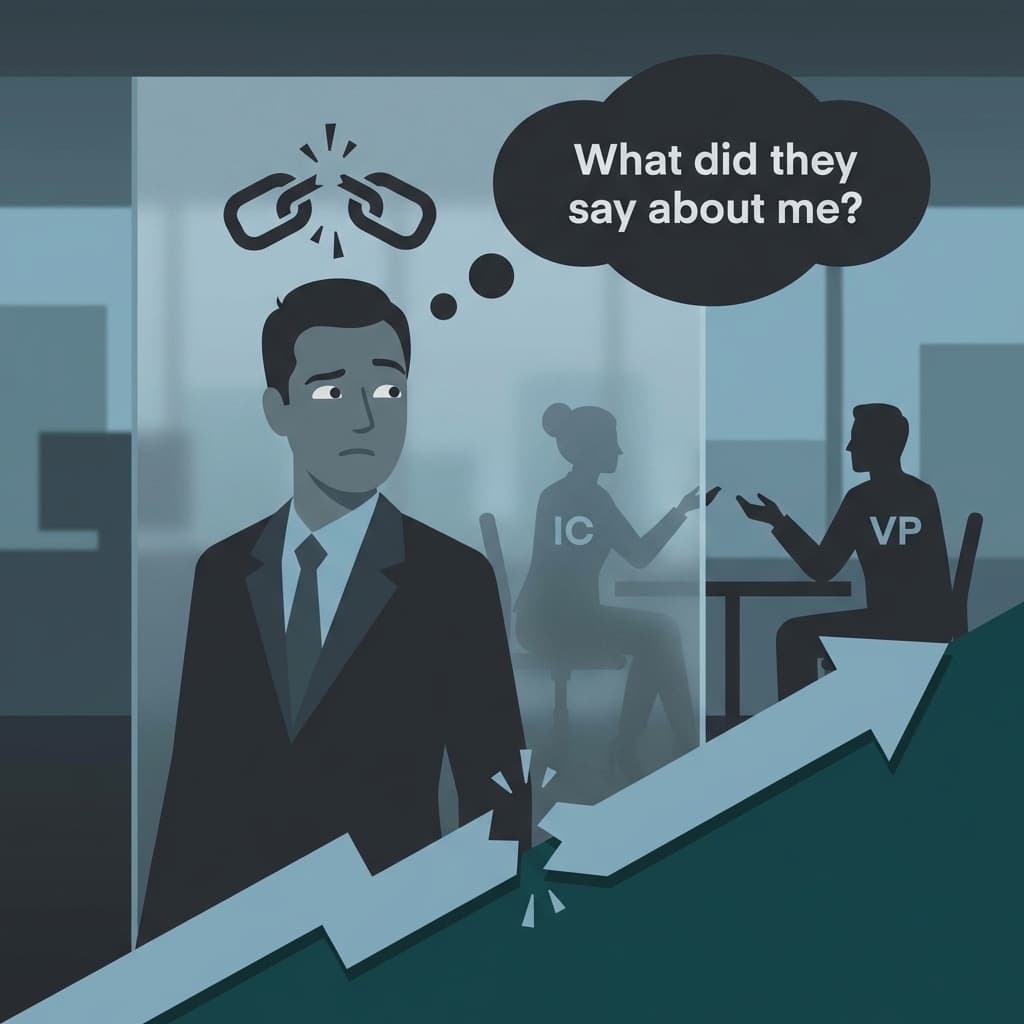
"You should do skip-level meetings!" the management books advised. "It shows you care about ICs! It surfaces problems that managers hide! It builds relationships across levels!" The logic seemed sound. As VP of Engineering, I was three levels removed from most individual contributors. How would I know what was really happening without direct access?
So we instituted a formal skip-level program. Every quarter, every IC would have a 30-minute 1:1 with someone two levels up. Directors met with engineers. VPs met with senior engineers. I met with staff engineers.
We designed a careful protocol. The sessions would be confidential. We'd ask about work satisfaction, career goals, and "anything you want to share about your experience." We promised to handle feedback "carefully and anonymously."
After two years of this program, we assessed the outcomes. What we found was disturbing:
Finding 1: The feedback we received was uniformly positive. Everyone loved their work. Every manager was "great." No problems were surfaced. This was statistically impossible given our engagement survey scores.
Finding 2: Manager anxiety had measurably increased. We could see it in their own 1:1 notes, their direct feedback, and eventually in exit interviews. Managers felt they were being "audited" by leadership.
Finding 3: Several high performers had left, citing in exit interviews that the skip-level program made them uncomfortable. "I felt like I was being asked to snitch on my manager."
We had created a "Broken Trust Factory." The program designed to build trust had systematically destroyed it. We killed the skip-level program and replaced it with approaches that actually worked.
Section 1: Why Skip-Levels Produce Fake Feedback
Skip-level meetings have a structural problem: the power dynamics make honest feedback nearly impossible.
The Information Flow Problem
When an IC meets with their skip-level manager (or higher), the conversation inevitably gets back to their direct manager. Maybe not the specific words, but the existence of the conversation, the topics discussed, the "vibe."
The skip-level says to the manager: "I had a great chat with Sarah. Really smart. You're lucky to have her."
The manager processes this as: "What did Sarah tell them? Why did they specifically mention her being 'smart'? Was there a complaint about me not developing her?"
Even when the skip-level says nothing, the manager wonders: "We haven't discussed the skip-level with Sarah. What happened in that meeting? What does leadership know that I don't?"
Information asymmetry creates paranoia. And paranoia damages the manager-report relationship—exactly the opposite of our goal.
The "Snitch" Dynamic
From the IC's perspective, the skip-level meeting feels like a trap.
If they share a genuine concern about their manager: "Will this become a conversation with my manager? Will I be identified as the source? Will there be retaliation?"
If they share no concerns: "Am I being perceived as not forthcoming? Will leadership think I'm hiding something?"
The safest path is to say something positive but vague. "Things are going well. I'm learning a lot. My manager is supportive." This is neither true nor false—it's just safe.
In our skip-level notes, 95% of feedback was some variant of "things are good." This was consistent across all skip-levels, all managers, all teams. It was obviously not representative of actual sentiment.
The Career Risk Calculus
ICs are not naive. They understand that the person conducting the skip-level has influence over their career—promotions, project assignments, layoff decisions.
Would you share genuine frustrations with someone who might decide whether you get promoted next cycle? Would you admit that you're thinking about leaving? Would you express doubt about the team direction?
Of course not. You'd present the best possible version of your situation. You'd express enthusiasm and alignment. You'd save your honest feedback for your therapist or your spouse.
Section 2: The Manager Paranoia Effect
Skip-levels don't just suppress honest feedback from ICs—they actively damage manager productivity and wellbeing.
The Audit Perception
Managers universally perceived skip-levels as "performance reviews conducted behind my back."
We framed them as "development conversations with ICs." Managers heard "leadership is collecting data about my effectiveness."
And honestly? They weren't entirely wrong. When leadership hears that an IC is frustrated, they do form opinions about the manager. Those opinions may be incomplete or unfair, but they form nonetheless.
Managers started prepping their reports for skip-levels. "Sarah, you have your skip-level with Alex next week. Let me know if there's anything I should be aware of beforehand." This is defensive behavior that wouldn't exist without the program.
The Undermined Authority Problem
When leadership has direct access to ICs, managers feel bypassed. Their role as the primary relationship with their reports is diluted.
If an IC can escalate directly to a VP, why go through the manager? If a VP might ask about a project decision, should the manager check with leadership before making decisions?
We saw managers become more deferential and less decisive. They'd say things like "let me check with the director before committing to that approach." The skip-level program had inadvertently compressed decision-making authority upward.
Exit Interview Signals
When managers left our organization, we asked about the skip-level program in exit interviews. Responses included:
"I always felt like I was being second-guessed. Leadership would hear something from my team and ask me about it before I even knew it was an issue."
"The skip-levels made me feel like my leadership didn't trust me to manage my own team."
"I started dreading the quarter after skip-levels because I never knew what was going to land on my desk from leadership."
We were losing good managers partly because of a program designed to make us "closer" to their teams.
Section 3: What Actually Works—The Replacement Model
We killed skip-levels and replaced them with a multi-method approach that actually surfaces useful information.
Anonymous Pulse Surveys
Monthly, short (5 question) surveys with quantitative ratings and one optional open-text field. Fully anonymous—we use a third-party tool where even we can't identify individual responses.
Questions:
- How would you rate your overall satisfaction this month? (1-10)
- Do you feel you have what you need to do your job effectively? (1-10)
- How likely are you to recommend our team as a great place to work? (1-10)
- Do you feel your direct manager supports your development? (1-10)
- (Optional) Is there anything you'd like leadership to know?
Results are aggregated by team (minimum 5 responses for anonymity). We see trends, not individuals. Managers see their team's aggregate scores—not individual responses.
This gives us signal without creating surveillance dynamics.
Open Office Hours
Instead of scheduled skip-levels, we hold weekly "open office hours" where any IC can drop in to talk with leadership. Completely optional. No calendar invite. No record of who attended.
The dynamic is different because it's voluntary. Someone choosing to attend has something they want to discuss. They're in control of the conversation.
Attendance varies (5-15 people per week). The conversations are more honest because they're self-selected. People come with specific questions, concerns, or ideas.
All-Hands Q&A
Monthly all-hands meetings include 30 minutes of live Q&A with leadership. Questions can be submitted anonymously via a tool during the meeting.
This creates public accountability. When leadership answers a question in front of 200 people, they can't give evasive non-answers. The audience sees how questions are handled.
The anonymous submission means people ask questions they'd never ask in a skip-level. "Why did we cancel the project after 6 months?" "What's happening with the layoff rumors?" "Is it true that comp bands are frozen?"
Manager 360 Reviews
Instead of skip-levels extracting feedback about managers, we run annual 360 reviews where ICs rate their managers on specific dimensions. Anonymous. Aggregated. Delivered to managers as development feedback, not performance evaluation.
This gives managers direct feedback about how their team perceives them—without leadership being the intermediary. Managers own their development. Leadership doesn't have surveillance data.
Section 4: When Skip-Levels Can Work
We're not dogmatic. There are contexts where skip-level-style conversations are appropriate:
Small Companies
At a 20-person startup, the CEO talking to everyone isn't a "skip-level"—it's just how small companies work. The formal power dynamic is less pronounced when everyone knows each other personally.
Investigation Mode
When there's a specific concern (a pattern in exit interviews, a concerning survey result, a manager on a PIP), direct investigation is appropriate. This isn't a general development program—it's targeted inquiry with a specific purpose.
Leadership Development
Senior ICs being considered for leadership roles might have skip-levels as part of their development process. These conversations are explicitly framed as "learning about leadership perspective," not as feedback channels.
The Key Distinction
Skip-levels fail when they're positioned as feedback mechanisms. They succeed when they have a different, explicit purpose that everyone understands.
"I'm talking to you because leadership is gathering information about your manager" = toxic.
"I'm talking to you because you're being considered for a leadership role and I want to share perspective" = useful.
The framing matters. The honest acknowledgment of purpose matters.
Conclusion: Trust Requires Respecting Boundaries
The skip-level program was designed to build trust by creating access. Instead, it destroyed trust by violating boundaries.
The boundary between a manager and their team exists for good reason. It creates psychological safety. It allows relationships to develop. It gives managers the autonomy to manage.
When leadership bypasses this boundary—even with good intentions—they signal that the boundary can't be trusted. And once that signal is sent, no one trusts any boundary.
ICs wonder: "If leadership skips my manager to talk to me, what else might they bypass? My privacy? My compensation confidentiality? My performance feedback?"
Managers wonder: "If leadership talks to my team without me, what decisions are they making without my input? Am I actually empowered to manage?"
Real organizational trust comes from respecting structure, not from circumventing it. Get feedback through anonymous channels. Create optional open-door policies. Make Q&A transparent and public.
Don't schedule surveillance disguised as development.
Trust is built by respecting boundaries, not by crossing them with good intentions.
Written by XQA Team
Our team of experts delivers insights on technology, business, and design. We are dedicated to helping you build better products and scale your business.