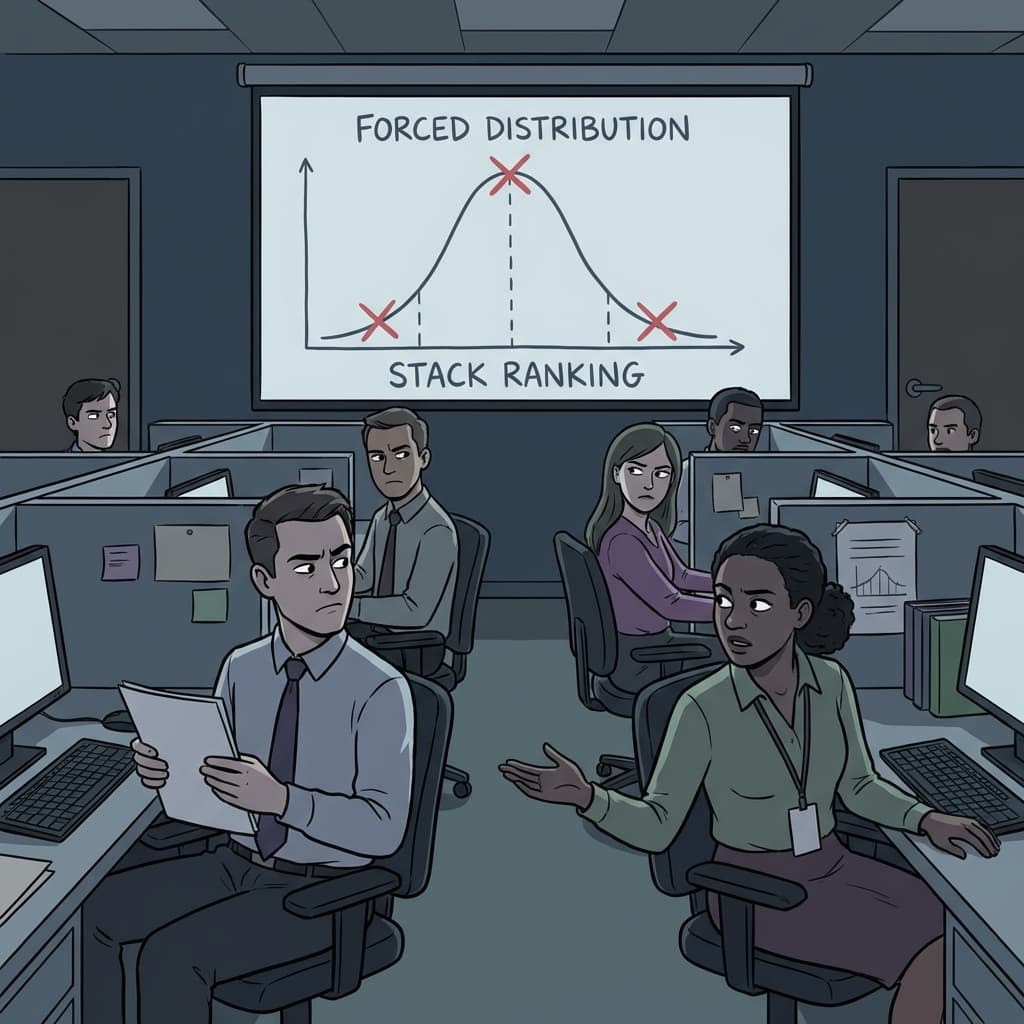
Stack ranking seemed fair. Compare everyone on the same criteria. Rank them. Reward the top, develop the middle, manage out the bottom. Objective. Defensible. Data-driven.
The results were catastrophic.
The Death of Helping
Sarah was stuck on a complex caching problem. Before stack ranking, she'd have walked to Tom's desk. Tom had solved similar problems. He would have helped. That's what teammates do.
After stack ranking, Sarah didn't ask. Tom was in her peer cohort. Helping Tom's velocity competitor (Sarah) could hurt her own ranking. So Sarah struggled alone for three days instead of getting help in thirty minutes.
Multiply this across the organization. Every act of helping became a competitive risk.
The Hoarding Pattern
Senior engineers stopped writing documentation. Why share knowledge that makes you replaceable? Why teach juniors who might surpass you in the rankings?
We noticed knowledge concentration increasing. Fewer people knew how critical systems worked. Bus factor decreased. But the people hoarding information were highly ranked—they were "essential."
The Gaming
People optimized for rankability, not impact:
- Visible work over invisible work: Flashy features beat critical infrastructure. Nobody got ranked high for keeping the servers running.
- Solo glory over team success: Being the hero of a project beat making five teammates more effective.
- Easy wins over hard problems: Ship ten small features, not one important one. Volume looked good in rankings.
- Politics: Being liked by the rankers mattered as much as actual performance.
The Quota Problem
Stack ranking with performance quotas means someone must be at the bottom. Even in a team of all-stars, someone gets ranked last.
We had quarters where genuinely excellent performers were put on PIPs because the math required it. "Someone has to be in the bottom 10%."
Their crime? Being excellent in a cohort of more excellent peers.
The Replacement: Absolute Standards
We replaced ranking with absolute criteria:
- Level expectations: "A Senior Engineer at this company delivers X, Y, Z." Either you meet the bar or you don't. Your peers' performance is irrelevant.
- Impact assessment: What did you accomplish? What would have happened without you? Evaluated independently, not comparatively.
- Collaboration credit: Helping others is explicitly rewarded. Unblocking a teammate counts. Mentoring counts. Writing docs counts.
The Results
After one year without stack ranking:
- Internal knowledge sharing: Up 3x (measured by wiki contributions, code review engagement, help-channel activity)
- Cross-team collaboration: Up significantly (teams no longer competing against each other implicitly)
- Time to onboard new hires: Down 40% (people actually helped them)
- High performer retention: Up 25% (they stopped feeling like they had to hoard)
We still have performance standards. Low performers still get managed. The difference: we measure against a bar, not against each other.
Ranking employees against each other makes them enemies. Make them meet a bar instead, and they'll help each other get over it.
Written by XQA Team
Our team of experts delivers insights on technology, business, and design. We are dedicated to helping you build better products and scale your business.