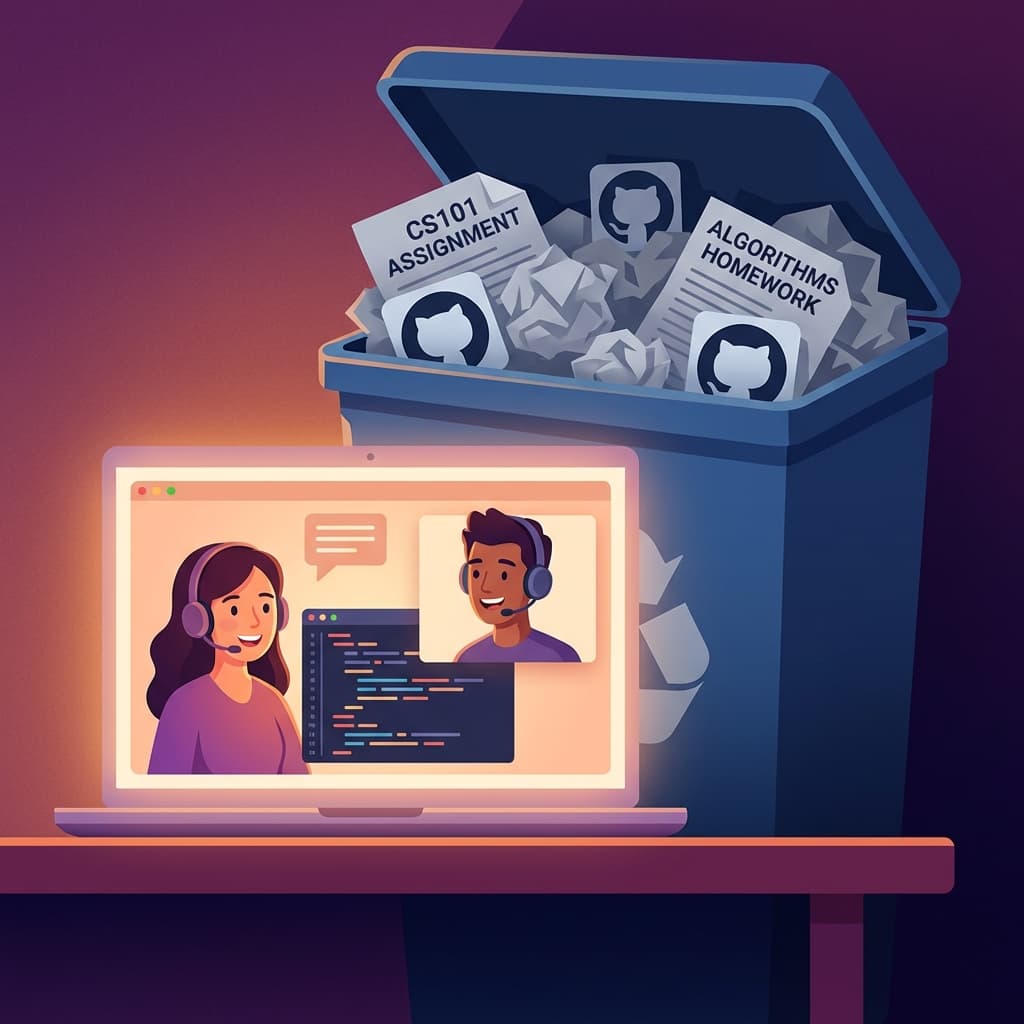
The "Take-Home Test" is the standard defense mechanism of engineering teams who are afraid to interview. "We don't want to put them on the spot with a whiteboard," we reasoned. "Let them work in their own environment. It mimics real work."
It sounded empathetic. In reality, it was exploitative and ineffective.
We realized that asking a Senior Engineer with two kids and a mortgage to spend their entire Saturday building a "To-Do List API with Authentication" was insulting. The best candidates simply ghosted us. The candidates who completed it often used ChatGPT or over-engineered it to death. We killed the Take-Home Test, and we haven't looked back.
The "Unlimited Time" Trap
The instructions always say: "This should take 3-4 hours."
This is a lie. If a candidate really wants the job, they will spend 12 hours. They will add Docker, unit tests, integration tests, a CI pipeline, and a fancy README.
So, who wins? The person who is better at coding? No. The person who has 12 hours of free time on a weekend wins.
We were systematically biasing our hiring against:
- Parents and caregivers.
- People with current demanding jobs.
- People from underrepresented groups who may feel they have to "prove" themselves more.
Meanwhile, we were selecting for:
- Single people with no hobbies.
- Desperate candidates who apply to 50 places.
- People who already had a "template" project ready to go.
The "ChatGPT" Problem
By 2025, take-home tests became effectively useless as a signal of coding ability. You can paste the prompt into Claude 3.5 or GPT-4 and get a perfect, production-ready solution in 30 seconds.
We found ourselves reviewing code that looked too perfect. "Wow, this Junior dev set up a perfect Hexagonal Architecture." No, they didn't. The AI did.
We had to bring them in for an on-site interview anyway to verify they wrote it. So the Take-Home wasn't even saving us time.
The Replacement: "fix-this-bug" (Live Debugging)
We replaced the weekend assignment with a 60-minute "Pair Debugging" session.
How it works:
1. The Repo: We give the candidate a link to a private repo (or a Codespace). It's a small, realistic service. It has a README. It runs.
2. The Bug: There is a reported issue. "The API returns a 500 error when the user has a special character in their name."
3. The Session: The candidate shares their screen. They have to run the app, reproduce the bug, read the logs, find the code, write a failing test, and fix it.
Why this works better:
It measures "Reading Code."
Professional software engineering is 90% reading other people's code and 10% writing new code. Take-homes measure writing. Debugging measures reading, navigation, and comprehension.
It tests the Toolchain.
Does the candidate know how to use `grep`? Do they know how to follow a stack trace? Do they use their IDE debugger or do they spam `console.log`? (Both are fine, but it tells you how they work).
It's impossible to fake.
You can't ChatGPT your way out of a live debugging session easily. You have to understand the specific context of this codebase.
It respects time.
It starts at 2 PM. It ends at 3 PM. No homework. No weekend sacrifice. Candidates loved this. Our offer acceptance rate went up because the interview process felt "professional and respectful."
The "Seniority" Filter
This method was incredible at distinguishing levels.
- Junior: Jumps straight into the code file, randomly changes lines hoping it works.
- Mid: reproducing the bug manually, adding logs, fixing it.
- Senior: Checks the git history ("Who touched this last?"), writes a reproduction test case first to ensure TDD, fixes the bug, and then refactors the surrounding bad code that caused it.
We got more signal in 45 minutes of watching someone navigate a codebase than we ever did from reading a flawless 2,000-line "ToDo App" submission.
Conclusion
The Take-Home test is a relic. It belongs to an era where we thought lines of code equaled productivity.
If you want to hire great engineers, test them on what they actually do: diving into an existing mess, making sense of it, and safely applying a fix.
Stop assigning homework. Start pair programming.
Written by XQA Team
Our team of experts delivers insights on technology, business, and design. We are dedicated to helping you build better products and scale your business.