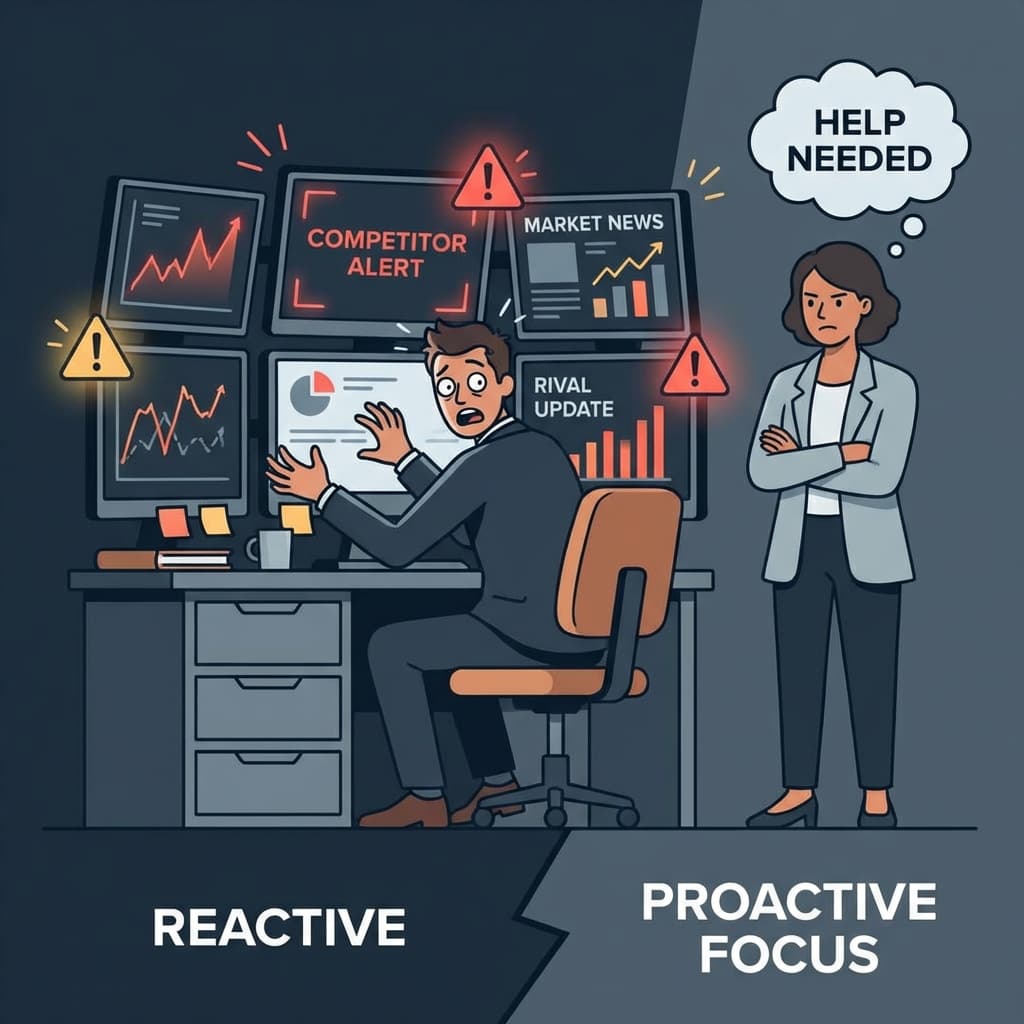
Competitor monitoring seems essential. How can you compete if you don't know what competitors are doing? How can you position without understanding the market? How can you win features if you don't know what features exist?
We believed this deeply. We built extensive competitor monitoring infrastructure:
- Dedicated Slack channel for competitor news
- Weekly competitive intelligence reports
- Feature comparison spreadsheets, updated monthly
- Win/loss analysis for every sales deal
- Google Alerts for every competitor
- Regular product teardowns of competitor updates
We knew everything competitors did, often within hours of them doing it.
And it was destroying us.
Every time a competitor launched a feature, we panicked. "We need to build that!" Every time a competitor raised money, we worried. "They're going to out-invest us!" Every time a competitor's marketing got attention, we copied. "That messaging must be working!"
We became reactive. Our roadmap wasn't driven by customer needs—it was driven by competitor moves. We were always playing catch-up, always responding, never leading.
We stopped competitor monitoring. We replaced it with customer monitoring. The transformation was immediate. Here's why competitor focus is usually a trap.
Section 1: The Reactive Roadmap Problem—Chasing Instead of Leading
When you know what competitors are doing, you feel pressure to respond. But response isn't strategy—it's reaction.
The Feature Arms Race
Competitor launches "intelligent auto-complete." Product meeting the next day: "We need intelligent auto-complete!"
But did we? Our customers hadn't asked for it. Our product vision didn't include it. We had no competitive advantage in building it fast. We just saw a competitor do it and panicked.
We analyzed our roadmap over 18 months:
- 40% of features were "responsive"—built because a competitor had it
- 30% were customer-requested
- 30% were strategic—aligned with our vision
Almost half our engineering investment was playing catch-up on features we hadn't planned, didn't have expertise in, and weren't differentiated by.
The Me-Too Trap
When you build what competitors build, you become interchangeable. Every feature matrix looks the same. Every marketing message sounds similar. You compete on execution and price—the hardest ways to compete.
We were becoming a "me-too" product. Good at everything competitors did, exceptional at nothing. Users couldn't articulate why they'd choose us over alternatives.
The Speed Disadvantage
Responsive building is inherently slower than proactive building. The competitor already built it—they had a head start. By the time we copied, they'd moved on to the next thing.
We were always one step behind. The perpetual follower.
Section 2: The Information Quality Problem—Competitors Don't Tell You the Truth
Competitor monitoring gives you information. But it's heavily filtered, potentially misleading information.
Marketing ≠ Reality
Competitors announce features with press releases and demos. These are marketing. They show the best case, the happy path, the polished version.
We'd see a competitor demo and think "their product is amazing!" Then we'd talk to their users and hear: "Yeah, that feature is buggy and nobody uses it."
We were reacting to marketing, not reality. Building features to compete with demos, not actual products.
Roadmaps Are Aspirational
Competitors publish roadmaps to excite customers and lock in deals. These roadmaps are aspirational—what they hope to build, not what they will build.
We'd see a competitor's roadmap and panic. "They're building X, Y, and Z next quarter!" Six months later, they'd delivered half of X and postponed Y and Z indefinitely.
We wasted cycles worrying about things that never happened.
Signal vs. Noise
Most competitor activity is noise. A feature launch. A blog post. A new pricing page. A conference appearance. Almost all of it is operationally irrelevant to your business.
But when you monitor everything, it all feels important. Every signal triggers anxiety. You can't distinguish what matters from what doesn't because you're drowning in updates.
Section 3: The Psychological Cost—Anxiety Over Agency
Competitor monitoring has psychological costs that don't appear on any dashboard.
The Anxiety Tax
Every competitor update triggers anxiety. "Are they ahead of us? Are we falling behind? Should we change direction?"
This anxiety compounds. The team becomes fearful rather than confident. Decisions are made from a defensive posture rather than an offensive one.
We surveyed our product team about stress sources. "Competitor pressure" ranked #2, above customer complaints and below only deadline pressure. We were making ourselves anxious about things outside our control.
The Confidence Erosion
When you focus on competitors, you see everything they're doing well. You don't see their struggles, bugs, internal chaos, customer complaints. They appear more capable than they are.
Simultaneously, you're intimately aware of your own struggles. Your bugs. Your delays. Your internal chaos.
This asymmetry erodes confidence. Competitors seem amazing. You seem flawed. The reality—everyone is struggling—is hidden.
The Agency Problem
Focusing on competitors focuses you on things you can't control. You can't control what competitors build. You can't control their funding. You can't control their marketing.
Psychological wellbeing requires agency—focusing on what you can control. Customer problems. Product quality. Team health. These are things you can affect.
Competitor monitoring trains you to care about the uncontrollable. That's a recipe for helplessness.
Section 4: The Replacement—Customer Monitoring
We replaced competitor monitoring with customer monitoring. The shift transformed our product organization.
What We Monitor Now
- Customer interviews: Weekly conversations with users about their problems and workflows
- Support ticket themes: What are customers struggling with?
- Feature requests: What do customers explicitly ask for?
- Usage data: Where are customers getting stuck? What features are underused?
- Churn reasons: Why do customers leave? (Not "which competitor did they go to?")
- NPS/CSAT verbatims: What language do customers use to describe us?
The Information Quality Difference
Customer information is first-party, unfiltered, and actionable:
- Customers tell you their real problems (competitors tell you their marketing)
- Customers tell you what they need (competitors tell you what they built)
- Customers tell you where they're going (competitors are guessing too)
When a customer says "I wish I could do X," that's a direct roadmap input. When a competitor announces feature X, you don't know if anyone actually wanted it.
The Proactive Roadmap
Our roadmap is now driven by three inputs:
- Customer problems: What are the biggest pain points?
- Strategic vision: Where do we want to go that customers can't articulate?
- Technical capability: What can we build better than anyone else?
Competitors don't appear in this framework. We don't ask "what are competitors building?" We ask "what do customers need that we can uniquely deliver?"
When We Do Look at Competitors
We haven't completely blinded ourselves. We do limited, strategic competitive analysis:
- Quarterly reviews: Once per quarter, 2-hour session on major competitive developments
- Deal-specific: In sales situations where competitors are explicitly compared
- Trend-level: Where is the market going broadly? (Not specific feature comparisons)
This is the minimum viable competitor awareness. Just enough to not be surprised, not enough to be distracted.
Conclusion: Compete by Being Different, Not by Keeping Up
The best companies don't win by copying competitors better. They win by solving customer problems that competitors don't even see.
When you're deep in customer problems, you see opportunities competitors miss. You build features that come from genuine need, not reactive pressure. You develop distinctive capabilities that can't be copied because they're built on intimate customer understanding.
Competitor monitoring feels responsible. "We must know what they're doing!" But it's actually irresponsible—it diverts attention from the things that actually determine success.
Customers determine success. Product quality determines success. Team capability determines success. Competitors are just other people trying to improve on those same dimensions. They're not your concern.
The next time you're tempted to see what a competitor launched, ask instead: "What problem did a customer tell us about this week?" That question will lead you somewhere more valuable.
You can't out-compete by watching competition. You out-compete by out-understanding customers.
Written by XQA Team
Our team of experts delivers insights on technology, business, and design. We are dedicated to helping you build better products and scale your business.