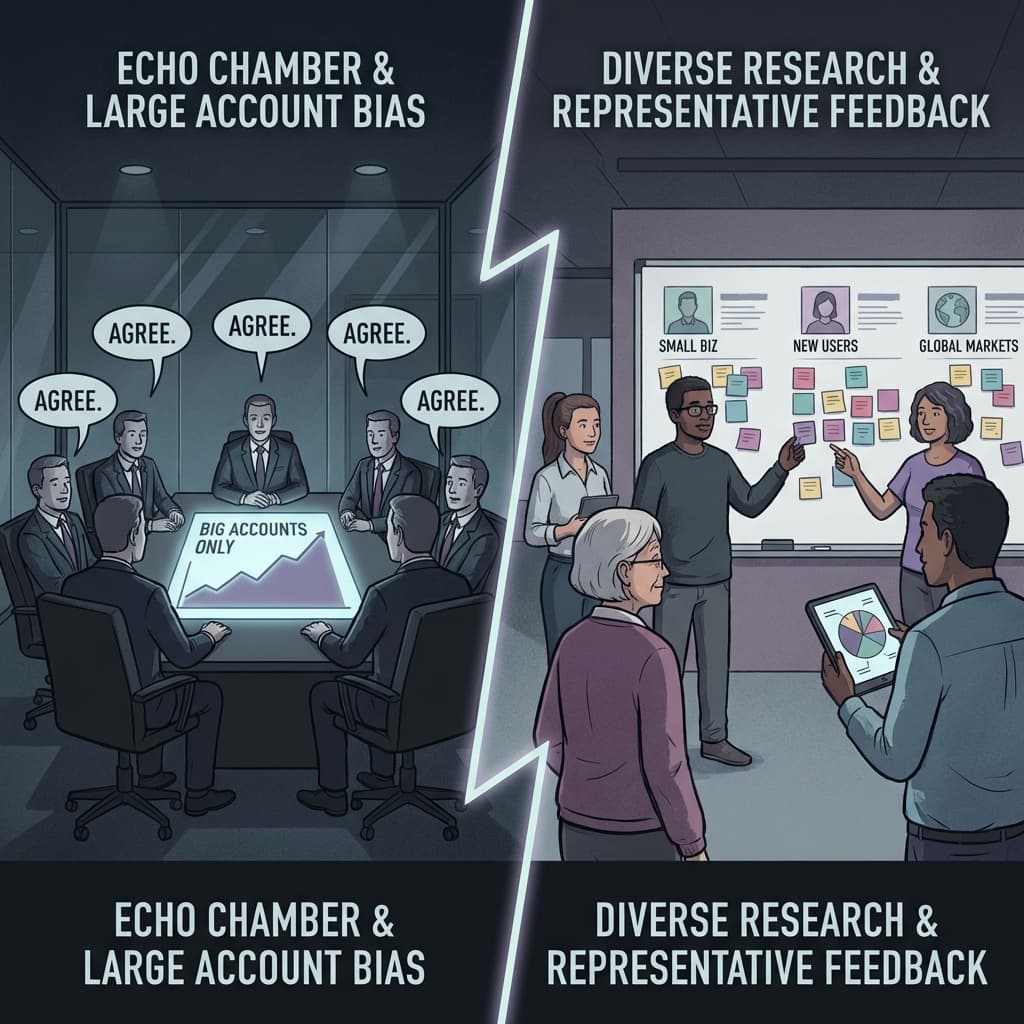
Our Customer Advisory Board seemed like best practice. Quarterly meetings with our largest customers. Strategic input on product direction. Executive relationship building. The CAB promised customer-centricity through privileged access to our most important accounts.
After three years, we disbanded the CAB. The insights it produced were heavily biased toward large accounts with non-representative needs. The meeting format generated performative feedback rather than genuine input. The relationship dynamics prioritized keeping CAB members happy over building the right product.
We replaced the CAB with diverse customer research programs—without the distortions of advisory board dynamics. Product decisions improved. Here's what we learned about why customer advisory boards often produce worse customer understanding, not better.
The CAB Premise
Customer advisory boards are common in B2B software. The pitch: bring together your most important customers for structured input on product direction. Build executive relationships that strengthen accounts. Show customers you value their perspective. Generate loyalty through inclusion.
We launched our CAB with 12 member companies. Our largest accounts, chosen for revenue significance and executive engagement. Quarterly meetings—one in-person annually, three virtual. Agenda included product roadmap review, feature prioritization, strategic planning input.
The participants were senior—VPs and directors from each company. They committed time, which signaled relationship investment. We committed resources—dedicated program management, executive participation, exclusive access to roadmap plans.
Early meetings generated enthusiastic feedback. "This is so valuable!" "Love being included in these discussions!" "Great to influence product direction!" The CAB seemed to be working.
Then we looked at what the input actually produced.
The Large Account Bias
CAB membership selected for revenue, not representativeness. Our largest customers weren't our typical customers. They had different needs, different resources, different use patterns.
The features they wanted served enterprise scale: complex permissions, elaborate integrations, administrative controls. These features mattered to 3% of our customer base that drove 30% of revenue. They didn't matter to the 97% of customers who constituted our growth engine.
The CAB created an amplifier for large-account requests. When our biggest customers asked for something in a CAB meeting, it felt more important than equivalent requests from smaller customers through normal channels. The meeting format artificially elevated certain voices.
We found ourselves building for the CAB rather than for the market. Product investments skewed toward enterprise complexity. The simplicity that attracted new customers eroded. Our competitive advantage was in ease of use; CAB influence pushed us toward feature complexity.
The bias was invisible until we analyzed it. CAB-influenced features had lower adoption than other features. The loudest voices weren't representative voices. We'd systematically over-weighted input from customers least like our future customers.
The Performative Feedback Problem
CAB meetings created social dynamics that distorted honest feedback. Executives in a room together performed rather than processed. The format produced performance, not insight.
Participants wanted to seem strategic, not petty. They raised "strategic direction" concerns rather than workflow friction. They spoke about where the market was going rather than where their pain points were. The elevated context elevated the conversation away from actionable specifics.
Groupthink emerged quickly. When one executive expressed enthusiasm for a direction, others agreed. When one criticized, others piled on. The social dynamics of the room overwhelmed individual judgment. We heard consensus that didn't exist outside the meeting.
Participants also performed for each other. They didn't want to appear unsophisticated in front of peer executives. This filtered out the simple, obvious feedback that would have been most useful. "The onboarding is confusing" became "We'd benefit from more sophisticated configurability in initial setup workflow."
The performative nature was clearest in contrast with one-on-one interviews. The same executives, asked the same questions privately, gave different, more specific, more actionable answers. The CAB format suppressed the signal we needed.
The Relationship Distortion
CAB membership became a relationship management tool rather than a research tool. Account teams nominated customers for CAB membership as a retention incentive. "Join the CAB" was a benefit offered to accounts we were trying to strengthen.
This meant CAB composition optimized for relationship needs, not input quality. Members included accounts where we needed to shore up relationships—not necessarily accounts with the most useful perspectives.
Once members, keeping them happy became a goal. CAB feedback received disproportionate attention not because it was more insightful but because ignoring it risked relationship damage. We built features we knew weren't broadly valuable because CAB members had requested them.
Renewals and expansions became entangled with CAB dynamics. Saying "no" to CAB requests felt risky when those accounts represented significant revenue. The advisory board became a leverage mechanism rather than a learning mechanism.
The worst case: members who expected their participation to guarantee feature delivery. "I've been on the CAB for two years asking for this; why haven't you built it?" The entitlement was understandable—we'd positioned the CAB as influence, not just input.
The Meeting Format Problem
Quarterly meetings created artificial urgency and artificial delay. Feedback arrived in quarterly batches rather than continuous flow. By the time a CAB meeting occurred, the participants had accumulated concerns that might have been addressed earlier.
The meeting format limited depth. With 12 companies and limited time, each topic received shallow treatment. We heard surface reactions rather than deep understanding. The format optimized for breadth at the expense of insight.
Preparation distorted feedback further. We prepared agendas, shared them in advance, and shaped discussion. Members came ready to respond to our framing rather than surface their own priorities. The meeting was interactive but not genuinely generative.
The in-person component created additional distortion. We flew members to our headquarters, hosted dinners, provided experiences. The hospitality created reciprocity pressure—harsh feedback felt socially difficult after we'd bought dinner. The format discouraged the criticism we most needed.
What We Replaced It With
We disbanded the CAB and invested the same resources into diverse customer research:
Continuous interviews: Product managers conduct regular one-on-one interviews across the customer base—not just large accounts. The sample represents our actual customer distribution: mostly smaller companies, with enterprise appropriately weighted.
Usage analysis: Behavioral data shows what customers do, not just what they say. Feature usage patterns reveal true priorities. We watch behavior, not just listen to requests.
Segment-specific research: Different customer segments get dedicated research. Enterprise customers get enterprise-focused sessions. SMBs get SMB-focused sessions. The feedback isn't homogenized across segments with different needs.
Problem discovery over solution validation: Research focuses on understanding problems before proposing solutions. Rather than "Do you like this roadmap?", we ask "What's frustrating about your workflow?" The input is generative, not reactive.
Deliberate rotation: We talk to different customers continuously rather than the same 12 repeatedly. Fresh perspectives prevent echo chamber formation.
Anonymous aggregation: Feedback is synthesized without account attribution where possible. Product decisions are made based on pattern prevalence, not account importance.
The Transition
Closing the CAB required careful communication. Members valued their participation. Account teams worried about relationship damage. We needed to wind down without insulting long-standing members.
We framed the change around improving research quality. "We've learned that quarterly meetings don't capture the continuous feedback we need. We're evolving toward ongoing conversations." This was true and avoided implying that CAB input hadn't been valuable.
Former CAB members were invited into the ongoing interview rotation—but as participants among many, not as privileged advisors. Most accepted gracefully; they'd noticed the CAB meetings weren't producing visible impact anyway.
Account teams initially resisted. The CAB had been a relationship tool. We addressed this by establishing other executive touch points: quarterly business reviews, executive sponsorship programs, customer summit events. The relationship component transferred; the research component improved.
Some accounts expected continued special treatment. We held firm that product input now came through research channels, not relationship channels. This was uncomfortable initially but established healthier dynamics.
The Results
Two years after disbanding the CAB:
Product decisions improved: Features now address patterns across customer segments rather than requests from specific large accounts. Adoption rates for new features increased measurably.
Input diversity increased: Product research conversations span hundreds of customers annually rather than 12 repeatedly. The input represents our actual customer base.
Relationship health maintained: Despite concerns, CAB dissolution didn't damage key accounts. Other relationship mechanisms—QBRs, executive sponsors, customer events—filled the connection need.
Research velocity increased: Without quarterly meeting logistics, research happens continuously. Insights arrive faster and more frequently.
Bias awareness increased: The organization became more conscious of large-account bias risks. We actively guard against over-weighting any single customer's perspective.
When CABs Work
Customer advisory boards aren't universally wrong. They work in specific contexts:
Homogeneous customer base: When customers are genuinely similar, a small sample can be representative. Our customer base spanned scales and use cases too diverse for any sample of 12 to represent.
Relationship-first objective: If the goal is executive relationships rather than product input, CABs can achieve that. Just don't pretend it's research.
Strategic partnership exploration: CABs can be venues for exploring integration partnerships or co-development. This specific use case benefits from repeated executive interaction.
Industry legitimacy: Having named companies on an advisory board can provide credibility. This is a marketing function, not a research function—which is fine if acknowledged.
Our CAB tried to be research, relationship, and legitimacy simultaneously. The confusion undermined all three purposes.
Lessons About Customer Input
Representativeness matters most: Who you're hearing from shapes what you hear. Systematically over-sampling any segment produces systematically biased input. Design research for representation.
Format shapes feedback: How you ask affects what you learn. Group dynamics, meeting settings, relationship contexts all distort. Consider format effects when designing research.
Separate relationships from research: Mixing account management with product research contaminates both. Keep the functions distinct, with different people and different processes.
Behavioral data complements feedback: What customers do is often more revealing than what they say. Combine claimed preferences with observed behavior for fuller understanding.
Continuous beats batched: Regular ongoing research produces better signal than periodic concentrated efforts. Build research into routine rather than episodic programs.
Conclusion
Our Customer Advisory Board produced confident input from unrepresentative sources. The format created performative feedback. The relationship dynamics distorted honest assessment. We built for the CAB's priorities, which weren't our market's priorities.
Replaced with diverse, continuous, well-structured customer research, our product decisions improved. We still hear from large accounts—just not disproportionately. We still build relationships—just separately from research. We still get input—just from samples that represent our actual customer base.
If your customer advisory board shapes product direction, ask honestly: Does it represent your customer base? Does the format produce genuine insight? Are relationship dynamics distorting input? Customer centricity requires hearing from the right customers, not just the loudest ones.
Written by XQA Team
Our team of experts delivers insights on technology, business, and design. We are dedicated to helping you build better products and scale your business.