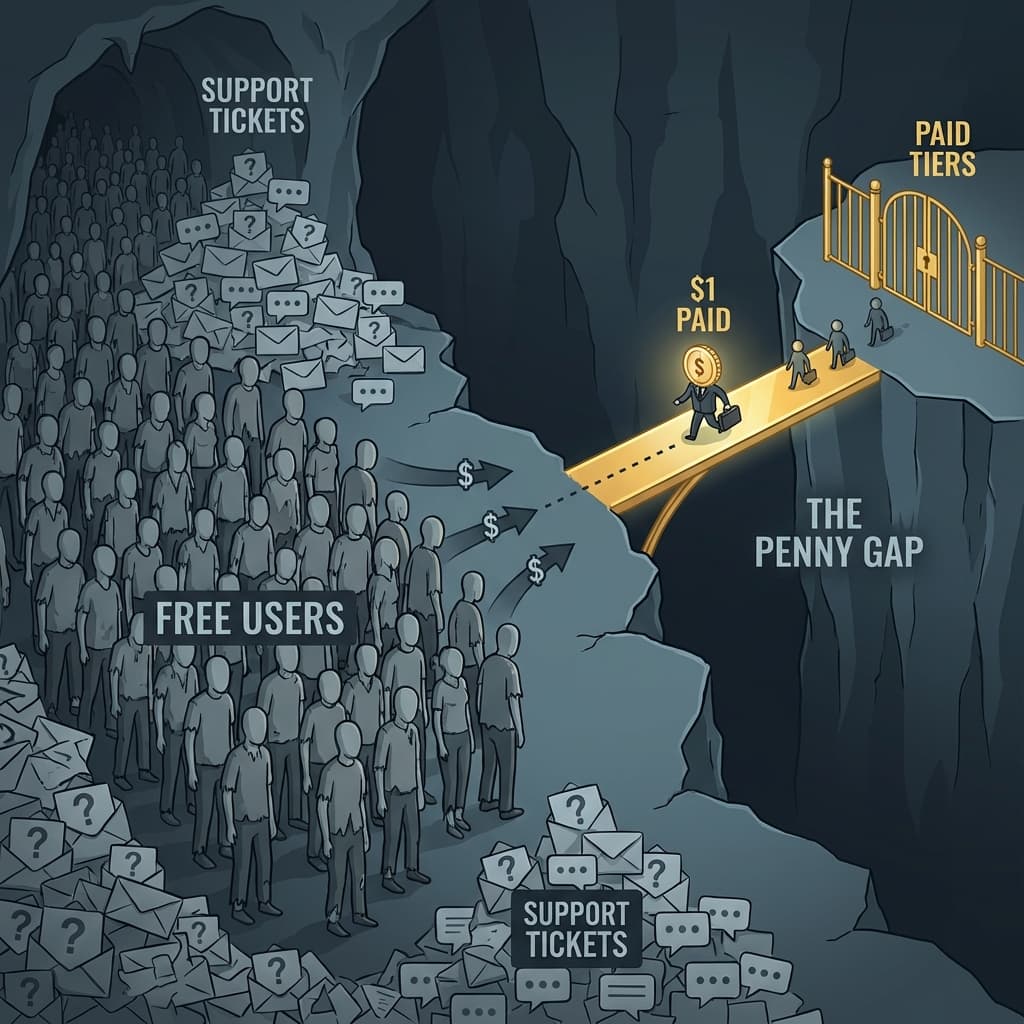
The freemium playbook is simple: give away value, build habit, convert later. Dropbox did it. Spotify did it. Slack did it. We would too.
Three years of data said otherwise.
The Funnel That Wasn't
| Stage | Users | Conversion |
|---|---|---|
| Free signups | 50,000 | 100% |
| Activated (used core feature) | 15,000 | 30% |
| Weekly active after 30 days | 4,000 | 8% |
| Hit paywall | 2,000 | 4% |
| Started checkout | 800 | 1.6% |
| Completed purchase | 400 | 0.8% |
50,000 free users. 400 paid. 0.8% conversion.
Industry benchmarks said 2-5% was normal for B2B freemium. We were well under. But even at 3%, we'd have 1,500 paid customers from 50,000 free—still terrible unit economics.
The Hidden Costs
Infrastructure: Free users consumed 40% of our compute. They used the product less intensively but there were many more of them. We were subsidizing non-customers.
Support: "Free" doesn't mean "no support expectations." Free users submitted 60% of support tickets. They had the least complex use cases but the most questions.
Fraud and abuse: Free tiers attract spam signups, crypto miners, and people testing the limits. We spent engineering cycles on abuse prevention that paid customers never needed.
Product distortion: We built features to convert free users. These weren't features paid users wanted. We optimized for a segment that wouldn't pay.
The Penny Gap
The difference between free and $1 is infinite. The difference between $1 and $100 is 100x.
People who won't pay $1 won't pay $100. But people who pay $1 will often pay more. Crossing the penny gap—getting any payment—filters for quality customers.
Our free users weren't future paid users. They were a different population entirely. People who wanted free software, not people evaluating before buying.
The Pivot
We replaced free with a 14-day trial. Full features. Credit card required upfront.
Results:
- Trial signups: 2,000/month (down from 8,000 free signups)
- Trial → Paid conversion: 25%
- New paid customers/month: 500
- Previous free → paid conversion/month: 33
15x more paid customers per month. From fewer signups.
Annual impact:
- Infrastructure costs: Down 35%
- Support costs: Down 50%
- Revenue: Up 200%
- Customer quality (measured by expansion rate): Up significantly
When Freemium Works
Freemium succeeds when:
- Network effects: Free users make the product better for paid users (Slack, Zoom)
- Viral distribution: Free users bring paying users (Dropbox referrals)
- Consumer products: Huge TAM where 0.5% conversion still works at scale
- Near-zero marginal cost: Free users cost almost nothing to serve
For B2B SaaS without strong network effects? Freemium is usually a trap.
Free users are customers of a different product. If you want paying customers, make them pay from day one.
Written by XQA Team
Our team of experts delivers insights on technology, business, and design. We are dedicated to helping you build better products and scale your business.