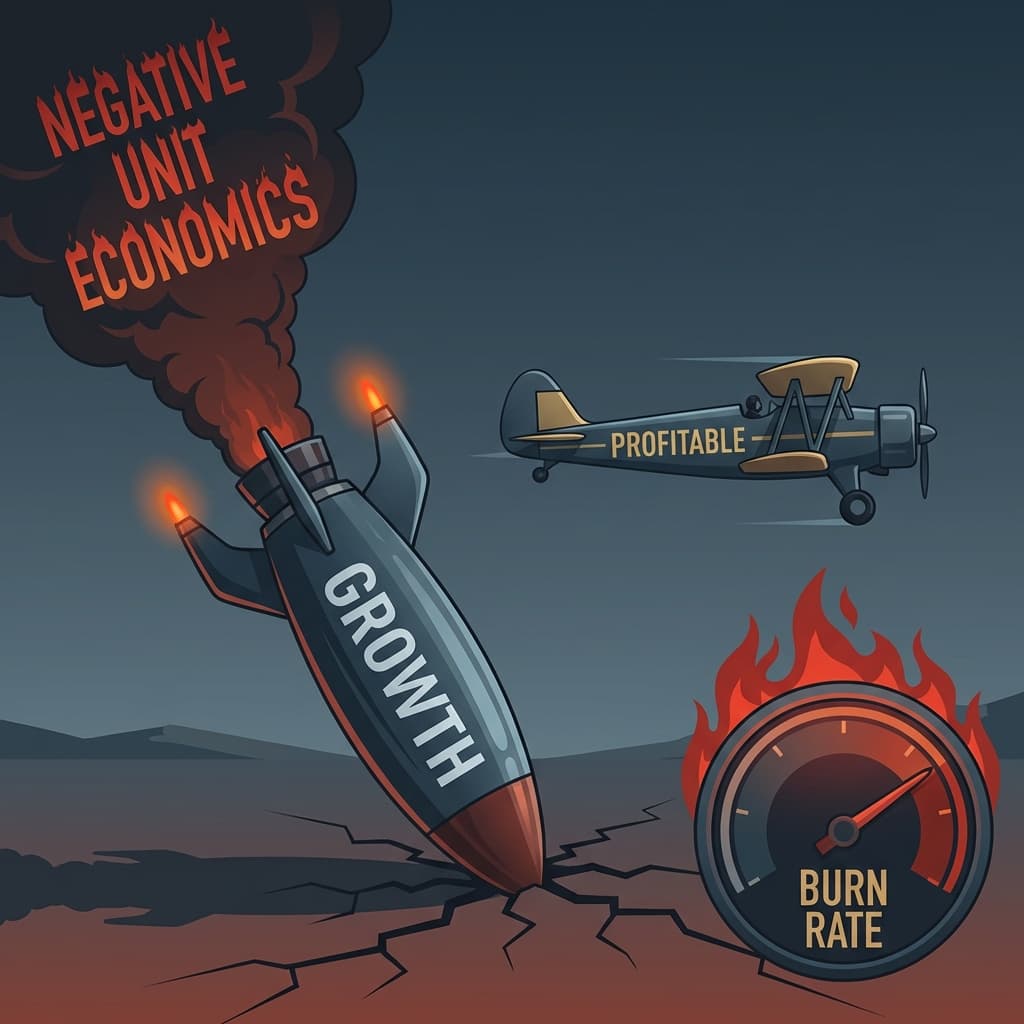
2021: Seed round. Investors said "grow fast, worry about profitability later." We believed them.
2022: Series A at 15x ARR multiple. Investors said "you're not spending enough. CAC payback over 12 months is fine. Capture market share."
2023: Interest rates spiked. Our next raise valued us at 4x ARR. Investors said "show a path to profitability." We had no path. We had a $400 CAC on a $100 ACV product.
2024: We laid off 40% of the company. We survived. Barely.
The Math That Never Worked
| Metric | 2021 | 2022 | 2023 |
|---|---|---|---|
| ARR | $500K | $2.5M | $4M |
| Burn Rate | $100K/mo | $500K/mo | $600K/mo |
| CAC | $200 | $350 | $450 |
| ACV | $100 | $100 | $120 |
| CAC Payback | 24 mo | 42 mo | 45 mo |
| Gross Margin | 70% | 65% | 60% |
CAC payback of 45 months on an ACV of $120 means we needed to retain customers 4+ years just to break even on acquisition. Our actual average customer lifespan: 18 months.
Every customer we acquired lost us money. Growing faster meant losing money faster.
How "Growth" Became the Religion
Nobody questioned the math because growth covered everything:
- VCs rewarded growth. Valuation was a multiple of revenue or growth rate. Profitability wasn't in the model.
- Employees were incentivized on growth. Sales quotas, marketing spend targets, hiring plans—all growth metrics.
- Competitors were growing. If we didn't keep up, we'd lose the market. (Spoiler: many competitors also died.)
- "We'll fix unit economics later." The magical hand-wave. Scale would bring efficiency. It didn't.
The Intervention
When the Series B fell through, we had 8 months of runway. We made brutal choices:
Cut 40% of staff. Mostly sales and marketing. We couldn't afford to acquire unprofitable customers.
Raised prices 3x. ACV went from $120 to $360. We lost 30% of customers. But the ones who stayed were more committed, less price-sensitive, lower churn.
Slashed ad spend 90%. CAC dropped to $150 through organic and referral. Volume dropped. Profitability improved.
Focused on expansion, not acquisition. Cheaper to grow existing accounts than acquire new ones.
The After
| Metric | 2023 (Pre-cuts) | 2024 (Post) |
|---|---|---|
| ARR | $4M | $3.2M |
| Burn Rate | $600K/mo | $80K/mo |
| CAC | $450 | $150 |
| ACV | $120 | $360 |
| CAC Payback | 45 mo | 5 mo |
| Net Revenue Retention | 95% | 120% |
| Profitable? | No | Yes |
ARR dropped 20%. But we went from losing $7M/year to making $500K/year. We stopped dying.
The Lessons We Preach Now
Unit economics must work from day one. If acquiring a customer costs more than they'll ever pay, you don't have a business. You have a wealth transfer from investors to ad platforms.
Growth covers problems, it doesn't solve them. Bad margins at $1M ARR are still bad margins at $10M ARR. If anything, they're harder to fix at scale.
Default alive > default dead. Can you survive if fundraising fails? If no, you're one macro shock away from disaster. 2023 proved that shocks happen.
Profitable customers are different from free-trial customers. When you charge real money, you attract people who find real value. When you optimize for sign-ups, you attract tire-kickers.
We're Smaller. We're Alive.
Our competitors who kept "growing" mostly died or sold for pennies. We're smaller than our peak. We're also profitable, calm, and in control of our destiny.
Growth is good. Growth that loses money on every transaction isn't growth—it's accelerated dying with good optics.
The best time to focus on profitability is before you need to. The second best time is now. There may not be a third time.
Written by XQA Team
Our team of experts delivers insights on technology, business, and design. We are dedicated to helping you build better products and scale your business.