"You need to scale through partners! Get resellers and system integrators bringing you deals! It's leveraged sales!" The advice came from advisors, investors, and enterprise sales veterans. Everyone said we needed a partner channel.
We built one. We recruited 40 reseller partners. We gave them 25% of revenue on deals they brought. We trained them. We supported them. We built partner portals and deal registration systems.
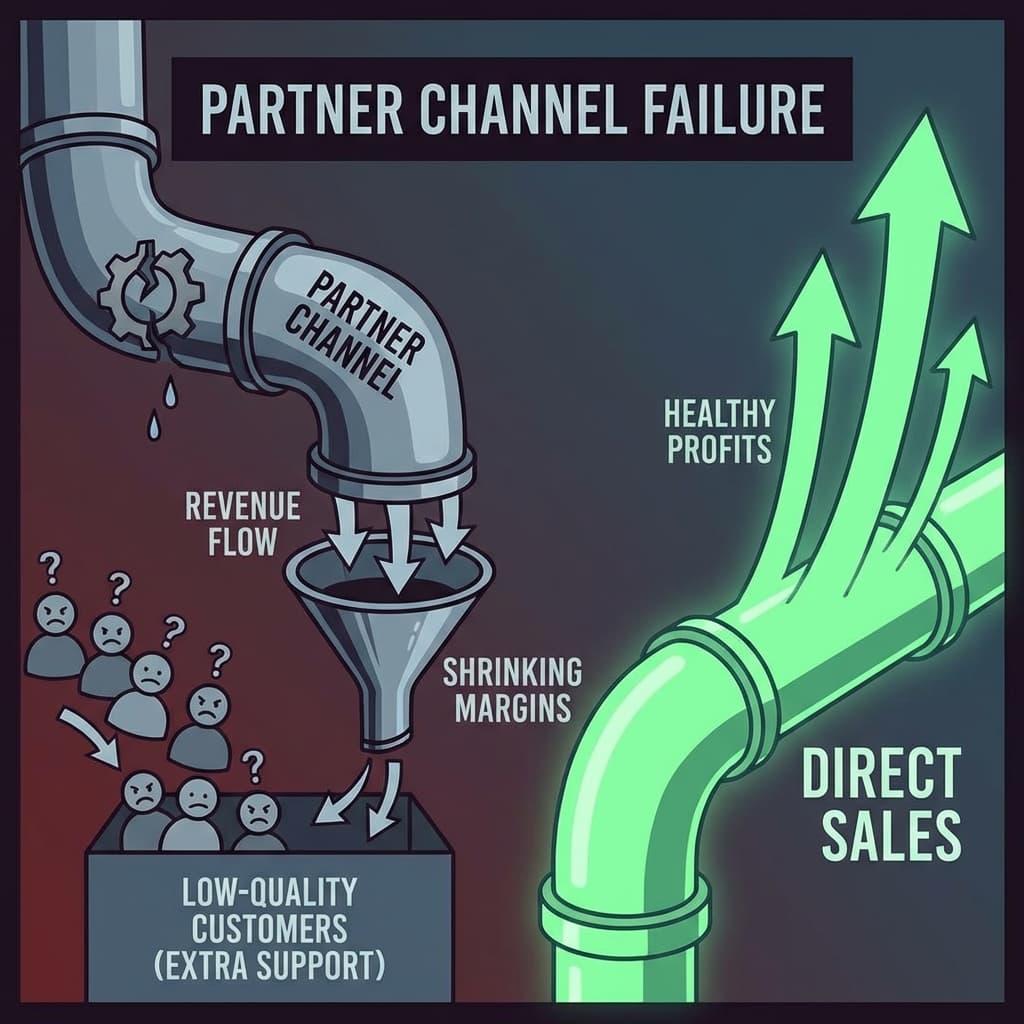
Three years and $4M in partner-sourced revenue later, we shut it down. The math never worked. Partners brought us the worst customers, demanded the most support, and compressed our margins to unsustainability. This is that story.
The Partner Channel Dream
Partner channels promise leverage: instead of hiring salespeople at $200K fully-loaded, you get "free" sales capacity from partners who only get paid on success. The unit economics look magical on a spreadsheet.
Our partners would be:
- Value-Added Resellers (VARs): Companies that sell technology solutions to their customer base. They know the customers, have relationships, and can bundle us with other products.
- System Integrators: Consulting firms that implement technology. They recommend us as part of their projects. Implementation revenue for them, subscription revenue for us.
- Agency Partners: Marketing and technology agencies who build solutions for clients. Embedding us in client projects expands our reach.
We'd give them 25% of the first-year revenue for any customer they brought (deal registration) and 15% on renewals. They'd handle initial sales. We'd handle product and support. Win-win.
Building the Program
We did this by the book. Partner program best practices from Salesforce's playbook, adapted for our scale:
Partner recruitment: We identified 200 potential partners. Attended their conferences. Pitched the opportunity. After six months, we had 40 active partners.
Enablement: We created partner training—product knowledge, sales messaging, demo scripts. We certified partner salespeople. We built a partner portal with co-branded materials, deal registration, and lead tracking.
Support: We assigned a Channel Manager (later two) to work with partners. They did quarterly business reviews, answered questions, and helped close deals. Partners had dedicated Slack channels for quick support.
Investment: MDF (Market Development Funds) for partner marketing activities. We co-sponsored events, paid for joint ads, and funded lead generation.
Total program cost: $600K/year (channel managers, enablement, MDF, portal maintenance)
Year one results: 45 deals from partners. $800K in ARR. At 25% payout, we kept $600K. Against $600K in program cost, we were breaking even—but the ARR would compound with renewals. Or so we expected.
The Reality That Emerged
Problem 1: Partners Brought the Worst Customers
Partner-sourced customers were measurably worse across every metric:
| Metric | Direct Customers | Partner Customers |
|---|---|---|
| Average Contract Value | $28,000/year | $18,000/year |
| Gross margin | 82% | 58% |
| Support tickets/customer/month | 1.2 | 3.8 |
| Net Revenue Retention | 115% | 85% |
| Churn rate | 12% | 28% |
Partner customers started smaller. After the partner's 25% cut, our effective ACV was $13,500—less than half of direct deals.
They churned faster. The partner made their commission and moved on. We were left with a customer who'd been sold by someone else, had unclear expectations, and often wasn't a great fit for our product.
They demanded more support. Partner salespeople often over-promised or misconfigured things during onboarding. We cleaned up their mess. Three times the support tickets meant three times the support cost.
After accounting for partner payout, higher support costs, and lower retention, partner customer gross margin was 58% versus 82% direct. Partner customers weren't just less profitable—they were barely profitable.
Problem 2: Channel Conflict Made Direct Sales Harder
We inevitably had deals where both a partner and our direct sales team were pursuing the same prospect. Who owned the deal? Complex rules attempted to adjudicate, but created friction:
- Partners registered deals they barely touched, trying to claim commission on our direct pipeline
- Our sales team felt undercut when a prospect mentioned talking to a partner
- Prospects got confused when approached by both us and a partner
- Pricing got messy—partner pricing couldn't be better than direct pricing, but partners needed margin too
Our sales team started sandbagging deals to avoid partner conflict. "I don't want to waste cycles if a partner's going to swoop in." Pipeline accuracy suffered. Forecasting became unreliable.
Problem 3: Partners Only Sold When Convenient
We weren't our partners' primary business. We were one of many products they might mention. If a deal was easy, they'd include us. If it required effort—real selling, handling objections, customization—they'd skip us and sell something they understood better.
Our 40 partners looked great on paper. In practice:
- 5 partners generated 80% of partner revenue
- 20 partners generated occasional deals (once or twice per year)
- 15 partners generated nothing after initial enthusiasm faded
We spent significant time servicing 35 partners who produced almost nothing. Training sessions. QBRs. Portal access. Slack support. All for "partners" who were really just names in a database.
Problem 4: Enablement Never Stuck
Partner salespeople turn over constantly. In three years, the average partner had 100% sales team turnover. Every person we trained left. Their replacement needed training again.
We created self-service enablement. Partners didn't use it. We created certifications. Partners gamed them. We offered incentives for completing training. Partners did the minimum.
The partners who performed well were the ones whose senior people personally understood our product. When those people moved on, the partnership effectively ended even though the contract continued.
Problem 5: We Couldn't Control the Customer Experience
A partner screws up a deal—overpromises, misimplements, ghosts after the sale—and who does the customer blame? Us. Our brand. Our product.
We had multiple situations where angry customers escalated to our executives, complaining about things the partner did. Our NPS was measurably lower for partner-sourced customers (15 versus 45 for direct). Our reputation was being damaged by people we didn't employ and couldn't control.
The Math That Killed the Channel
After three years, we did the full analysis:
Partner channel revenue: $4.2M cumulative ARR (across 3 years of cohorts)
Partner payouts: $1.1M (25% first year, 15% renewals)
Program costs: $1.8M ($600K/year for 3 years)
Additional support costs: $600K (higher ticket volume from partner customers)
Revenue lost to churn: $1.2M (partner customers churned faster)
Total investment: $4.7M
Net revenue retained: $2.1M
We invested $4.7M to get $2.1M in retained revenue. We lost money on the partner channel. It wasn't even close.
For comparison: if we'd spent that $4.7M on direct sales and marketing, at our normal CAC, we'd have acquired approximately $12M in ARR. The opportunity cost was staggering.
The Wind-Down
We decided to shut down the partner program. This required careful execution to avoid burning bridges and ensure customer continuity.
Communication: We informed partners with 6-month notice. No new deal registrations after a date. Existing deals honored. We explained the business rationale honestly—it wasn't personal; the model didn't work for us.
Customer transition: Partner customers were transitioned to direct account management. We reached out proactively to ensure they knew we were still supporting them, regardless of how they'd purchased.
Top partner handling: Our 5 productive partners were offered options: become referral partners (flat fee per referral, no ongoing revenue share), or transition their customers to direct with a one-time payout. Three took the referral model. Two exited with payouts.
Team reallocation: Channel managers were redeployed to direct sales roles. Their relationship skills translated well. The portal and enablement systems were sunsetted.
By month 6, we were fully direct. Partner customers who'd churned... churned. Partner customers who were good fits remained and actually became more profitable once the partner cut disappeared from their renewals.
What We Do Now
Referral program: Instead of resellers, we have a simple referral program. If someone introduces us to a prospect who becomes a customer, they get a flat $2,000 fee. One-time. No ongoing commission. No complex enablement. Works for consultants who occasionally recommend us.
Integration partners: We partner with complementary tools on integrations. No revenue share—just co-marketing and joint customer success. These "partners" don't sell us; they work well with us. Different value proposition.
Direct sales investment: The budget that went to channel now funds direct sales. More SDRs. More AEs. More marketing. We control the customer experience end-to-end.
When Partner Channels Work
Our experience doesn't universally condemn partner channels. They work in specific conditions:
- Geographic expansion: If you can't establish direct presence in a market, local partners can be necessary. Accept the margin hit for market access.
- Complex implementation required: If customers need significant services to use your product, system integrators add genuine value. The partner cut buys real work.
- Massive TAM you can't serve directly: If your market is truly huge (millions of potential customers), partners extend reach. But this requires very high volume to work—not 45 deals per year.
- Incumbent relationships you can't build: Some industries buy through existing vendors. Breaking in requires a partner with that relationship. Painful but sometimes necessary.
For a mid-market SaaS company that can effectively sell direct? Partner channels are usually a distraction that looks like scale but delivers margin destruction.
The Lesson
Partner channels look like leverage. In practice, they're often margin transfer plus complexity plus loss of control. The "free" sales capacity isn't free—you're paying 25%+ of revenue for lower-quality customers and higher support burden.
Before building a partner channel, ask:
- Why can't we reach these customers directly?
- What unique value does a partner add that justifies their cut?
- Will partner-sourced customers be as good as direct customers?
- Can we control the customer experience through a partner?
If the answers aren't compelling, invest in direct sales instead. You'll build a better business.
Partner channels promise scale without headcount. They often deliver margin destruction with complexity. Sell direct if you can. Your P&L will thank you.
Written by XQA Team
Our team of experts delivers insights on technology, business, and design. We are dedicated to helping you build better products and scale your business.