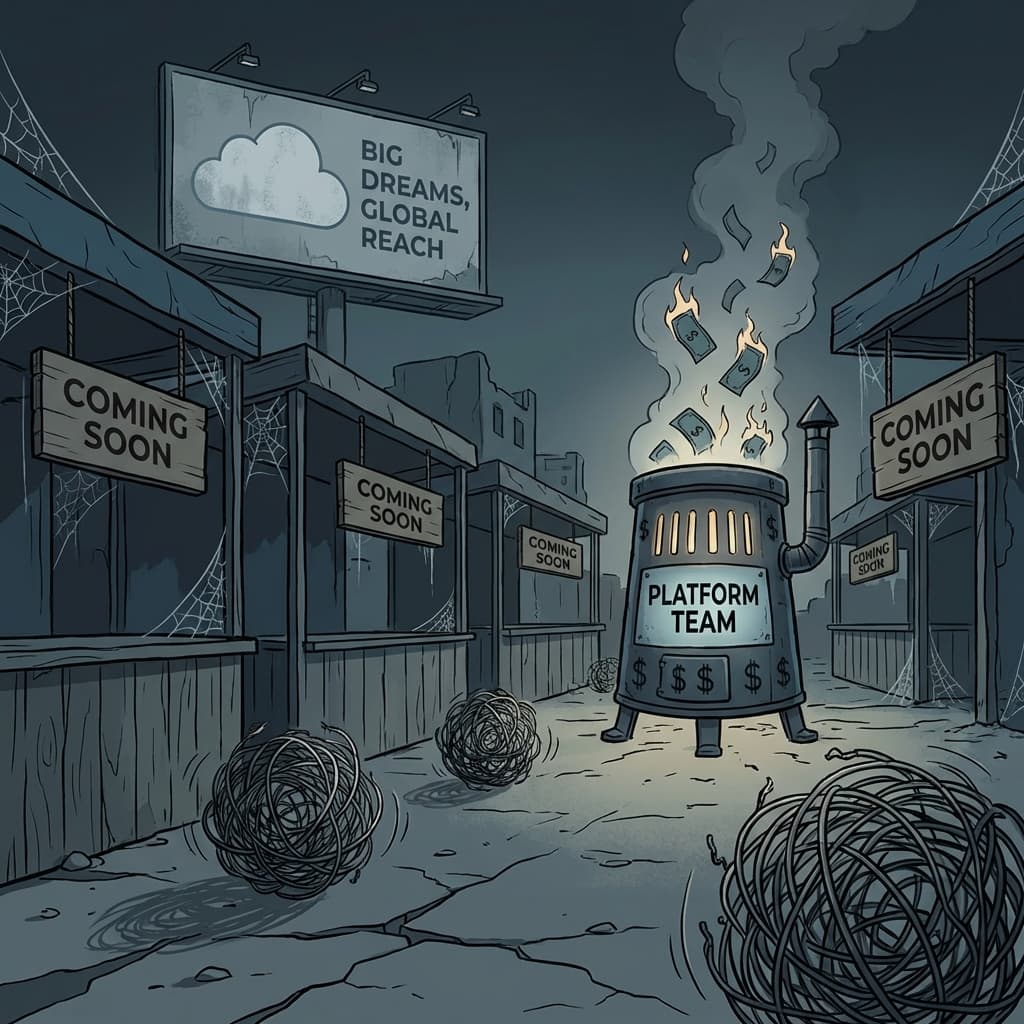
"Be the platform, not just the product!" Every startup advisor said it. Build APIs. Create an ecosystem. Let developers extend you. That's where the real value is. Look at Salesforce. Look at Shopify. Look at Slack.
We believed. We built:
- Public APIs (REST and GraphQL)
- SDKs in 5 languages
- A developer portal with docs
- A marketplace for integrations
- A partner program with certifications
Three years later, we shut it all down.
The Numbers
| Metric | Year 1 | Year 2 | Year 3 |
|---|---|---|---|
| Active integrations | 12 | 28 | 40 |
| Marketplace revenue | $8K | $25K | $50K |
| Platform team cost | $400K | $800K | $1.2M |
| Support cost (platform-related) | $200K | $500K | $800K |
| Net platform ROI | -$592K | -$1.275M | -$1.95M |
We spent $2M/year on a platform that generated $50K. The math never worked.
Why Platforms Fail at Our Scale
We weren't big enough. Salesforce can sustain a platform because they have 150,000 customers. Third-party developers build for Salesforce because the market is huge. We had 2,000 customers. The market for "tools that integrate with us" was tiny.
Most integrations were custom. 35 of our 40 integrations were built by consulting partners for specific customers. Not reusable products—bespoke implementations. We got the support burden, they got the services revenue.
API maintenance is expensive. Every API is a promise. Breaking changes break customers. We spent engineering cycles maintaining backward compatibility for APIs that 3 people used.
Developer relations is a full-time job. Docs. Tutorials. Discord server. Office hours. Conference talks. Sample apps. All to attract developers who weren't coming anyway.
The Survivors Aren't Proof
"But Shopify did it!" Shopify has 2 million merchants. They had platform-market fit before they built the platform.
"But Slack did it!" Slack had 8 million daily active users before apps mattered.
Platforms work when you're already dominant. They don't make you dominant. Putting the platform before the dominance is cargo culting—doing what successful companies do without having their preconditions.
What We Do Now
First-party integrations for top 10 tools. We build Salesforce, HubSpot, Slack, Jira integrations ourselves. No API. No SDK. We control the experience.
Zapier instead of custom APIs. For everything else, customers use Zapier or Make. They handle the integration complexity. We exposed hooks. Done.
No marketplace. Customers who need custom integrations hire consultants directly. We provide documentation and examples, not infrastructure.
The Lesson
Platforms are multipliers. 10x of something small is still small. You need substantial network effects before a platform makes sense.
For most B2B SaaS companies, the right strategy is:
- Build a great core product
- Integrate with major tools directly
- Use Zapier for the long tail
- Maybe consider a platform when you have 50,000+ active users
Everything else is expensive theater.
Platforms are for market leaders, not market entrants. Make sure you're leading before you platform.
Written by XQA Team
Our team of experts delivers insights on technology, business, and design. We are dedicated to helping you build better products and scale your business.