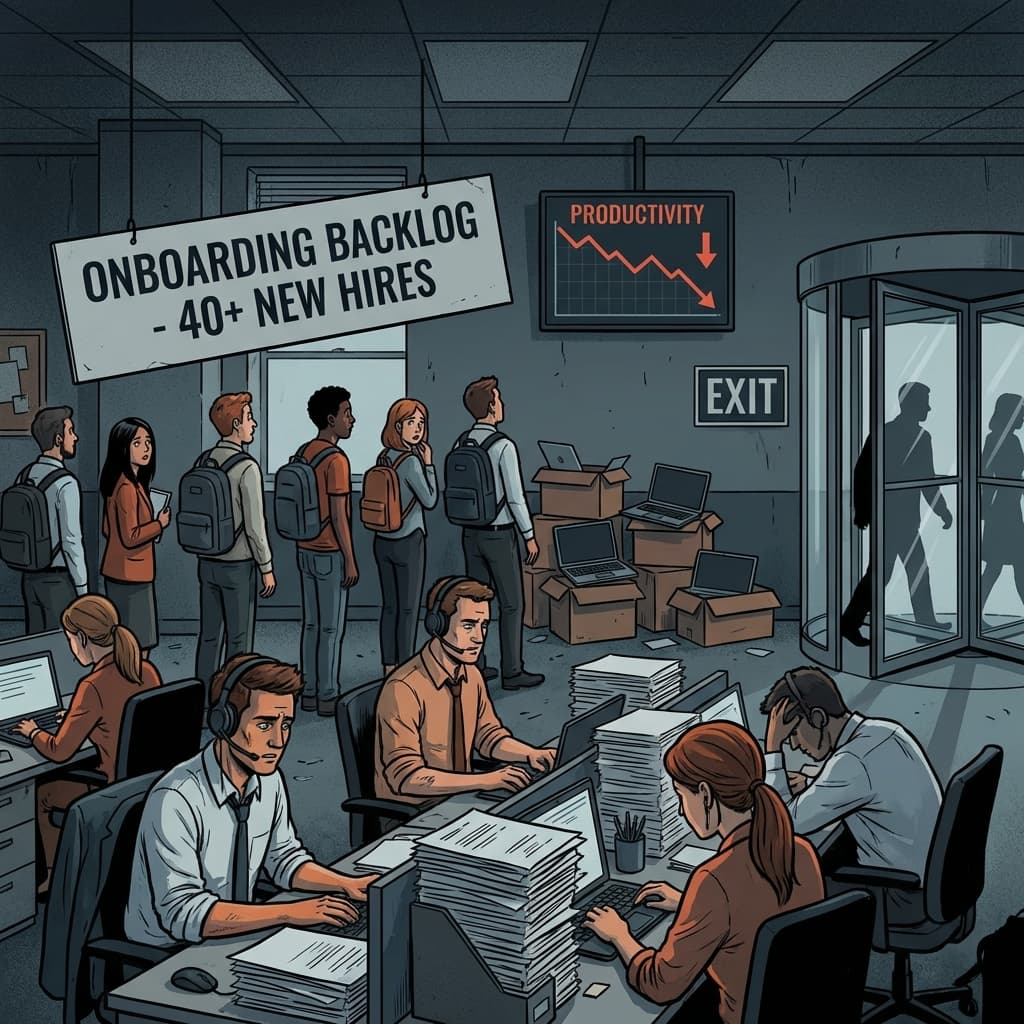
"We need to hire 40 engineers in Q1." The mandate came from the board meeting. We'd raised money. We had ambitious goals. We needed to scale the team fast. Standard startup playbook.
We hired 40 engineers in Q1. By the end of the year, 18 of them had left, productivity had cratered, and the survivors were burnt out. The hiring sprint that was supposed to accelerate our growth set us back an entire year.
This is the story of bulk hiring, why it backfires, and what we do instead. Sustainable hiring beats heroic sprints, every time.
The Mandate
Context: We were a 60-person company that had just raised a Series B. The board wanted to see investment deployed quickly. Bigger team = faster execution = higher valuation at the next round. Standard venture logic.
The hiring mandate was aggressive:
- Q1 target: 40 engineers (from 35 to 75)
- Timeline: 12 weeks
- Method: All hands on deck. Every engineer interviewing. Multiple recruiters engaged. Referral bonuses tripled.
We treated it like a company-wide project. Daily standups on recruiting pipeline. Weekly reviews with the exec team. Headcount became the primary metric everyone optimized for.
We hit the target. 40 engineers hired by end of Q1. We celebrated. The real problems were just beginning.
What Happened Next
Onboarding Collapsed
Our onboarding process was designed for 2-3 new engineers per month. When 40 people started in a 12-week window—some weeks had 8 people starting simultaneously—the system broke down.
There weren't enough laptops. IT ordered bulk, but supply chain delays meant some new hires waited two weeks for machines. They sat in meetings, unable to code, feeling useless.
There weren't enough onboarding buddies. Each new hire was supposed to have an experienced engineer as their guide. When you're doubling the engineering team, where do the buddies come from? We assigned people 3-4 buddies each. The buddies became bottlenecked, frustrated, and ineffective.
There weren't enough small projects. New hires need starter tasks—meaningful work that isn't on the critical path. We ran out of starter tasks by week 3. New hires were thrown into complex projects without context, struggling while trying not to break things.
Documentation was stale. When you're hiring 2-3 people per month, experienced engineers can hand-hold through the gaps. When you're hiring 8-10 per week, documentation becomes critical—and ours was out of date, incomplete, and contradictory.
Existing Team Productivity Cratered
We measured engineer productivity through output metrics (PRs, tickets closed, features shipped). Here's what happened during and after the hiring sprint:
| Period | Avg PRs/Engineer/Week | Team Velocity (Story Points) |
|---|---|---|
| Pre-sprint (Q4 prior year) | 4.2 | 180 |
| During sprint (Q1) | 2.1 | 95 |
| Post-sprint (Q2) | 2.8 | 130 |
| Recovery (Q3) | 3.5 | 165 |
| Stabilized (Q4) | 3.8 | 210 |
During the sprint, existing team productivity dropped 50%. Why? Because everyone with knowledge was spending their time interviewing, onboarding, code reviewing, and answering questions instead of shipping code.
The recovery took three quarters. We didn't return to pre-sprint productivity per-engineer until Q4—nine months after the sprint. We nearly doubled the team to move slower.
Quality Dropped
New hires make mistakes. That's normal and expected. When you have 40 new hires simultaneously, the mistakes compound.
Production incidents in Q2 (first full quarter with new hires shipping): 3x the previous baseline. Root causes were almost always new engineers who didn't yet understand the system, combined with overtaxed reviewers who didn't catch issues in code review.
Technical debt accumulated rapidly. New hires, eager to contribute, made architecture decisions based on incomplete understanding. They copied patterns from the existing codebase without understanding the context. They added libraries we already had equivalents of. The codebase became cluttered and inconsistent.
We spent most of Q3 cleaning up Q2's mess. That's not growth—that's treading water.
The Churn Bomb
By the end of the year, 18 of the 40 engineers we'd hired in Q1 had left. 45% attrition in under a year.
Exit interview themes:
- "I never felt onboarded properly." They'd been thrown in without adequate support and never recovered.
- "It was chaotic and nobody seemed to know what was going on." The sprint hiring had created confusion that persisted for months.
- "I didn't feel like I was making an impact." With too many people and too few meaningful projects, people felt lost.
- "The culture changed and I didn't like the new version." Rapid growth changes culture whether you want it to or not.
- "Better opportunity." The chaos made people receptive to recruiters.
Hiring 40 people and losing 18 within a year meant we'd net added 22—at enormous cost. Each of those 18 departures cost onboarding, disruption, knowledge loss, and recruiting for their replacement.
The Math Nobody Did
Let's calculate the actual cost of the hiring sprint:
Direct recruiting costs:
- External recruiters at $25K/hire average: $500K
- Referral bonuses (tripled): $120K
- Job postings, tools, events: $80K
- Subtotal: $700K
Interview time cost:
- 40 hires at ~20 engineer-hours per hire: 800 hours
- At $100/hour fully-loaded: $80K
Onboarding burden:
- Buddy time: 40 people × 40 hours average: 1,600 hours
- At $100/hour: $160K
Productivity loss:
- Existing team at 50% productivity for Q1: 17.5 engineer-weeks × 35 engineers × $3K/week: $1.8M
- Reduced productivity Q2-Q3: Harder to calculate but easily another $1M+
Churn costs:
- 18 departures × $50K replacement cost each: $900K
- Plus lost productivity, knowledge drain, team disruption: incalculable
Estimated total cost of hiring sprint: $4.5M+
For context, we paid those 40 engineers approximately $6M in salary that year. We spent nearly that much again on the dysfunction of hiring them all at once.
What We Do Now: Continuous Hiring
We replaced sprints with continuous, sustainable hiring. The principles:
Constant Pace
We hire 3-4 engineers per month, every month, regardless of headcount goals. This is the maximum pace our organization can absorb without degrading team productivity or culture.
If the board wants 40 hires, they get 40 hires over 12 months, not 12 weeks. If they don't like that, they can visit engineering during a sprint and watch productivity crater.
Constant pace means:
- Onboarding buddies are never overloaded
- There are always small projects for new hires
- Interviewers can maintain their regular work
- Cultural integration happens naturally
- Mistakes from new hires are caught and corrected individually, not en masse
Never-Empty Pipeline
Instead of sprint recruiting when we need people, we recruit continuously. The pipeline is always active. When we're not actively hiring, we're sourcing and building relationships. When a role opens, we have warm candidates already.
This means we can move quickly for individual hires without sprinting. Great candidate appears unexpectedly? We can hire them immediately because the infrastructure is always running.
Onboarding Investment
We invested heavily in onboarding when we weren't in crisis mode:
- Documentation overhauled and kept current by rotating ownership
- Starter project backlog maintained explicitly—always 3-4 ready
- Onboarding buddy training program with explicit time allocation
- 30/60/90 day check-ins with structured feedback
Good onboarding means new hires reach full productivity in 3 months instead of 6. That compounds—every hire is twice as valuable, earlier.
Absorption Metrics
We track whether the organization is absorbing new hires well:
- Time to first PR: Target is first week. If it's stretching to week 2-3, onboarding is overloaded.
- New hire satisfaction at 30 days: Simple survey. If scores drop, slow down hiring.
- Buddy workload: No buddy should have more than one new hire at a time.
- Team velocity during onboarding: If velocity is dropping with hires, we're hiring too fast.
These metrics create natural governors. We can't sprint even if we wanted to because the metrics would immediately flash red.
When Sprints Seem Necessary
Sometimes external pressure demands fast team growth. A huge contract that requires immediate expansion. A competitive threat that needs rapid response. Board pressure to deploy capital.
Our answer: negotiate differently.
For contracts: Negotiate timelines that match realistic hiring. If a customer needs 6 months, propose 9 months. Underpromise on timeline so you can deliver quality.
For competition: Fast-but-broken teams don't beat competitors. Focused, productive teams do. Hiring 40 people who are ineffective for 6 months is worse than hiring 20 people who are effective in 3 months.
For boards: Present the math. Show them the cost analysis of sprint hiring versus sustainable hiring. Most boards, when presented with data, will accept the slower pace. They want returns, not chaos.
If none of these work and you must sprint, go in with eyes open. Know that you'll pay the productivity tax. Know that churn will be elevated. Know that recovery will take 6-12 months. Factor those costs into the decision.
The Counterintuitive Truth
Hiring slowly is faster. A team of 50 productive engineers outperforms a team of 75 unproductive engineers. The payroll is lower. The coordination cost is lower. The momentum is sustainable.
We're now 100 engineers. We got here over 18 months of continuous hiring, not a hiring sprint. Every one of those hires was properly onboarded. Our churn is 10% annually—healthy for the industry. Our productivity per engineer is above pre-sprint levels.
We could have sprinted to 100 in 6 months. Based on our Q1 experience, we'd be at 70 effective engineers today, with another sprint needed to recover. Instead, we have 100 effective engineers who trust each other, know the codebase, and ship reliably.
The tortoise beats the hare. In hiring, always.
Hiring sprints feel aggressive and ambitious. They're actually expensive and destructive. Hire at the pace your organization can absorb—no faster. Sustainable is faster than sprint.
Written by XQA Team
Our team of experts delivers insights on technology, business, and design. We are dedicated to helping you build better products and scale your business.