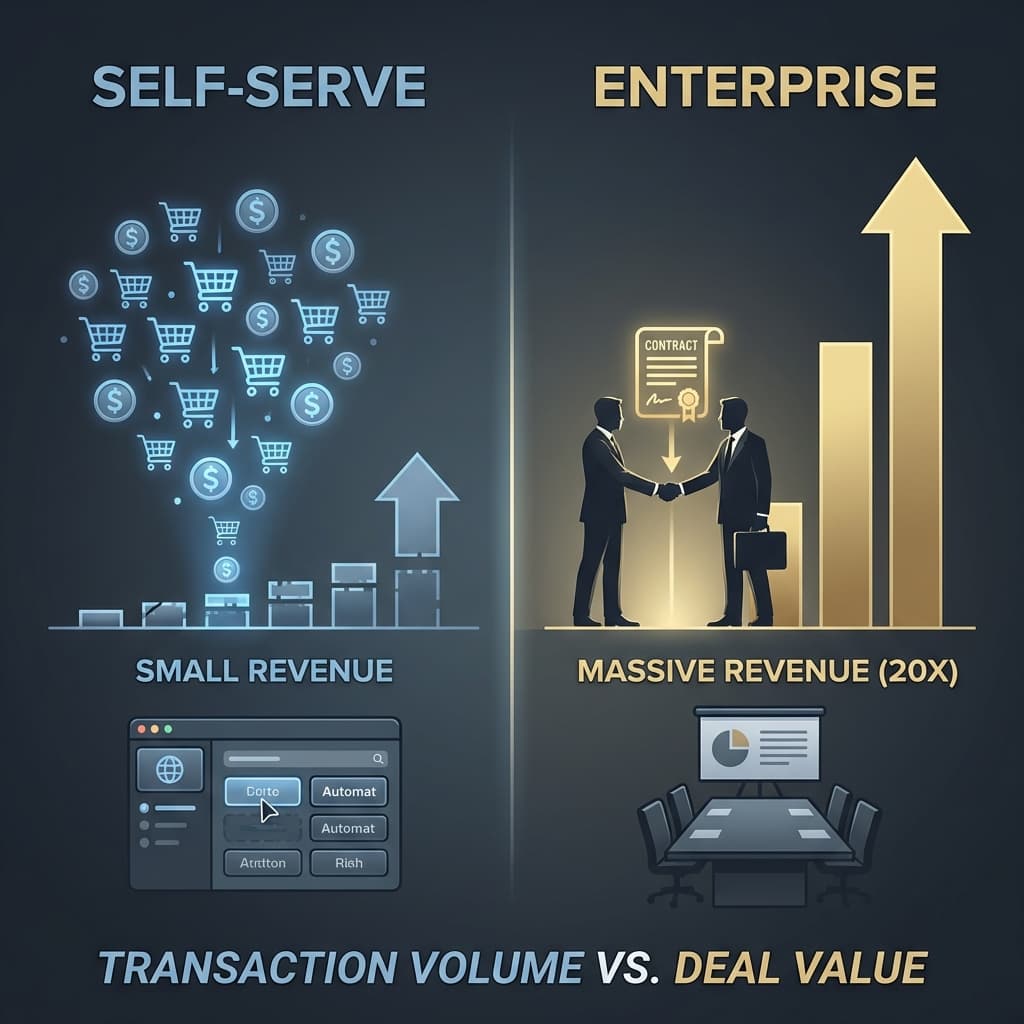
Product-led growth was the dream. No sales team. Customers find you, sign up, upgrade themselves. Low CAC. High margins. The SaaS holy grail.
We built it. Beautiful self-serve flow. Credit card checkout. Usage-based plans. Automatic upgrades.
Then we looked at the numbers.
The Self-Serve Reality
| Metric | Self-Serve |
|---|---|
| Monthly signups | 800 |
| Conversion to paid | 3% |
| New customers/month | 24 |
| Average contract value | $200/month |
| Annual value | $2,400 |
| New ARR/month | $57,600 |
| Churn (annual) | 40% |
40% annual churn. Small customers, low commitment, high churn. We were on a treadmill.
The Experiment
We hired one salesperson. Just to see. She focused on larger companies who signed up but didn't convert self-serve.
| Metric | Sales-Assisted |
|---|---|
| Leads worked/month | 40 |
| Demos scheduled | 25 |
| Proposals sent | 12 |
| Closed deals | 4 |
| Average contract value | $4,000/month |
| Annual value | $48,000 |
| New ARR/month | $192,000 |
| Churn (annual) | 15% |
One salesperson. 3x the ARR of the entire self-serve funnel. 1/3 the churn.
Why Enterprise Wins
Decision-makers need hand-holding: Self-serve assumes the user has authority to buy. Enterprise buyers don't work that way. Procurement, security, legal—all need human interaction.
Complex use cases need customization: Self-serve offers one size. Enterprise wants configuration, integration support, implementation help. They'll pay for it.
Higher ACVs mean higher tolerance: A $48K customer expects calls, support, and account management. That's fine—the margin covers it easily.
Lower churn compounds: 15% churn vs 40% churn is the difference between building value and running in place.
The Pivot
We didn't kill self-serve entirely. We repositioned it:
- Self-serve = lead generation: Small teams sign up, use the product, become internal champions.
- Sales = expansion: When usage grows, sales reaches out to convert to enterprise.
- Pricing = self-serve is starter only: Any serious usage requires talking to sales.
Today's Numbers
| Channel | ARR | % of Total |
|---|---|---|
| Self-serve (unchanged) | $600K | 8% |
| SMB sales | $2.1M | 28% |
| Enterprise sales | $4.8M | 64% |
Enterprise is 64% of revenue. Self-serve is lead gen and long-tail. The business model flipped.
When Self-Serve Works
- Consumer products (huge volume, low ACV is fine)
- Developer tools (users are buyers, no procurement)
- Low-stakes purchases (under ~$5K/year)
- Products with no implementation complexity
For B2B with $10K+ potential ACV? Sales almost always wins.
Self-serve feels efficient because there's no sales cost. It's often inefficient because there's no sales revenue either.
Written by XQA Team
Our team of experts delivers insights on technology, business, and design. We are dedicated to helping you build better products and scale your business.