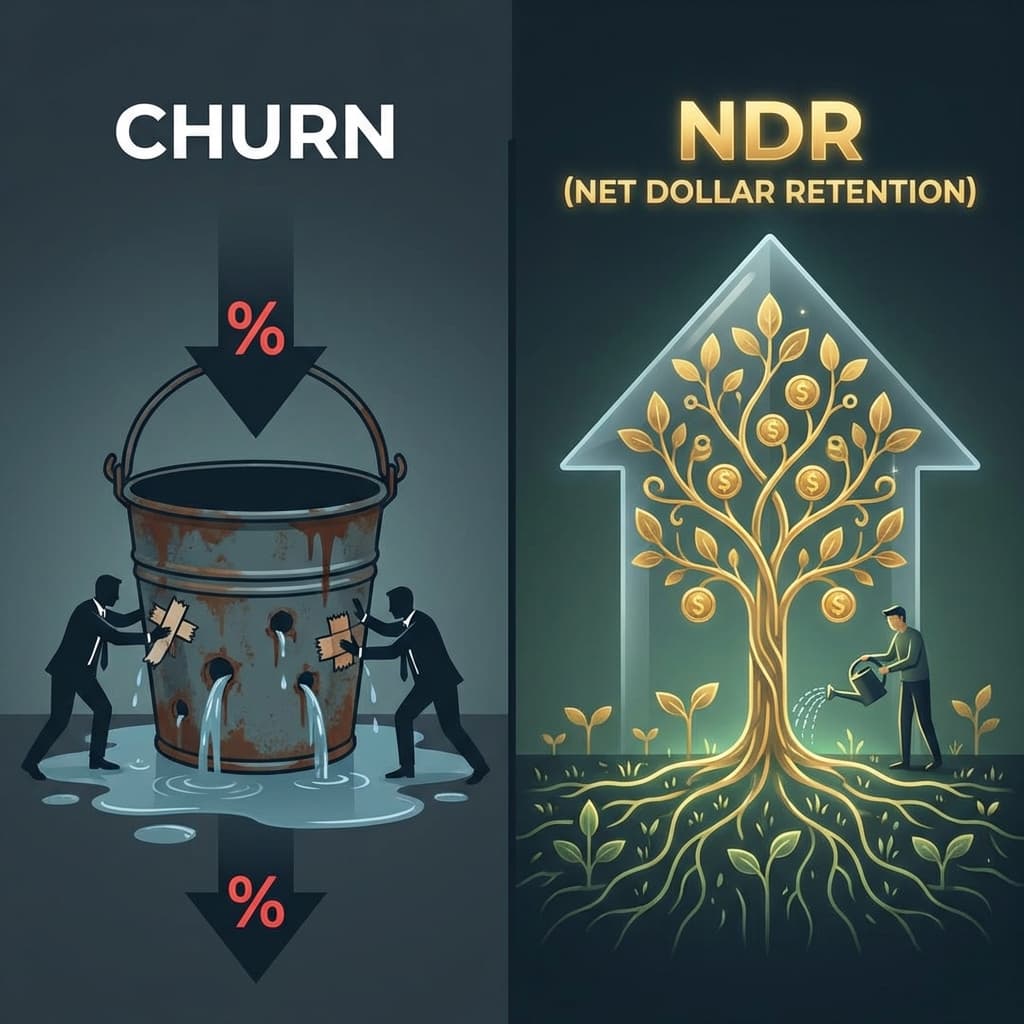
Every SaaS board meeting starts with the "Churn Slide." Copious charts showing logo retention, gross revenue retention, and cancellation reasons. "Why did Customer X leave?" "Why did Customer Y downgrade?" It creates a culture of defense. You build features to save the customers who are already halfway out the door.
We realized this was a losing game. We were optimizing our company for our worst customers. We stopped reporting Churn as a top-line metric. We replaced it with Net Dollar Retention (NDR). The shift in mindset was profound. We stopped building "save mechanics" and started building "growth engines."
The Trap of the "Leaky Bucket" Metaphor
The standard SaaS wisdom says: "You can't fill a bucket that has a hole in the bottom." So you panic about the hole. You hire "Churn Busters" in Customer Success. You offer deep discounts to people who threaten to cancel.
But this metaphor ignores a crucial reality of SaaS: Not all water in the bucket is equal. Some water expands.
If you lose 10% of your customers (the small, annoying ones) but your remaining customers expand their spend by 30%, your bucket is overflowing despite the leak. This is the magic of Net Dollar Retention.
The Math: Churn vs. NDR
Let's look at two hypothetical scenarios to understand why NDR is the superior metric.
Company A (Churn Focused):
Starts with $10M ARR.
Obsesses over saving every customer. Churn is low (5%).
Upsell is low because CS is busy reacting to complaints. Expansion is 5%.
Ending ARR from existing base: $10M (flat).
Company B (NDR Focused):
Starts with $10M ARR.
Accepts that bad fits will leave. Churn is higher (15%).
Focuses heavily on making successful customers grow. Expansion is 40%.
Ending ARR from existing base: $12.5M (+25% growth without new sales).
Company B is a rocket ship. Company A is a treadmill. We wanted to be Company B.
The "Bad Fit" Customer
When you analyze your churn, you often find that the customers leaving are the ones who should never have bought in the first place. They are too small, or they wanted a feature you don't really do well, or they needed bespoke consulting.
Keeping these customers is actually expensive. They create noise in your product roadmap. "Can you add this specific export button?" avoiding churn often means building a "Frankenstein product" of disparate features requested by disparate dying customers.
By accepting they would churn, we liberated our Product team. "We aren't building for them. We are building for the Power User who wants to go from 10 seats to 100 seats."
The Strategic Shift: "Land and Expand"
Moving to NDR changed how we sold.
1. Pricing Model Changes: We moved away from flat-rate "Enterprise Licenses" to usage-based or seat-based models that had uncapped upside. If the customer succeeded, we succeeded. We wanted friction-free expansion.
2. Customer Success Compensation: We stopped paying CS reps on renewal rate. We paid them on Net Retention. If a CS rep managed a book of $1M, and at the end of the year it was $1.2M, they got a massive bonus—even if they lost 3 logos along the way.
This incentivized them to spend their time with the winners. They stopped being tech support and started being strategic advisors. "Hey, I see you're using module A, did you know module B could help you automate that other workflow?"
The Product Roadmap Alignment
Product decisions became clearer.
Old Question: "What feature do we need to build to stop Customer X from cancelling?"
New Question: "What feature do we need to build to enable Customer Y to double their usage?"
Answers to the second question tend to make the product better for everyone. Answers to the first question tend to make the product more cluttered and complex. We started building "Enterprise Grade" features—SSO, granular permissions, advanced analytics, API access. These are the things that allow a deployment to go viral inside a large company.
The Signal in the Noise
NDR is the ultimate truth teller about product-market fit.
If your NDR is 90%, your product is a leaky bucket. You don't have product-market fit yet. You are renting customers, not acquiring them.
If your NDR is 120%+, you have a growth engine. Even if your sales team takes a month off, the company grows. This is how companies like Snowflake and Datadog achieved massive valuations—their NDRs were consistently 140%+.
We realized that high churn is often a symptom of bad sales targeting, not a bad product. By focusing on NDR, we tightened our Ideal Customer Profile (ICP). Marketing stopped bringing in "anyone with a credit card" and started targeting "companies that look like our high-expansion customers."
Conclusion
Churn is a metric of fear. It measures what you lost. NDR is a metric of value. It measures what you built.
By obsessing over NDR, we realigned the entire company around success. We stopped trying to be everything to everyone and committed to being the perfect solution for the customers who were growing.
If you find yourself in a meeting debating how to save a $500/month customer who hates your product, stop. Let them go. Call your happy $5,000/month customer and ask, "How can we help you spend $10,000?" That is the path to victory.
Written by XQA Team
Our team of experts delivers insights on technology, business, and design. We are dedicated to helping you build better products and scale your business.