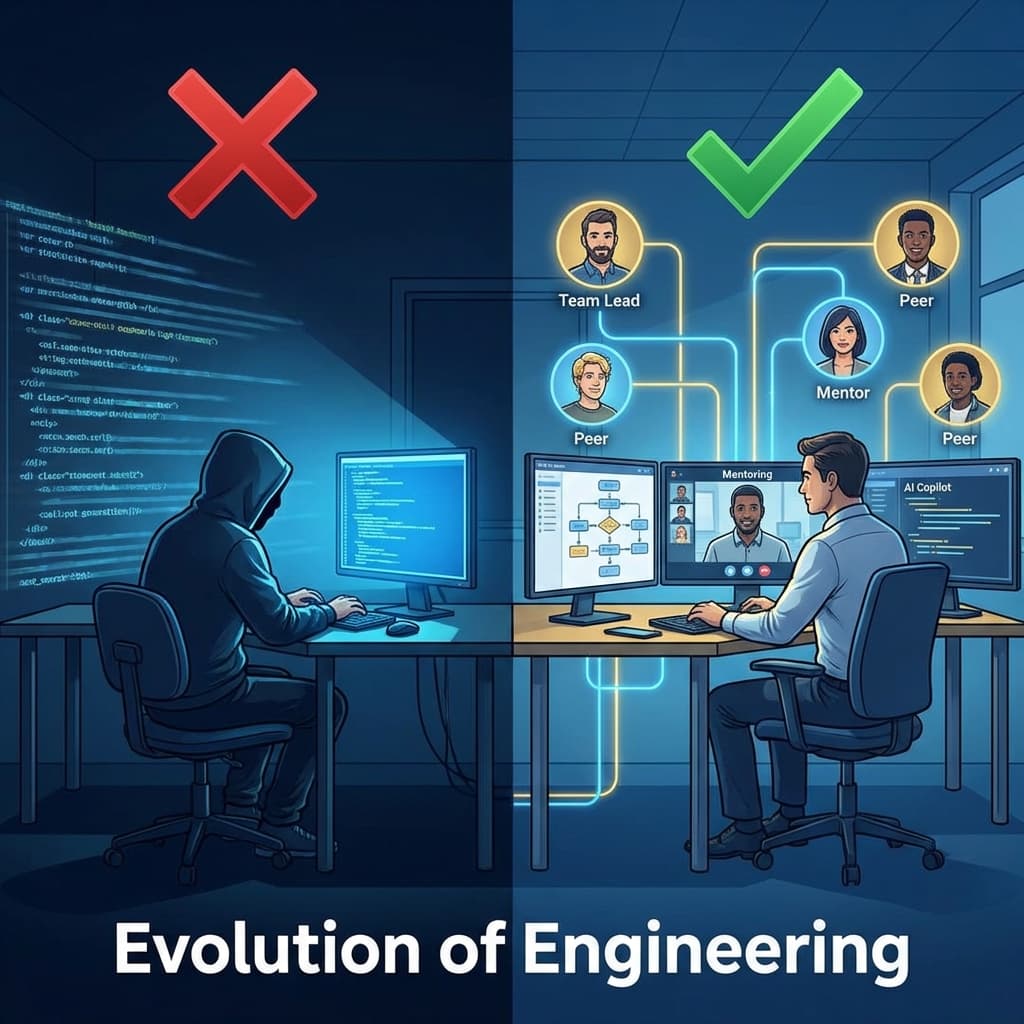
The Hiring Decision That Changed My Perspective
Two years ago, I was hiring for a senior engineer position. We had two finalists.
Candidate A was a legend. He had worked at two FAANG companies. His GitHub had 15,000 stars. He finished our 4-hour coding challenge in 47 minutes, with a solution so elegant it made our staff engineer jealous. "This guy is a 10x engineer," my co-founder said, practically salivating.
Candidate B was... quieter. Mid-tier companies on his resume. A modest GitHub. He took the full 4 hours on the coding challenge, and his solution was merely correct—not brilliant. But he did something Candidate A didn't: he wrote tests. He added comments. He created a README explaining his approach. He even documented a bug he found in our challenge instructions.
My co-founder wanted to hire Candidate A. I pushed for Candidate B. We had a heated debate.
I won. We hired Candidate B.
Six months later, Candidate B had shipped three major features, mentored two junior engineers, and created a documentation culture that reduced onboarding time by 60%. He wasn't fast. But everything he touched became better for everyone else.
Meanwhile, I later heard from a friend that Candidate A had joined another startup. He shipped a lot of code—alone—and then quit after 4 months, leaving behind a codebase that only he understood. It took two engineers three months to unravel his "elegant" architecture.
That's when I stopped believing in the 10x engineer. That's when I started believing in something else: the leveraged engineer.
Section 1: The Myth of the 10x Engineer—Where It Came From
Let's start by understanding where the "10x" meme originated. It's become so embedded in tech culture that people treat it as fact. But like most "facts" in our industry, it's more complicated than the headline suggests.
The 1968 Study That Started It All
The origin of the "10x" claim traces back to a 1968 study by Sackman, Erikson, and Grant, published in the Communications of the ACM. Researchers measured how long it took different programmers to complete various tasks. They found variation of roughly 10:1 between the fastest and slowest performers.
Notice what the study actually measured: speed. Not value. Not maintainability. Not business impact. Just raw time to completion.
And yet, over 50 years, this finding has been transmuted into something much grander: the myth that certain engineers deliver 10x the business value of their peers. That's a much bigger claim—and it's not what the research showed.
What "10x" Actually Means in Practice
When companies talk about "10x engineers," they usually mean one of the following:
- Speed: They write code faster than others.
- Volume: They produce more lines of code, more PRs, more tickets closed.
- Brilliance: They solve problems others can't.
All of these are real attributes. Some engineers are faster, more prolific, and smarter than others. I'm not denying that variation exists.
But here's the problem: none of these attributes directly measure value delivered to the business. And when you optimize for speed, volume, or individual brilliance, you often create negative externalities that destroy value elsewhere.
The Hidden Costs of "10x" Culture
Let me describe what I've seen in organizations that worship 10x engineers:
- Knowledge Silos: The 10x engineer understands the system. No one else does. When they leave, months of work are lost.
- Hero Culture: The team waits for the hero to solve hard problems. Everyone else atrophies. Junior engineers never level up.
- Burnout: The 10x engineer works 80-hour weeks to maintain their reputation. They eventually flame out or leave.
- Technical Debt: Fast code is often messy code. The 10x engineer is on to the next feature before cleaning up the last one.
- Team Dysfunction: The 10x engineer's ego creates friction. Collaboration suffers. Good people quit.
I've seen teams where removing the "10x engineer" actually increased overall productivity. The hero was a single point of failure, and their presence was suppressing everyone else's contributions.
Section 2: Why "Leverage" is the New Metric
If raw speed isn't the right metric, what is? I propose we measure leverage.
Leverage = Output / Input
An engineer with high leverage produces more output for less input—or produces output that enables others to be more productive.
A 1x engineer with 10x leverage delivers the same total value as a 10x engineer with 1x leverage. But the leveraged engineer does it sustainably, repeatably, and without burning out or creating silos.
Sources of Leverage in 2026
What creates leverage for an engineer today? The sources have evolved dramatically:
- AI Copilots: Using Cursor, Copilot, or Claude to write code 3x faster.
- No-Code/Low-Code: Using Retool, Zapier, or Airtable to build internal tools in hours instead of weeks.
- Templates and Boilerplates: Maintaining a library of reusable starting points.
- Automation: Writing scripts that eliminate repetitive tasks for the whole team.
- Documentation: Creating artifacts that reduce questions and onboarding time.
- Delegation to Agents: Deploying AI agents to handle routine work (code review, test generation, monitoring).
- Mentorship: Making junior engineers more productive.
Notice that several of these sources of leverage don't involve writing code at all. They involve creating systems, processes, and knowledge that amplify the entire team's output.
The Leverage Stack: A Day in the Life
Let me describe a day in the life of a "1x engineer with 10x leverage." This is a composite based on real people I know.
9:00 AM: Review AI-generated code from the night before. A Claude agent has drafted 3 pull requests based on tickets in Linear. The engineer reviews, adjusts, and merges. Time: 45 minutes. Output: 3 features shipped. Old way: 2 days of coding.
10:00 AM: Write a design document for a new system. This is not code—it's prose. It explains the architecture, trade-offs, and decision rationale. It will prevent 20 questions and 3 wrong implementations down the line.
11:30 AM: Pair programming session with a junior engineer. The junior is stuck on a tricky bug. The leveraged engineer doesn't solve it themselves; they ask questions, point to documentation, and guide the junior to the solution. Leverage: the junior is now 10% better and will face this problem again without help.
1:00 PM: Lunch. (Leveraged engineers protect their recovery time. Burnout destroys leverage.)
2:00 PM: Build an internal tool using Retool. A sales team has been manually copying data between systems. 3 hours of work eliminates 2 hours of manual labor per day for a 5-person team. ROI: infinite.
5:00 PM: Update the engineering wiki with lessons learned from a recent production incident. This will prevent the next engineer from making the same mistake.
In this day, the leveraged engineer wrote maybe 100 lines of code. But they shipped 3 features, unblocked 1 junior, saved 10 hours/week for another team, and prevented future production issues.
That's leverage. That's value.
Section 3: Case Study—The Team That Fired Its "Rockstar" and Thrived
Let me tell you about a team I worked with at a previous company. I'll change the names, but the story is real.
The team had Marcus. Marcus was, by every traditional measure, a 10x engineer. He had been there for 3 years. He was the fastest coder on the team. He closed twice as many tickets as anyone else. He had opinions—strong ones—about every technical decision.
Marcus was also, to put it politely, difficult. He dismissed code reviews as "bureaucracy." He rarely wrote documentation ("the code is the documentation"). He worked alone, in marathon sessions, emerging with brilliant but inscrutable solutions. He had a sarcastic streak that made junior engineers afraid to ask questions.
Leadership tolerated this because Marcus was "productive." The team tolerated this because they had no choice.
What Happened When Marcus Left
One day, Marcus got a better offer and resigned. Panic ensued. The VP of Engineering called emergency meetings. How would the team survive without their rockstar?
The first month was rough. Velocity dropped 40%. People were terrified to touch Marcus's code—they didn't understand it. Technical debt that Marcus had been "managing" (i.e., propping up by himself) started collapsing.
But then something interesting happened.
The junior engineers who had been afraid to contribute started contributing. A mid-level engineer took over the codebase and started documenting it. "I finally understand what this thing does," she said after 3 weeks. The team started pair programming—something Marcus had refused to do.
By month 3, velocity was back to pre-Marcus levels. By month 6, it was 20% higher.
Here's what they realized: Marcus wasn't actually 10x. His individual output was high, but he was suppressing everyone else's output. He was a force divider, not a force multiplier. The team was more productive without him.
The Uncomfortable Truth
Sometimes your best performer is your biggest liability.
This is counterintuitive. But consider the metrics that matter at the team level:
- Bus Factor: Marcus = 1. After Marcus: higher. The knowledge is distributed.
- Onboarding Time: With Marcus: 2 months. After Marcus (with documentation): 3 weeks.
- Junior Growth: With Marcus: stalled. After Marcus: accelerated.
- Morale: With Marcus: low-key terrified. After Marcus: collaborative and energized.
Individual output is not team output. Optimizing for the individual can destroy the system.
Section 4: How to Hire (and Be) the Leveraged Engineer
If leverage matters more than speed, how do we change our hiring—and our career development—to optimize for it?
Hiring Signals: Look for Multipliers
In interviews, stop asking "How fast can you solve this puzzle?" Start asking:
- "Tell me about a time you made a team more productive."
- "What's something you automated that helped others?"
- "How do you share knowledge with junior engineers?"
- "Describe a document, guide, or tool you created that the team still uses."
Look for candidates who instinctively think about the system, not just the task.
In coding interviews, pay attention to what happens after the solution is found. Does the candidate clean up their code? Add comments? Write a test? Explain their reasoning clearly? Those behaviors predict leverage.
Red flag: The candidate who finishes in 20 minutes and sits back, smug. They've optimized for the interview metric, not the job.
Career Advice: Stop Trying to Code Faster
If you're an individual contributor reading this, here's my advice: stop trying to be a 10x engineer. Start trying to be a 10x multiplier.
- Automate yourself. Every time you do a task twice, ask: "Can I script this?"
- Document obsessively. Every decision, every architecture, every gotcha. Your future self (and your colleagues) will thank you.
- Teach constantly. Pair with junior engineers. Answer questions thoroughly. Write internal blog posts.
- Build tools, not just features. A CLI that saves the team 5 minutes/day compounds forever.
- Learn no-code. Sometimes the highest-leverage move is not writing code.
- Embrace AI. Use copilots, agents, and generators aggressively. Your job is to direct the AI, not to compete with it.
The goal is to make yourself replaceable—not because you don't matter, but because you've built systems that work without you. That's the highest form of professional contribution.
The Org Chart Implication
If leverage matters, we need to measure it. And if we measure it, we need to reward it.
I believe companies should promote engineers who raise the water level for everyone, not just engineers who produce raw output. This means:
- Including "multiplier behaviors" (documentation, mentorship, tooling) in performance reviews.
- Rewarding engineers who reduce onboarding time, not just engineers who close tickets.
- Valuing engineers who write reusable code, even if it takes longer.
- Penalizing knowledge hoarding, even if the hoarder is "productive."
This is a culture shift. It's not easy. But teams that make this shift outcompete teams that worship the lone wolf.
Closing Thought
The 10x engineer is a lone wolf. They are fast, brilliant, and alone.
The leveraged engineer is a force multiplier. They are deliberate, systematic, and collaborative.
In a world of AI copilots, automation, and remote teams, the lone wolf is increasingly obsolete. The future belongs to engineers who can orchestrate systems—human and machine—to produce value at scale.
I don't want to hire the person who can code 10x faster. I want to hire the person who can make the entire team 2x better. That's a much bigger multiplier.
The 10x engineer is dead. Long live the 1x engineer with 10x leverage.
Appendix: A Self-Assessment for Leverage
Rate yourself 1-5 on each dimension. A leveraged engineer scores 4+ on most of these.
- Documentation: I document my work thoroughly and update docs proactively.
- Automation: I automate repetitive tasks for myself and the team.
- Mentorship: I actively help junior engineers grow.
- Reusability: I write code and tools that others can use.
- AI Adoption: I use AI tools extensively to amplify my output.
- Knowledge Sharing: I regularly share learnings with the team (standups, write-ups, talks).
- Bus Factor: If I left tomorrow, the team would be fine.
If you scored low on any of these, that's your growth area. Leverage is a learnable skill.
Written by XQA Team
Our team of experts delivers insights on technology, business, and design. We are dedicated to helping you build better products and scale your business.