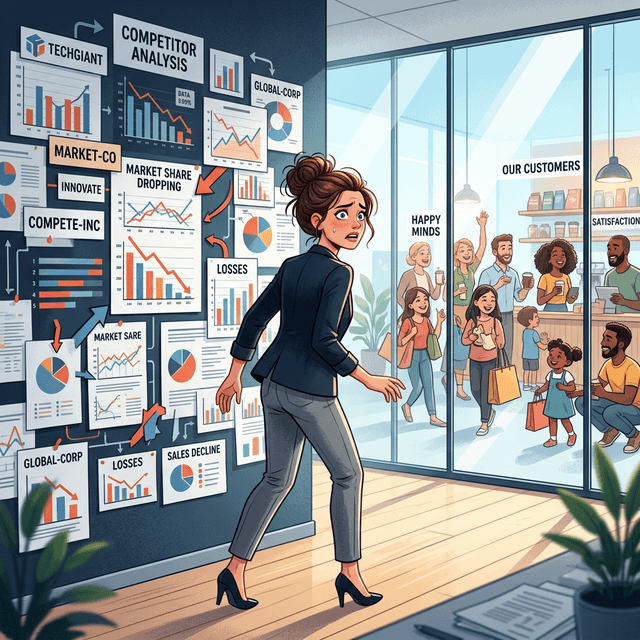
Every Monday morning, our product team reviewed a competitive intelligence dashboard. It tracked 12 competitors across 47 feature dimensions. It logged their pricing changes, blog posts, press releases, and social media activity. A dedicated analyst maintained it.
We were spending 20 hours per month across product, marketing, and leadership analyzing what our competitors were doing. And it was making us worse.
Not better. Worse.
Here is what competitor analysis actually does to your company: it makes you reactive instead of innovative, derivative instead of original, and anxious instead of confident. We stopped all of it and focused exclusively on our customers. Revenue grew 40% in the following year.
The Reactive Trap
When you watch competitors closely, every move they make triggers a response.
Competitor launches a new feature? "We need to build that." Competitor drops their price? "We need to match it." Competitor gets press coverage? "We need a PR push." Competitor raises a funding round? "We need to raise too."
This is reactive product development. You are not building what your customers need. You are building what your competitors built. The difference matters.
Example: Our main competitor launched an AI-powered analytics feature with significant marketing fanfare. Our competitive analysis flagged it as a "critical gap." We panicked. We redirected two engineers from our roadmap to build a comparable feature.
Three months later, our AI analytics feature launched. It had 8% adoption. Meanwhile, the two engineers had been pulled from building an integration feature that 60% of our customers had requested. The integration would have driven retention. The AI feature drove nothing.
We built the wrong thing because our competitor told us to, not because our customers told us to.
The Derivative Death Spiral
Competitive analysis makes you derivative. When you define your product in terms of competitor features, you are not creating differentiation. You are creating a copy.
Customers do not want copies. They want products that solve their specific problems in ways that feel intentional and coherent. A product built by feature-matching competitors is a Frankenstein of disconnected features with no unifying vision.
Our roadmap had become a mirror of our competitors' roadmaps. We were building features because they existed elsewhere, not because they solved problems for our users. The product felt scattered. Customers noticed.
"Your product tries to do everything but doesn't do anything great" was an actual customer feedback quote that haunted me for months.
That feedback was a direct consequence of competitive feature-matching. We were so busy keeping up with competitors that we forgot to be excellent at anything.
The Anxiety Machine
Competitive analysis creates institutional anxiety. Every competitor announcement feels like a threat. Every competitor funding round feels like a countdown. The mood in the company oscillates based on what competitors are doing, not based on what your customers are experiencing.
This anxiety is toxic for decision-making. Anxious teams make short-term decisions. They ship features before they are ready because "the competitor already has it." They discount prices because "the competitor is cheaper." They chase trends because "the competitor is doing it."
We had a Slack channel called #competitor-watch. Every post in that channel triggered anxiety. "They just released X!" "They just hired Y!" "They just raised Z!" The implicit message was always: we are falling behind.
We were not falling behind. We were growing. Our customers were happy. Our metrics were improving. But the competitor channel made us feel like we were losing, because it only showed what others were doing, never what we were accomplishing.
What We Did Instead
We deleted the competitive intelligence dashboard. We archived the #competitor-watch Slack channel. We cancelled the analyst's weekly report. We redirected all that time and energy toward customer intelligence.
Customer Advisory Calls: Instead of studying competitors, we scheduled 15 customer calls per month. Not NPS surveys. Not feedback forms. Real conversations where we asked: "What is the most painful part of your workflow right now?"
These conversations surfaced problems we had never considered. Problems our competitors had not solved either, because they were too busy watching each other instead of watching their customers.
Usage-Driven Roadmap: We built our product analytics pipeline to identify the features with the highest engagement and the workflows with the highest drop-off rates. The roadmap became: make popular features better and fix broken workflows.
This is boring. It is not innovative in a press-release way. But it drove retention, expansion, and revenue growth better than any competitor-inspired feature ever did.
Jobs-to-Be-Done Framework: We reframed our product strategy around the jobs our customers were hiring us to do, not the features our competitors had. This shifted the conversation from "Do we have feature X?" to "Does our product help the customer accomplish Y?"
The difference is profound. Feature parity is a race to the bottom. Job completion is a race to the top.
The Results
In the year following our competitive analysis detox:
- Revenue: Grew 40% (up from 22% growth the previous year).
- Net retention: Improved from 108% to 125%.
- Features shipped: Decreased from 24 to 14, but each had significantly higher adoption.
- Customer satisfaction (CSAT): Improved from 72 to 86.
- Employee morale (internal survey): Improved 18 points. Teams reported feeling more focused and less anxious.
We shipped fewer features but better features. We grew faster by doing less. The paradox resolves when you realize that most competitor-inspired features were waste, effort that produced no customer value.
When Competitive Awareness Matters
I am not saying you should be completely ignorant of your market. There are specific situations where competitive awareness is valuable:
- Pricing: You should know the general price range of alternatives so you are not wildly misaligned with market expectations.
- Existential threats: If a competitor is doing something that could make your entire product category obsolete, you should know about it.
- Sales objections: Your sales team needs to know enough about competitors to handle "why should we choose you over X?" questions.
But these are occasional, lightweight activities. They do not require a dedicated dashboard, a weekly report, or a Slack channel. They require a quarterly check-in at most.
The default should be customer obsession, not competitor obsession. Build for the people who pay you, not for the companies that compete with you.
Conclusion
Competitive analysis feels productive. It feels like due diligence, like strategic thinking, like being informed. But it is a trap. It replaces original thinking with reactive thinking. It replaces customer empathy with competitor anxiety. It replaces product vision with feature checklists.
Delete the competitor dashboard. Archive the competitor Slack channel. Call a customer instead. The answers to your product questions are in their workflows, not in your competitor's changelog.
Written by XQA Team
Our team of experts delivers insights on technology, business, and design. We are dedicated to helping you build better products and scale your business.