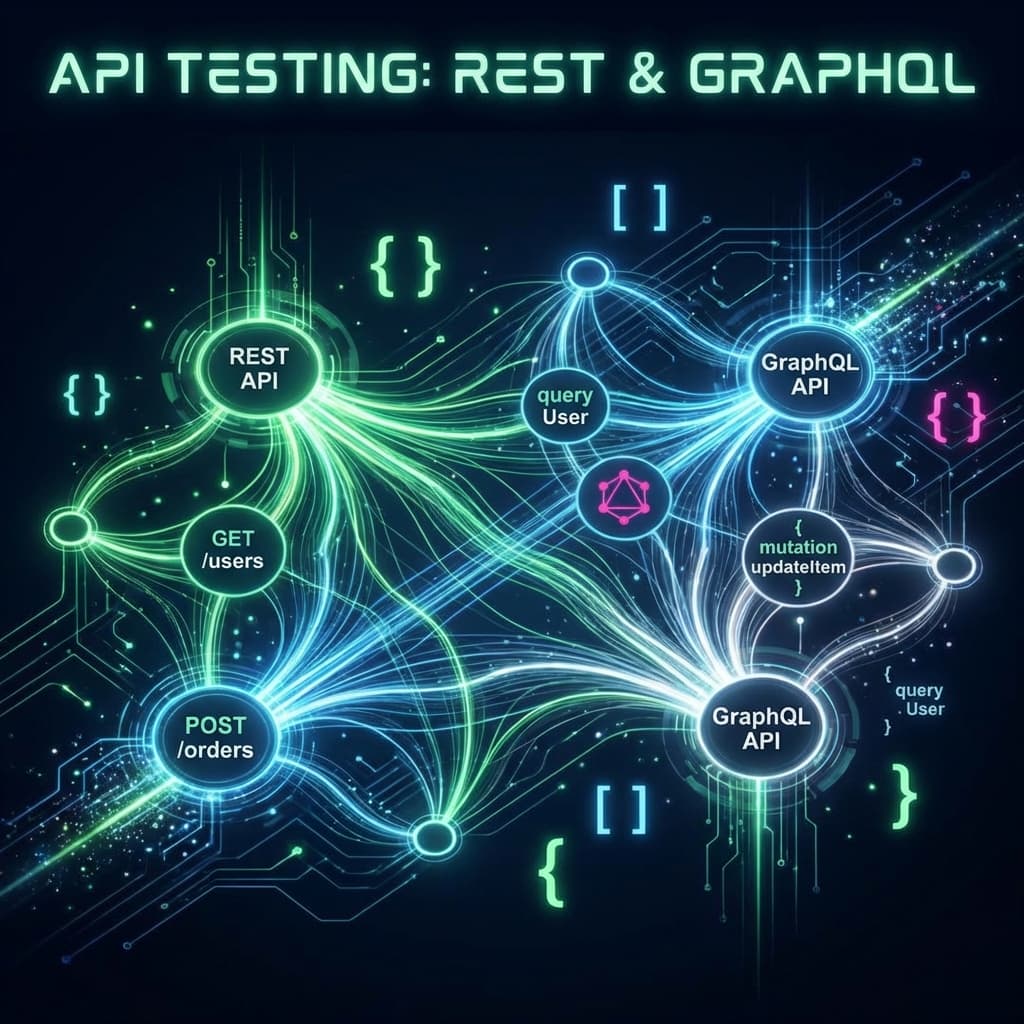
Why API Testing is Non-Negotiable
In the age of microservices, mobile applications, and third-party integrations, APIs are the connective tissue of software. A failure in an API can cascade into user-facing outages, data corruption, or security breaches. Front-end bugs are annoying; API bugs are catastrophic.
Yet API testing is often under-invested. Teams focus on end-to-end UI tests (slow, flaky, expensive) while neglecting the service layer where the real business logic lives. This masterclass provides a comprehensive framework for testing APIs—both REST and GraphQL—covering everything from functional validation to performance and security.
Part 1: REST API Testing Fundamentals
REST (Representational State Transfer) remains the dominant paradigm for web APIs. Testing REST APIs involves validating HTTP methods, status codes, headers, and JSON/XML payloads.
1. Request-Response Validation
The core of REST testing is sending requests and validating responses.
- Status Codes: Verify the correct HTTP status code is returned (200 OK, 201 Created, 400 Bad Request, 404 Not Found, 500 Internal Server Error). A common bug is returning 200 OK even when an error occurred, with the error message buried in the response body.
- Response Body: Use JSON Schema validation to ensure the response structure matches the API contract. This catches missing fields, type mismatches, and unexpected data.
- Headers: Validate important headers like Content-Type, Cache-Control, and custom headers used for versioning or tracing.
2. CRUD Operation Testing
For resource-based APIs, test the full Create-Read-Update-Delete lifecycle.
- POST: Create a resource and verify it is persisted correctly.
- GET: Retrieve the resource and validate the data matches what was created.
- PUT/PATCH: Update the resource and verify the changes are reflected.
- DELETE: Delete the resource and verify subsequent GET requests return 404.
3. Negative Testing
Happy path testing is not enough. Actively try to break the API.
- Invalid Inputs: Send malformed JSON, missing required fields, incorrect data types, strings exceeding length limits.
- Boundary Conditions: Test with empty strings, null values, zero, negative numbers, very large numbers.
- Authorization Failures: Attempt to access resources without authentication, with expired tokens, or with tokens scoped to a different user.
Part 2: GraphQL Testing Strategies
GraphQL presents unique testing challenges. Unlike REST, where endpoints are fixed, GraphQL has a single endpoint that accepts dynamic queries. This flexibility is powerful but introduces complexity.
1. Schema Validation
The GraphQL schema is the source of truth. Use schema linting tools to ensure the schema is well-designed (no deprecated fields without reason, consistent naming conventions).
2. Query Testing
Test that queries return the correct data format. Unlike REST, clients can request exactly the fields they need, so you must test various field combinations.
- Field Selection: Verify that requesting a subset of fields returns only those fields.
- Nested Queries: GraphQL allows deeply nested queries. Test that nested relationships resolve correctly and do not suffer from N+1 query performance issues.
- Aliases and Fragments: Ensure these advanced features work as expected.
3. Mutation Testing
Mutations are the GraphQL equivalent of POST/PUT/DELETE. Test that they correctly modify data and return appropriate success or error responses.
4. Error Handling
GraphQL returns errors in a structured errors array. Validate that error messages are informative but do not leak sensitive information (stack traces, database queries).
5. Query Complexity and Depth Limiting
Malicious clients can craft deeply nested queries that overwhelm the server (denial-of-service). Test that query depth limits and complexity limits are enforced.
Part 3: Contract Testing
In a microservices architecture, services depend on each other. Contract testing ensures that these dependencies do not silently break.
Consumer-Driven Contracts
The consumer of an API defines a contract specifying what it expects from the provider. The provider then runs tests to ensure it satisfies all consumer contracts. Tools like Pact are the industry standard.
Benefits
- Early Detection: Breaking changes are caught before deployment, not in production.
- Decoupled Development: Teams can develop independently without waiting for end-to-end integration.
- Living Documentation: Contracts serve as executable documentation of API behavior.
Part 4: Performance Testing APIs
Functional correctness is not enough. An API that returns the right data in 10 seconds is useless.
Load Testing
Simulate expected production traffic to ensure the API can handle the load. Tools like k6, Gatling, and Locust are popular.
Stress Testing
Push the API beyond expected limits to find the breaking point. At what request rate does the API start returning errors? How does it degrade?
Soak Testing
Run moderate load over an extended period (hours or days) to detect memory leaks or resource exhaustion.
Key Metrics
- Latency (P50, P95, P99): Median latency is less useful than tail latency. The P99 latency is what 1% of your users experience—often the most valuable customers.
- Throughput (requests per second): How many requests can the API handle?
- Error Rate: What percentage of requests fail under load?
Part 5: Security Testing APIs
APIs are prime targets for attackers. OWASP publishes a specific API Security Top 10.
Common Vulnerabilities to Test
- Broken Object Level Authorization (BOLA): Can a user access another users resources by manipulating IDs in the URL?
- Broken Authentication: Are tokens properly validated? Can expired or revoked tokens still access protected resources?
- Injection: Is user input properly sanitized before being used in database queries or OS commands?
- Excessive Data Exposure: Does the API return more data than the client needs, potentially leaking sensitive information?
- Rate Limiting: Can an attacker brute-force authentication endpoints? Is there protection against credential stuffing?
Part 6: Tooling Ecosystem
The right tools make API testing efficient and effective.
- Postman: Still the go-to for manual API exploration and simple automation.
- REST Assured (Java) / Requests (Python) / Axios (JavaScript): Libraries for programmatic API testing integrated into CI.
- k6 / Gatling: Performance testing tools designed for developer ergonomics.
- Pact: The standard for consumer-driven contract testing.
- OWASP ZAP: Automated security scanning for APIs.
- Spectral: Linter for OpenAPI specifications.
Conclusion: APIs Deserve First-Class Testing
APIs are not internal plumbing to be tested as an afterthought. They are the primary interface through which your system interacts with the world. Invest in API testing with the same rigor you apply to front-end quality. The payoff—in reliability, security, and developer confidence—is immense.
Written by XQA Team
Our team of experts delivers insights on technology, business, and design. We are dedicated to helping you build better products and scale your business.