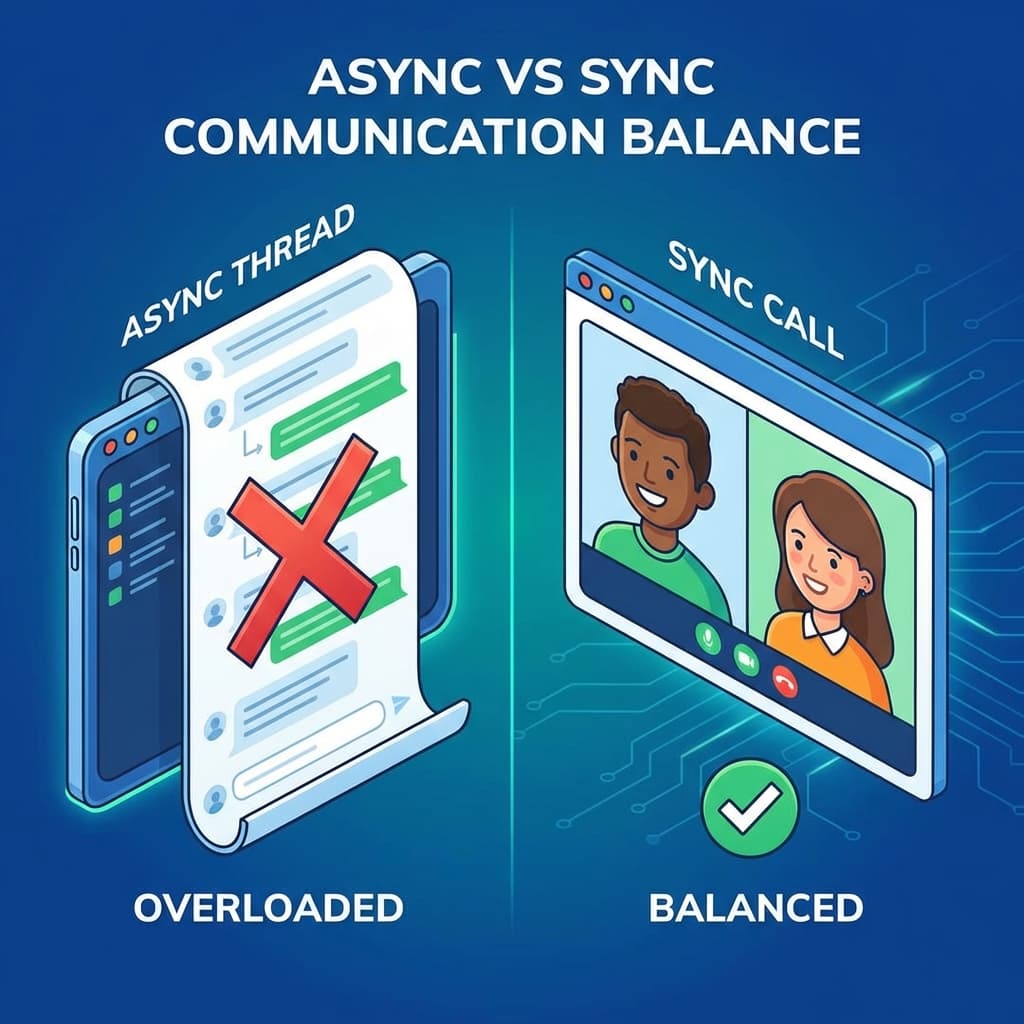
We were militant about async. "Respect people's time. Write it down. No meetings." It was gospel.
Then a product decision sat in a Slack thread for 48 hours.
15 people weighed in. 2,000 words of back-and-forth. Misunderstandings compounded with each reply. Passive-aggressive emojis appeared. Everyone was frustrated. Nobody was aligned.
I broke the rules. I called a 10-minute Zoom.
The issue that had festered for 2 days? Resolved in 10 minutes. Decision made. Everyone aligned. People actually laughed together. The tension dissolved.
We had worshipped async so religiously that we forgot the point: productivity.
Async is a tool, not a religion. Here's how we found balance.
Section 1: How Async Became a Religion
The remote work boom of the early 2020s created a generation of async evangelists.
The argument was compelling: "Meetings are evil. They interrupt deep work. They privilege the loudest voices. They waste time. Writing is superior — it's thoughtful, inclusive, and creates documentation."
For some work, this is absolutely true.
Where Async Genuinely Wins:
- Status updates: A daily standup meeting is 15 minutes x 8 people = 2 hours of human time. A Slack post takes 5 minutes to write and 30 seconds to read.
- Documentation: Written docs are searchable, shareable, and persistent. Meeting discussions evaporate unless someone takes notes.
- Code review: Asynchronous review lets reviewers think deeply without time pressure.
- Low-stakes feedback: "Thoughts on this design?" works great in async when the stakes are low.
Where Async Fails:
- Complex decisions: When there are multiple perspectives, trade-offs, and ambiguity, text threads spiral into confusion.
- Conflict resolution: Text lacks tone. Written disagreements escalate faster than spoken ones.
- Relationship building: Trust is built through presence, body language, and shared moments. You can't build culture through Slack.
- Ambiguity: When nobody knows the right answer, brainstorming in real-time often unblocks faster than async back-and-forth.
The Mistake:
We applied async dogmatically to everything. Every decision. Every disagreement. Every brainstorm.
We turned a useful tool into an ideology. And ideologies make you blind.
Section 2: The Hidden Costs of Pure Async
Our async religion had costs we didn't measure — until the damage was done.
Decision Latency:
The 48-hour Slack thread was not an outlier. It was typical.
Async decisions took 3-5x longer than sync decisions. People replied when they had time. Time zones added delay. Clarifying questions added more delay. Misunderstandings required even more messages.
A 10-minute call would have resolved most of these in real-time. But our culture forbade "unnecessary" meetings.
Speed matters. In a competitive market, the company that decides faster wins. Our async religion made us slow.
Misunderstanding Accumulation:
Text lacks tone. You can't hear someone's voice. You can't see their face. You project your own emotional state onto their words.
Neutral messages get read as curt. Questions get read as accusations. Disagreements get read as attacks.
We had team members who disliked each other — and when they finally met on video, they discovered they'd misread each other for months. The "tension" was a text illusion.
Relationship Erosion:
Teams who never see each other don't trust each other. Period.
Trust is built through informal moments: the joke before the meeting starts, the shared frustration over a bug, the celebration when something ships.
In an async-only world, there are no informal moments. Everything is transactional. "Here's the task. Here's the update. Done."
Our employee engagement scores dropped 15% over the year we went "full async." People felt disconnected. They didn't know their teammates. They were lonely.
Documentation Burden:
"Write everything down" sounds efficient. In practice, it's exhausting.
People spent 30% of their time writing: status updates, decision docs, meeting summaries (for meetings we shouldn't have banned), Slack explanations, follow-up clarifications.
Writing is slower than speaking. For ephemeral communication that doesn't need to persist, it's overhead.
Section 3: The "Mode Matching" Framework
After the 48-hour thread incident, we developed a framework we call "Mode Matching."
The idea: Match communication mode to task type. Use the right tool for the job.
When to Use Async:
- Status updates: "Here's what I did yesterday, here's what I'm doing today." Never needs a meeting.
- Documentation: Technical specs, decision records, process docs. Write it down.
- Low-stakes feedback: "Thoughts on this color?" "Does this copy sound right?" Quick, non-controversial.
- FYI announcements: "We shipped the feature." "The server is back up." Information, not discussion.
- Deep work context: Anything that would interrupt someone's focus unnecessarily.
When to Use Sync (Calls/Meetings):
- Complex decisions: Multiple options, trade-offs, ambiguity. Real-time discussion resolves faster.
- Conflict resolution: Disagreements escalate in text. Voices de-escalate. Always resolve conflict synchronously.
- Brainstorming: Ideas build on ideas. Real-time energy sparks creativity that async threads don't.
- Relationship building: 1:1s, team bonding, onboarding. Presence matters.
- Anything emotional: Praise, criticism, support. Humans need human connection for emotional communication.
The 5-Reply Rule:
We instituted a simple rule: If a Slack thread hits 5 replies without resolution, escalate to a call.
This prevents the 48-hour thread problem. It acknowledges that some discussions don't belong in text. It gives people permission to break the async dogma when needed.
Section 4: Results After Rebalancing
We've been running "Mode Matching" for over a year. Here's what we've measured.
Decision Velocity:
Average time from "decision needed" to "decision made" dropped 40%.
Complex decisions that used to take 3-5 days now take 1-2 days. We're faster.
Employee Satisfaction with Communication:
We survey employees quarterly on communication quality.
Before Mode Matching: 55% said communication was "effective."
After Mode Matching: 80% said the same.
People feel heard. They feel connected. They're not frustrated by endless text threads.
Meeting Hours:
One fear: "If we allow sync, meetings will explode."
Reality: Meeting hours increased only 15%. We went from 6 hours/week average to 7 hours/week.
Why so modest? Because Mode Matching isn't "meetings for everything." It's "the right mode for the task." Most tasks are still async. Only the right tasks became sync.
Relationship Quality:
Harder to measure, but we see it in the culture. People know each other. They joke on calls. They celebrate together.
The loneliness that plagued our async era is gone. We're a team again, not a collection of Slack avatars.
Conclusion
Async is a tool. Sync is a tool. Dogma is a trap.
The async evangelists got some things right: many meetings are wasteful, writing creates clarity, deep work needs protection.
But they went too far. They turned a useful practice into a religion. And religions don't adapt to context.
Mode Matching is our antidote. Ask: "What does this task need?" Then choose the right communication mode.
Sometimes that's a Slack message. Sometimes that's a Zoom call. The wisdom is knowing which is which.
Use async as a tool. Use sync as a tool. But never let either become your religion.
Written by XQA Team
Our team of experts delivers insights on technology, business, and design. We are dedicated to helping you build better products and scale your business.