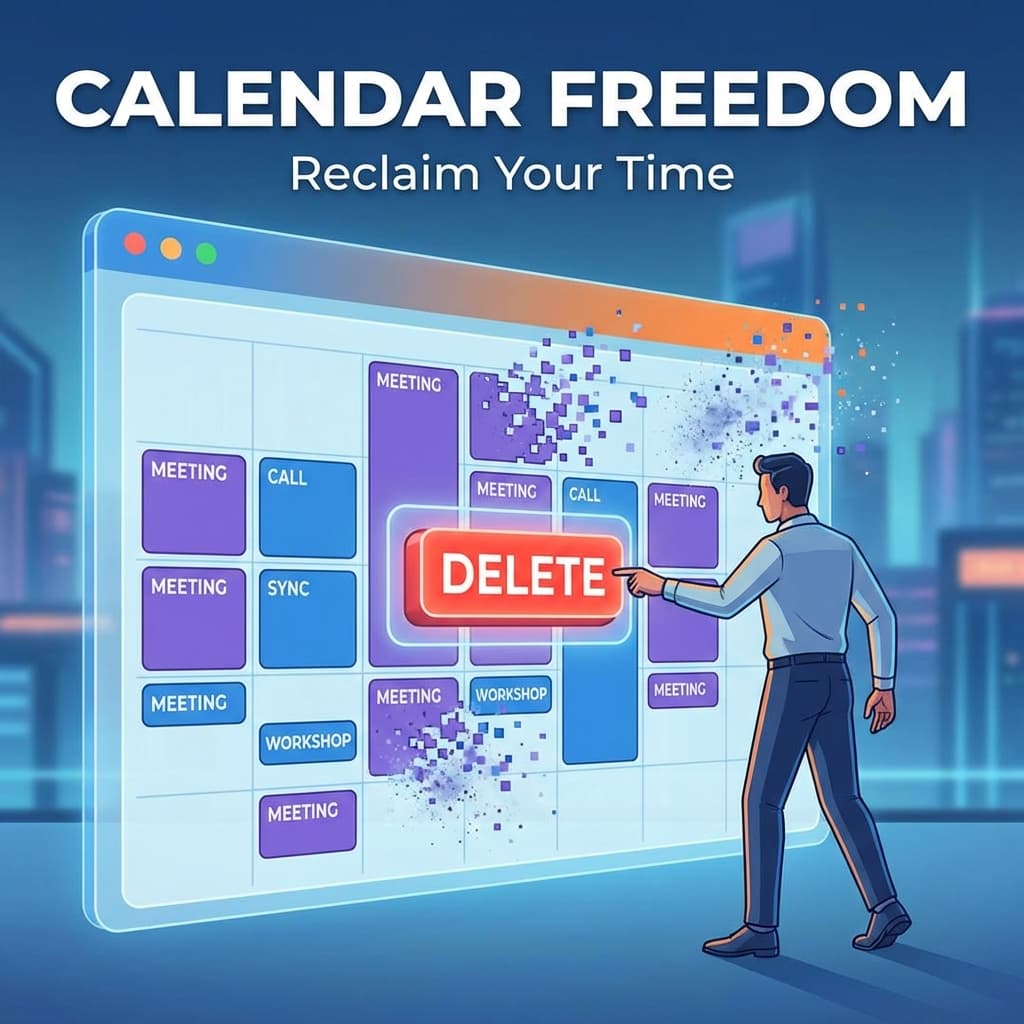
I audited my calendar last quarter. In a 40-hour work week, I had 47 hours of meetings scheduled.
That is not a typo. Forty-seven hours. Meetings overlapped. I was double-booked 15% of the time. I ran between Zoom calls, arriving late to everything, context-switching constantly.
My "work" — the actual building, thinking, creating — happened from 6pm to 10pm, after the meetings ended. I was burnt out. My team was burnt out. Everyone was "too busy" to do their actual job.
So I did something radical.
I declared "Calendar Bankruptcy."
I deleted every recurring meeting. All of them. Daily standups. Weekly 1:1s. Bi-weekly syncs. Monthly planning. Quarterly retrospectives. Stakeholder reviews.
Gone. All of it.
Then I rebuilt from zero with one rule: "If it doesn't have an agenda and a decision to be made, it's not a meeting. It's a Slack thread."
Here is what happened — and how you can do the same.
Section 1: How Meetings Became the Default
Somewhere along the way, meetings became the default action for knowledge workers.
Have a question? Schedule a meeting.
Need alignment? Schedule a meeting.
Want to brainstorm? Schedule a meeting.
Not sure what to do? Schedule a meeting to discuss what meetings we need.
But why did this happen?
Managers Use Meetings as Visibility:
Middle managers have a problem: their work is invisible. They don't write code. They don't close deals. They don't ship designs.
So they attend meetings. Lots of them. Being "in meetings all day" signals importance. It says "I am needed everywhere."
The manager with an empty calendar looks unemployed. The manager with a packed calendar looks essential.
This incentive is perverse. It rewards presence over output.
Employees Use Meetings as CYA:
If something goes wrong and you didn't invite the right people to the meeting, you are blamed. "Why wasn't I told?"
So everyone over-invites. 10 people in a meeting where 3 are needed. The other 7 are there for political coverage.
Meetings become insurance policies, not work sessions.
The Zero Marginal Cost Problem:
Scheduling a meeting costs nothing. You click a button. Send an invite. It takes 30 seconds.
Because the marginal cost of scheduling is zero, the marginal meetings are infinite. There is no brake on the system.
Compare this to, say, printing a memo. In the pre-digital era, calling a meeting required effort. You had to book a room, coordinate schedules manually, physically assemble people. The friction was a feature.
Today, friction is gone. And so is sanity.
Section 2: The True Cost of a 30-Minute Meeting
A "30-minute meeting" is never 30 minutes. Here is the real math.
Human-Hours Consumed:
30 minutes x 6 attendees = 3 hours of human time.
That "quick sync" is a half-day of productivity spread across the org.
If the average engineer costs $150/hour (fully loaded), that 30-minute sync just cost $450.
Context Switching Tax:
Research shows it takes approximately 23 minutes to regain deep focus after an interruption.
A morning with 3 meetings (9am, 10am, 11am) is not "3 hours of meetings + 1 hour of work." It is 4 hours of zero deep work.
The calendar slots between meetings are too short for meaningful work. They become email/Slack time — shallow work that feels productive but produces nothing lasting.
Opportunity Cost:
What would those 6 people have built if they weren't in a room talking?
Every meeting has an invisible price tag: the features not shipped, the bugs not fixed, the ideas not pursued.
And here is the cruelest part: most meetings conclude with "Let's schedule another meeting to follow up."
Meetings beget meetings. The calendar is a virus that replicates.
Section 3: The "Calendar Bankruptcy" Protocol
Calendar Bankruptcy is not about hating meetings. It is about resetting to zero and adding back only what is truly necessary.
Here is the protocol we followed.
Step 1: Delete All Recurring Meetings
Open your calendar. Find every recurring meeting. Delete it.
Yes, even the sacred ones:
- Daily standups? Deleted.
- Weekly 1:1s? Deleted.
- Sprint planning? Deleted.
- Retrospectives? Deleted.
Do not "pause" them. Delete them entirely. This is important psychologically. You are declaring the old system dead.
Step 2: Wait 2 Weeks. See What Breaks.
Most things won't break.
The daily standup? People will just post async updates in Slack (which they should have been doing anyway).
The weekly sync? Issues will get resolved through direct messages or brief ad-hoc calls.
Pay attention to what actually causes problems. Write it down. Those are the meetings worth re-adding.
Step 3: Re-Add Only Meetings That Pass the Test
A meeting is valid only if it has:
- A written agenda: Shared 24 hours in advance. If you cannot articulate what the meeting is about in writing, it is not a meeting — it is a hangout.
- A decision to be made: Meetings are for decisions, not discussions. If there is no decision, there is no meeting.
- 4 or fewer attendees: Every additional attendee dilutes accountability. If you need 10 people to make a decision, you have a governance problem, not a scheduling problem.
Step 4: Replace Meetings with Async Alternatives
- Status updates: Become Slack posts or Loom videos. A 5-minute Loom replaces a 30-minute standup.
- Brainstorms: Become Google Docs. People add ideas asynchronously. Comments refine them. A "brainstorm meeting" is just reading the doc out loud — a waste.
- Decision-making: Becomes an RFC (Request for Comments) document. Write the proposal. Collect feedback. Make the call. No meeting needed unless there is genuine disagreement.
Section 4: The Results (After 6 Months)
We ran this experiment for 6 months. Here are the measurable outcomes.
Meeting Hours Per Week:
Before: 25 hours average per person.
After: 8 hours average per person.
A 68% reduction in meeting load.
Deep Work Blocks Per Week:
Before: 2 blocks of 2+ uninterrupted hours.
After: 12 blocks of 2+ uninterrupted hours.
Engineers now have the time to actually build things.
Employee Satisfaction (eNPS):
Before: 32.
After: 61.
When you give people their time back, they are happier. Shocking, I know.
Shipping Velocity:
Measured by PRs merged per engineer per week.
Before: 4.2.
After: 5.9.
A 40% increase in output.
We did not hire more people. We did not work longer hours. We just stopped wasting time in rooms talking about work instead of doing it.
Conclusion
Your calendar is not a neutral tool. It is a battlefield.
Every meeting is a demand on your attention, your energy, your creative capacity. And most meetings are not worth the cost.
Protect your calendar like you protect your codebase. Audit it. Refactor it. Delete the cruft.
Declare bankruptcy. Rebuild from zero. Add back only what earns its place.
Your future self — the one who ships great work — will thank you.
Written by XQA Team
Our team of experts delivers insights on technology, business, and design. We are dedicated to helping you build better products and scale your business.