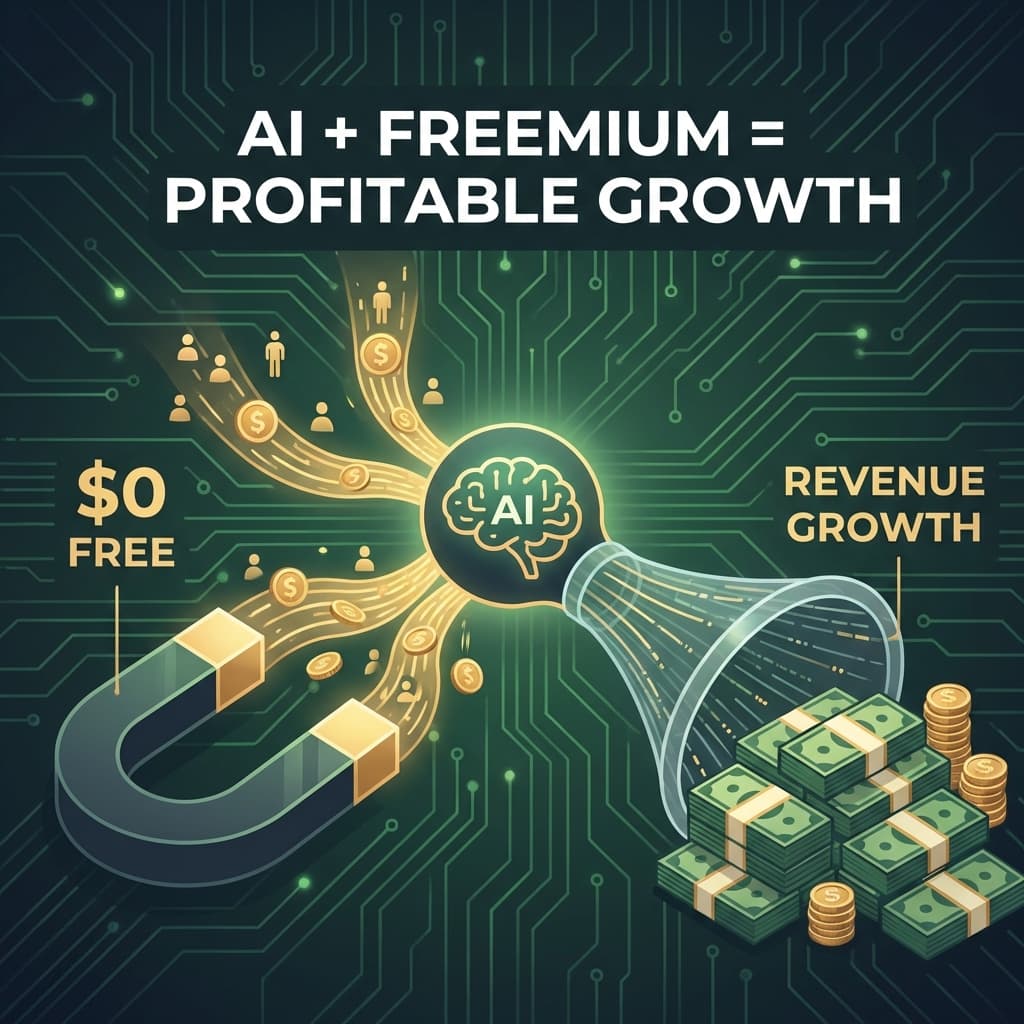
The Spreadsheet That Changed Everything
In early 2024, my co-founder and I had an argument that nearly broke our company. We had just finished building an AI feature—an automated test case generator that could analyze a product spec and produce comprehensive QA test suites in seconds. It was genuinely useful. Users loved it in beta.
The question was: how do we monetize it?
I wanted to charge $49/month. "It saves users hours of work," I argued. "That's easily worth $49."
My co-founder, Elena, had a different idea. "What if we charge nothing?"
I thought she was insane. We were burning runway. Every API call to Claude cost us money. How could we give away something that actively cost us to run?
Elena walked to the whiteboard and drew a simple equation:
Cost of AI Feature < Cost of Google Ads < Lifetime Value of Converted Users
Then she pulled up a spreadsheet. It showed our current customer acquisition cost (CAC) for paid users: $180 per signup via Google Ads. It showed the API cost of the free AI feature: roughly $2.50 per active user per month. And it showed the conversion rate from free users to paid plans: 8%.
The math was stark: if we gave away the AI feature for free and 1,000 users signed up, we'd spend $2,500/month on API costs. But 80 of those users would convert to our $99/month paid plan. That's $7,920/month in new MRR.
Net gain: $5,420/month. And that's before accounting for organic referrals, SEO boost from new traffic, and brand awareness.
We stopped arguing. We launched the free AI feature the next week. Within 18 months, it had generated $1.2 million in attributed revenue. Here's how—and why this model might work for you.
Section 1: The Loss Leader Strategy, Explained for Software
The "loss leader" is one of the oldest retail strategies in existence. Grocery stores sell milk at a loss because they know you'll walk past profitable items on your way to the dairy aisle. Amazon sells Kindles at near-cost because they know you'll buy ebooks at high margins for years afterward. The initial loss is an investment in a profitable relationship.
For most of software history, this strategy was hard to apply. Software didn't have a "milk"—a commoditized product that customers expected to be cheap or free. Every feature cost money to build, and the marginal cost of serving a user was too high to give away at scale.
AI changes this equation in two critical ways.
Change 1: High Perceived Value, Plummeting Marginal Cost
AI features have unusually high perceived value relative to their marginal cost. Users see "AI" and think: expensive, scarce, valuable. They expect to pay.
But the actual cost to serve an AI feature is surprisingly low—and getting lower. The cost of a GPT-4o API call has dropped 50%+ in the past year. A feature that cost $0.10/query in 2023 might cost $0.03/query in 2025, and $0.01/query in 2027.
This creates an arbitrage opportunity. If you launch a free AI feature today, you're betting that its cost will become trivially small tomorrow. You're front-running the cost curve.
Change 2: AI as a Distribution Channel
The second insight is more subtle. In 2024-2026, "AI" is one of the most powerful words in SEO and product marketing. Users are actively searching for AI tools. Tech journalists are actively covering AI features. Product Hunt is hungry for AI launches.
A free AI feature is, in effect, a marketing campaign. It attracts users who would never have found you otherwise. It generates press coverage you couldn't afford to buy. It creates word-of-mouth in Slack channels and Twitter threads.
Our free test case generator didn't just acquire users. It acquired the right kind of users: developers and QA engineers who were already in buying mode, looking for tools to improve their workflow. These users had dramatically higher intent than random traffic from display ads.
Section 2: The 3 Business Model Archetypes for "Free AI"
Not all "free AI" strategies are the same. Based on studying dozens of companies (and our own experiments), I've identified three distinct archetypes. Each has different mechanics, risks, and requirements.
Archetype 1: The Trojan Horse
Mechanic: The free AI feature gets users to upload data or create content within your platform. You monetize the data, the workflows, or the ecosystem—not the AI itself.
Examples:
- Notion AI: The AI writing assistant is free (included in the base plan). But using it means you're creating more documents, more databases, more content—all inside Notion. That content locks you into the platform. You're paying for Notion, not for the AI.
- Canva's Magic Tools: Magic Resize, Magic Eraser, and AI image generation are free or cheap. But every design you create is stored in Canva, tempts you to buy premium assets, and drives you toward paid team plans.
Requirement: You need a strong core product that users get locked into. The AI is the bait; the platform is the trap.
Archetype 2: The Upsell Lever
Mechanic: The free AI feature is crippled in some non-annoying way—limited uses, limited features, limited quality. Users who exceed the limit pay for the upgrade.
Examples:
- ChatGPT Free vs. Plus: Free users get GPT-3.5 and limited GPT-4 access. Power users who need more speed, more tokens, or more capabilities pay $20/month.
- Copy.ai, Jasper, etc.: Free plans give you 2,000 words/month. Professionals who need more pay $49+/month.
Requirement: You need a clear usage metric (words, queries, tasks) that correlates with user sophistication. The limit must feel generous to casual users but constraining to power users.
Archetype 3: The Brand Play
Mechanic: The free AI feature has no direct monetization at all. Its purpose is to build brand awareness, attract developers, and drive traffic to your "real" business.
Examples:
- ChatGPT as a Brand Play for OpenAI: OpenAI doesn't make money directly from ChatGPT's free tier. But ChatGPT put "OpenAI" in every headline, drove millions of developers to the API, and established them as the default AI provider. The free product is a $10 billion marketing campaign.
- Hugging Face Spaces: Free hosted demos of open-source models. Hugging Face doesn't charge for Spaces. But every viral demo drives traffic to their model hub, their enterprise offerings, and their consulting services.
Requirement: You need a high-margin "back-end" business that benefits from brand awareness. APIs, enterprise contracts, consulting, or data licensing are common backends.
Section 3: Case Study: How Our "Free AI" Made Us $1.2M
Let me walk through our actual numbers. I'm simplifying slightly for confidentiality, but the ratios are accurate.
The Feature
Our free feature is a "Test Case Generator." Users paste a product spec or user story, and the AI produces a comprehensive list of test cases: positive tests, negative tests, edge cases, and performance considerations. It's a 15-second workflow that replaces 2+ hours of manual work.
The Costs
- API Cost per Use: ~$0.35 (Claude 3.5 Sonnet, including the spec analysis and generation passes)
- Average Uses per User per Month: 7
- Monthly Active Users (Free Tier): ~3,200
- Total Monthly API Spend on Free Feature: ~$7,800
The Revenue
- Conversion Rate (Free to Paid): 8%
- Paid Plan Price: $99/month
- Monthly Conversions: ~256 users
- Monthly Revenue from Conversions: ~$25,344
- Net Monthly Gain: ~$17,544
Over 18 months, that adds up to approximately $315,000 in net gain from direct conversions alone.
But wait—there's more revenue we can attribute to the free feature.
The Second-Order Effects
- Organic SEO: The free feature landing page ranks #3 for "AI test case generator." That's ~15,000 organic visits/month that cost us $0 in ads.
- Press Coverage: We got featured in 4 major tech publications after launch. Estimated ad-equivalent value: ~$80,000.
- Referrals: Free users recommend the tool to colleagues. ~30% of our paid conversions attribute to "word of mouth."
- Enterprise Leads: Three enterprise deals ($50k+ ACV each) started with someone on the team using the free tool and asking about team plans.
When you add the enterprise contracts, the SEO value, and the reduced CAC from organic growth, total attributed revenue over 18 months is $1.2 million.
The Insight
The free AI feature is not a product. It's a distribution channel. It replaced what would have been ~$500,000 in Google Ads spend, delivered higher-quality leads, and created compounding organic growth.
Would we have made more money charging $49/month? Almost certainly not. The conversion friction would have killed growth. The SEO benefit would have vanished (no one searches for "paid AI test generator"). The press coverage wouldn't have happened.
Free was the correct price. It just took a spreadsheet to see it.
Section 4: How to Decide: Should You Give Away AI for Free?
This strategy doesn't work for everyone. Here's a decision framework to determine if "Loss Leader AI" is right for your business.
Question 1: What is Your Marginal Cost?
If your AI feature costs $5 per use, you probably can't give it away. If it costs $0.05 per use, you probably can.
Calculate your fully loaded marginal cost: API fees + infrastructure + any human review overhead. If that number is less than 5% of your average revenue per user (ARPU), you have room for a loss leader.
Question 2: What is the Perceived Value to the User?
Users need to feel like they're getting something valuable. If your free AI feature is a glorified FAQ bot, no one will care. If it's genuinely solving a pain point—saving hours of work, automating something annoying—people will talk about it, share it, and remember your brand.
The "wow factor" matters. Our test case generator makes people say "wait, that's free?" That reaction is the marketing.
Question 3: Do You Have a Monetization Path Behind the Free Feature?
This is the most important question. Giving away AI without a backend business model is just subsidizing OpenAI's growth, not yours.
You need a "conversion path"—something users will pay for after they experience the free feature. For us, it's the paid platform (test management, integrations, team features). For others, it might be:
- Upsell to a paid tier with higher limits
- Enterprise contracts with SSO and compliance features
- Consulting or services sold to power users
- Data or API licensing to other developers
If you don't have a clear answer to "what do they buy next?", don't launch a free AI feature. You'll just burn cash.
Question 4: Can You Track Attribution?
This is an operational requirement. You need to know which paid customers came through the free feature. Otherwise, you can't calculate ROI, and you're flying blind.
We use a simple system: every free user gets a cookie. When they convert to paid, we log the source. We also ask in onboarding: "How did you hear about us?" The data is imperfect, but it's good enough to prove the model works.
Anti-Pattern Warning: The "Charity AI" Trap
I want to be explicit about the failure mode. Some founders see "free AI" as a way to defer hard decisions about monetization. "We'll figure out the business model later. For now, let's give it away and grow."
This is dangerous. Without a backend business, you're not a company—you're a charity. And charities run out of money.
The loss leader model only works if the "loss" is calculated and the "leader" actually leads somewhere. If you're just giving away AI because it's cool and you haven't figured out the monetization, stop. The model will not save you.
5 Questions Before Launching a Free AI Feature
Before you ship, answer these honestly:
- What is my fully-loaded cost per use? Is it under $1?
- Does the feature deliver a genuine "wow" moment within 30 seconds?
- Is there a clear conversion path to a paid product?
- Can I track which paid customers came from free?
- Am I prepared to lose money for 6+ months before the model pays off?
If you answered "yes" to all five, you might have a loss leader on your hands.
Closing Provocation: The Future of SaaS Pricing
Here's my prediction for where this is headed.
The next great SaaS companies won't charge for AI. They'll give away AI features the way grocery stores give away milk—at or below cost, as a customer acquisition lever.
What they'll charge for is the outcome that AI enables. Not "AI writing" but "content that ranks." Not "AI test generation" but "bugs caught before production." Not "AI analysis" but "decisions made faster."
The AI is just the bait. The outcome is the product. And the companies that figure this out first will have an insurmountable distribution advantage.
We charged $0 for our AI product. We made $1.2 million. And we're just getting started.
Appendix: The Spreadsheet Template
For those who want to run this analysis themselves, here's a simplified version of the spreadsheet we used:
LOSS LEADER AI: ROI CALCULATOR

INPUTS:
- API Cost per Use: $0.35
- Average Uses per User/Month: 7
- Expected Monthly Active Free Users: 3,000
- Conversion Rate (Free to Paid): 8%
- Paid Plan Monthly Price: $99

CALCULATIONS:
- Monthly API Cost: 3,000 users × 7 uses × $0.35 = $7,350
- Monthly Conversions: 3,000 × 8% = 240 users
- Monthly Revenue from Conversions: 240 × $99 = $23,760
- Net Monthly Gain/Loss: $23,760 - $7,350 = +$16,410

BREAK-EVEN ANALYSIS:
- Break-even Conversion Rate: 2.5%
- We are 3x above break-even. Model is viable.
Adjust the inputs for your business. If the net is positive and robust to pessimistic assumptions, you have a loss leader worth testing.
Written by XQA Team
Our team of experts delivers insights on technology, business, and design. We are dedicated to helping you build better products and scale your business.