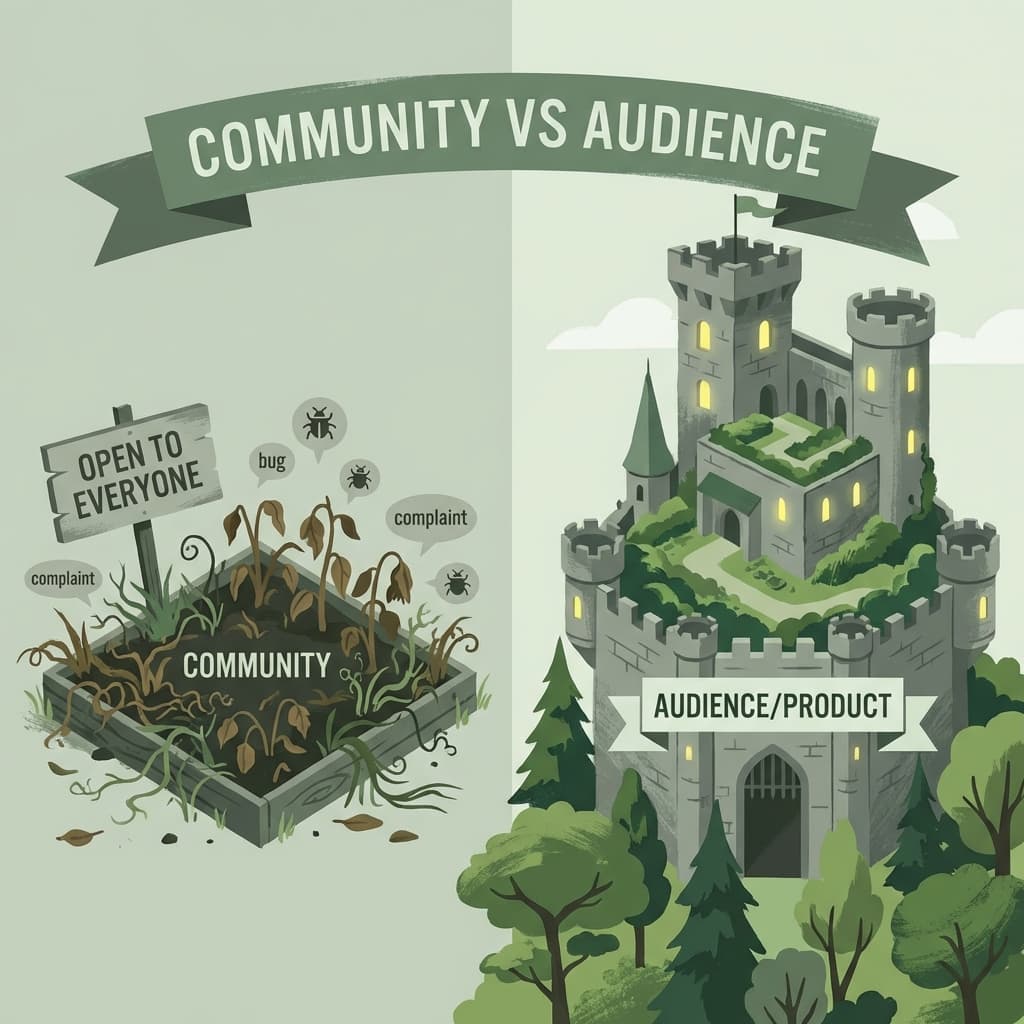
The Ghost Town Discord
In 2024, the hottest buzzword in B2B SaaS was "Community-Led Growth." Every VC deck had a slide about "Moats" and "Flywheels" powered by a vibrant user community.
We bought the hype. We launched a Discord server. We promoted it in our onboarding emails. We hired a Community Manager.
In month one, we got 4,000 members. The numbers looked incredible. "Look at this engagement!" we told our investors.
Then we actually looked at the chat logs.
- 80% were job seekers spamming "GM" and "Following" to farm engagement points, hoping to get hired.
- 15% were competitors (or their product managers) quietly monitoring our feature announcements and bug reports.
- 5% were actual users. And they weren't discussing "best practices." They were using the
#generalchannel to complain about bugs because our support ticket SLA was 24 hours and Discord was instant.
We were spending $60,000 a year on moderation tools and staff to host a public forum for our own support debt. Worst of all, when a prospect joined the server to "check out the vibe," the first thing they saw was a list of complaints.
We shut the Discord down 8 months later. We expected backlash. Instead, our churn decreased. Our support team became more efficient. And our sales team stopped having to explain away public bug reports.
Here is the hard truth: Most B2B companies have no business building a "Community." You should be building an Audience.
Section 1: Community != Audience (The Fatal Confusion)
People use these terms interchangeably. They are opposites.
One-to-Many vs. Many-to-Many
Audience (One-to-Many): You talk, they listen. You publish a blog post, they read it. You send a newsletter, they open it. The value flows from you to them.
Community (Many-to-Many): They talk to each other. The value comes from the peer interaction. You are just the host.
The Difficulty Spike
Building an audience is hard. You need to create great content.
Building a community is 100x harder. You need "Liquidity."
Liquidity means that if I post a question, someone (not you) answers it within 10 minutes. If I post and get silence, I leave and never come back. Achieving liquidity requires a massive critical mass of active, knowledgeable, generous users.
Most startups don't have this. They have a "Ghost Town." And a Ghost Town is worse than no town at all.
The Value Trap
Ask yourself honestly: Does your user want to hang out with other users?
If you sell a hobby product (Photography, Gaming), yes. Passionate users love discussing their passion.
If you sell B2B software (Accounting, HR, DevOps), NO. Your users want to finish their work and go home to their families. They do not want to hang out in a "Payroll Enthusiasts Discord" on Saturday.
By forcing them into a community, you are adding friction, not value.
Section 2: The Support Forum Trap
Most B2B "Communities" devolve into unpaid, unorganized support forums.
The "Negative Tuples"
In any product population:
- Happy customers are quiet. They are doing their work.
- Unhappy customers are loud. They are seeking help.
A public community aggregates the loud, unhappy minority. It creates a skewed perception of reality.
When a prospect visits your G2 page, they see reviews clearly marked as reviews. When they join your Slack/Discord, they see a raw feed of "Is the server down?" and "This bug is annoying."
You are essentially paying to advertise your technical debt.
The Competitor Intel Feed
Your "Feature Requests" channel is a goldmine for your competitors.
We tracked a competitor who literally copied our "Top Voted Features" list. Why wouldn't they? We prioritized the market research for them and published it for free.
Keeping your roadmap and user feedback semi-private isn't secrecy—it's strategy.
Section 3: The Attribution Nightmare
How do you measure the ROI of a conversation?
Community managers talk about "Dark Social" and "Brand Halo." CFOs talk about Customer Acquisition Cost (CAC) and Lifetime Value (LTV).
It is nearly impossible to prove that the $100k you spent on community resulted in closed deals. Usually, the data suggests the opposite:
Opportunity Cost: The time your team spends moderating trolls, answering support questions in chat, and trying to "spark engagement" is time not spent on:
- Writing high-authority documentation (Asset)
- Building features (Asset)
- Doing sales calls (Revenue)
Chat is ephemeral. It disappears. Documentation is an asset. It compounds. Investing in chat is investing in entropy.
Section 4: The "Product-Centric" Alternative
So, should you ignore your users? Of course not.
But stop trying to be a "Community Host." Be a **Product Leader**.
1. Build a User Advisory Board (Not a Crowd)
Instead of a public Discord, create a private, invite-only group of your top 20 customers. Give them direct access to your Product team via email or a private Slack channel.
This provides high-quality feedback without the noise of 4,000 randoms.
2. The "Content Moat" (Audience Building)
Take your moderation budget and hire a Technical Writer.
Create the best documentation, templates, and "How-To" guides in your industry. When people have questions, they should find an article, not a chat thread.
An audience that subscribes to your blog because it makes them smarter is far more valuable than a community that joins your Discord to complain.
3. The "Review" Strategy
Encourage users to talk about you, not to you.
Push them to write reviews on G2, Capterra, or Twitter/LinkedIn. Public praise on third-party platforms builds trust. Public complaints on your own platform destroys it.
Conclusion
Community is an outcome of a great product, not a marketing channel to fix a mediocre one.
If you build something people love, a community will form naturally (on Reddit, on Twitter, offline). You don't need to own the clubhouse. You just need to build the thing they want to talk about.
Save your money. Delete the Discord. Build an audience.
Appendix: The Community Audit
Should you shut down your community? Score yourself:
- Liquidity: If you stopped posting today, would the community continue talking for a week? (If No, purely Audience).
- Ratio: What is the ratio of [Value Add Posts] to [Support/Bug Posts]? (If >50% bugs, it's a support channel).
- ROI: Can you name 5 deals closed directly because of the community this quarter?
Written by XQA Team
Our team of experts delivers insights on technology, business, and design. We are dedicated to helping you build better products and scale your business.