The Question That Ended Our Fundraise
We were in the middle of our Series A pitch. Things were going well. Traction numbers looked good. Product demo had generated genuine interest. Then we got to the competitive positioning slide.
"Our moat is our data," I said confidently. "We have 18 months of proprietary training data from our customers. Nobody else has this."
The lead partner leaned forward. She asked a simple question that I've thought about every day since:
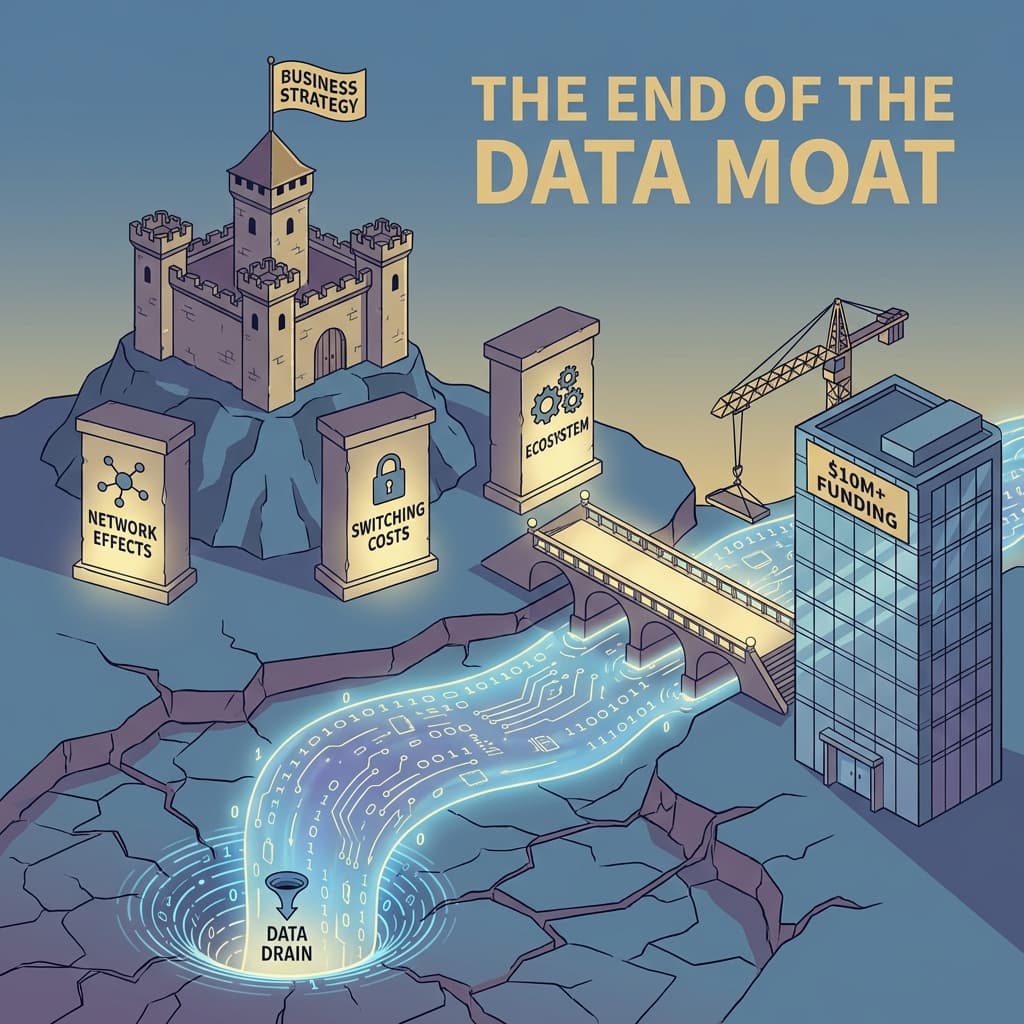
"If I gave a competitor $10 million and 18 months, could they replicate your dataset?"
I paused. The honest answer was yes. With enough money, they could license similar data, partner with companies in our space, or simply acquire a company that had it. Our "18 months of data" was a head start, not a moat.
"Maybe," I admitted. "With enough capital—"
"Then it's not a moat," she said. "It's a lead. Leads get closed."
We didn't close that round. And that question forced me to completely rethink what actually creates defensibility in SaaS.
Section 1: The "Data Moat" Myth
Every AI startup in 2024-2026 claims a data moat. Very few actually have one.
Why Everyone Claims Data Moat
"Our data is our moat" is the default answer when founders don't have a better one. It sounds sophisticated. It sounds AI-native. It sounds defensible.
Here's why people believe it:
- AI models need data to train or fine-tune
- More data generally = better models
- If you have proprietary data, only you can train on it
- Therefore, data = defensibility
Each step seems reasonable. But the conclusion is usually wrong because it ignores how data actually works in competitive markets.
The $10M Test
The VC's question is the acid test: Could a well-funded competitor replicate your data advantage in 18-24 months?
For most startups, the answer is yes:
- Data can be licensed: Most "proprietary" data can be bought from data brokers, or licensed from the same sources you used.
- Data can be acquired: A competitor can acquire a company that has similar data, or partner with someone who does.
- Data can be generated: Synthetic data is improving rapidly. For many applications, synthetic data + foundation models matches or exceeds small proprietary datasets.
- Foundation models already know it: If your data is public or semi-public (scraped from the web, social media, SEC filings, etc.), it's likely already in GPT-4 or Claude's training set.
What a Real Data Moat Looks Like
Real data moats are rare. They require:
- Irreplaceable data: No one else can get it at any price. Not for sale, not acquirable, not replicable.
- Continuously refreshing: The data grows automatically as you operate, creating a compounding advantage.
- Critical to product quality: The data directly enables product capabilities that can't be achieved otherwise.
Examples of real data moats:
- Bloomberg: 40 years of financial data, proprietary terminals, and relationships with every major financial institution. You can't replicate this.
- Google Maps: Billions of location pings from Android phones, constantly refreshed, enabling real-time traffic that competitors can't match.
- Waze: User-contributed road data forming a network effect where more users = better data = more users.
Notice what these have in common: massive scale, continuous refresh, and network effects. A startup with 18 months of customer data has none of these.
Section 2: What Actually Creates Defensibility
If data isn't your moat, what is? There are five things that actually protect SaaS businesses.
Moat 1: Network Effects
Each user makes the product better for every other user. This is the strongest moat because it compounds.
Examples:
- Slack: The more people in your company on Slack, the more useful Slack becomes for everyone. Switching costs increase with adoption.
- Figma: Designers share Figma files with each other. The more designers on Figma, the more pressure on non-Figma designers to switch.
- Marketplaces: More sellers attract more buyers, which attracts more sellers.
Network effects are hard to build but extremely powerful. If you have them, other moats matter less.
Moat 2: Switching Costs
Integration into workflows creates lock-in. The deeper you embed, the harder you are to rip out.
Examples:
- Salesforce: Companies build entire business processes around Salesforce. Years of custom fields, workflows, and integrations. Switching means rebuilding everything.
- Workday: HR and finance data is deeply embedded. Migration takes 12-18 months and millions of dollars.
- AWS: Applications are built on AWS-specific services. Moving to GCP means rewriting infrastructure code.
Switching costs aren't about making customers miserable—they're about providing value so deeply integrated that leaving would be painful.
Moat 3: Distribution Advantage
You own the customer relationship in ways competitors can't replicate.
Examples:
- Installed base: Microsoft can bundle new products with Windows/Office because they're already on every enterprise desktop.
- Trusted brand: Enterprise buyers have approved vendors lists. Getting on that list takes years. Once you're on, competitors have to go through the same process.
- Channel partnerships: Exclusive relationships with resellers, integrators, or platforms that control access to customers.
Distribution moats are unsexy but powerful. Many successful B2B companies win on distribution, not product.
Moat 4: Speed / Iteration Velocity
You can ship and iterate faster than anyone else. This isn't a permanent moat, but it buys time.
Examples:
- Startup vs. incumbent: A startup can ship in weeks what IBM ships in quarters. This speed advantage lets them capture markets before incumbents react.
- Tight customer feedback loops: Companies with rapid customer learning cycles compound improvements faster.
Speed erodes as companies grow. It's a temporary moat that must be converted into a permanent one (network effects, switching costs) before it disappears.
Moat 5: Ecosystem / Platform
Third parties build on your platform, creating a web of dependencies that's hard to displace.
Examples:
- Shopify: Thousands of apps built on Shopify's platform. Merchants depend on these apps. Switching platforms means losing access to them.
- Stripe: Fintech companies build on Stripe's APIs. Moving to another payment processor means rewriting integrations.
- Salesforce AppExchange: An ecosystem of add-ons and integrations that make Salesforce stickier.
Platform moats take years to build but create powerful lock-in when achieved.
Section 3: Case Studies—Data Moat Failures
Let me share two examples of companies that thought they had data moats and didn't.
Case Study A: Health Data Startup
Company A built a health analytics platform. Their pitch: "We have proprietary access to patient data from 50 clinics. Competitors can't get this data."
What happened: A competitor partnered with a large hospital chain—100x the size of Company A's clinic network. Within 8 months, the competitor had more data, higher quality, and better coverage.
Company A's "moat" evaporated. They were acquired for a fraction of their peak valuation.
The lesson: Data from 50 clinics isn't irreplaceable. There are thousands of clinics. Someone with more capital can always get more data if the data source isn't truly unique.
Case Study B: E-commerce Analytics
Company B built analytics for e-commerce stores. They ingested transaction data from thousands of Shopify merchants and used it to provide benchmarks and recommendations.
Their moat claim: "We have more e-commerce data than anyone. Merchants can't get these benchmarks elsewhere."
What happened: Shopify added native analytics. They had more data (they are the platform), and they bundled it for free. Company B's premium product became redundant.
The lesson: When your data comes from a platform, the platform can always take it back. You don't own the data—you're renting it.
The Pattern
In both cases, the companies confused current data access with defensible data moat. They had data, but the data wasn't irreplaceable.
What worked? Companies that combined data with other moats:
- Data + network effects (Waze: more users = more data = more users)
- Data + switching costs (Salesforce: your data customizations are locked in their platform)
- Data + ecosystem (Stripe: third-party tools built on their data APIs)
Data alone is an accelerant, not a moat. It helps you build moats, but it isn't one itself.
Section 4: Building Real Defensibility
Based on this analysis, here's a framework for building genuine defensibility in SaaS.
Layer 1: Product Excellence (Table Stakes)
You have to be good before you can be defensible. A mediocre product with network effects is still mediocre.
Focus here first: build something users love. Don't worry about moats until you have product-market fit.
Layer 2: Habit Formation
Design for daily (or at least weekly) use. Products used habitually are harder to abandon.
- Slack: Daily communication
- Linear: Daily task management
- Notion: Daily note-taking and documentation
If your product is used monthly or quarterly, habit-based retention is weak. Consider how to increase engagement frequency.
Layer 3: Integration Depth
Embed in customer workflows as deeply as possible. Every integration is a switching cost.
- Integrate with other tools they use daily
- Store customer data that they can't easily export
- Build custom fields, workflows, and configurations that are specific to them
The goal: make migration painful enough that inertia keeps them with you.
Layer 4: Community / Ecosystem
Build around your product, not just inside it.
- App stores and marketplaces
- Partner programs
- User communities
- Certification programs
When third parties depend on your product, they become advocates for your continued existence. They don't want you to fail.
Layer 5: Brand / Trust
Over time, reputation compounds. Enterprise buyers choose known quantities because switching carries risk.
- Oracle and SAP survive on trust, not features
- "Nobody ever got fired for buying IBM"
- HIPAA, SOC2, FedRAMP certifications create trust-based barriers
Brand moats take years to build but provide durable protection.
The Audit
For your own business, ask:
- Which of these layers do we have?
- Which are we actively building toward?
- Are we relying on "data moat" as a crutch for missing real moats?
If you can't identify at least one real moat beyond data, you're vulnerable.
Closing Thought
Stop claiming data moat. Start building real defensibility.
The VC who asked me the $10M question did me a favor. She forced me to confront the fact that "we have data" is not a strategy—it's a statement of current state.
Moats are about the future. Can a well-funded competitor catch you? If the answer is yes, you don't have a moat. You have a head start. And head starts get closed.
Build network effects. Create switching costs. Own distribution. Move fast while you build these. And stop claiming data moat unless you're Bloomberg.
Appendix: Moat Self-Assessment
Score your company 1-5 on each moat type:
- Network Effects: Does each user make the product better for other users?
- Switching Costs: Would migration take a customer more than a week?
- Distribution: Do we have access to customers that competitors can't get?
- Ecosystem: Have third parties built products or integrations on our platform?
- Brand/Trust: Would an enterprise choose us over an unknown competitor just because of reputation?
If your average score is below 3, you need to build moats—fast. If you're relying on "data" as your only answer, you're probably at a 2 or below.
Written by XQA Team
Our team of experts delivers insights on technology, business, and design. We are dedicated to helping you build better products and scale your business.