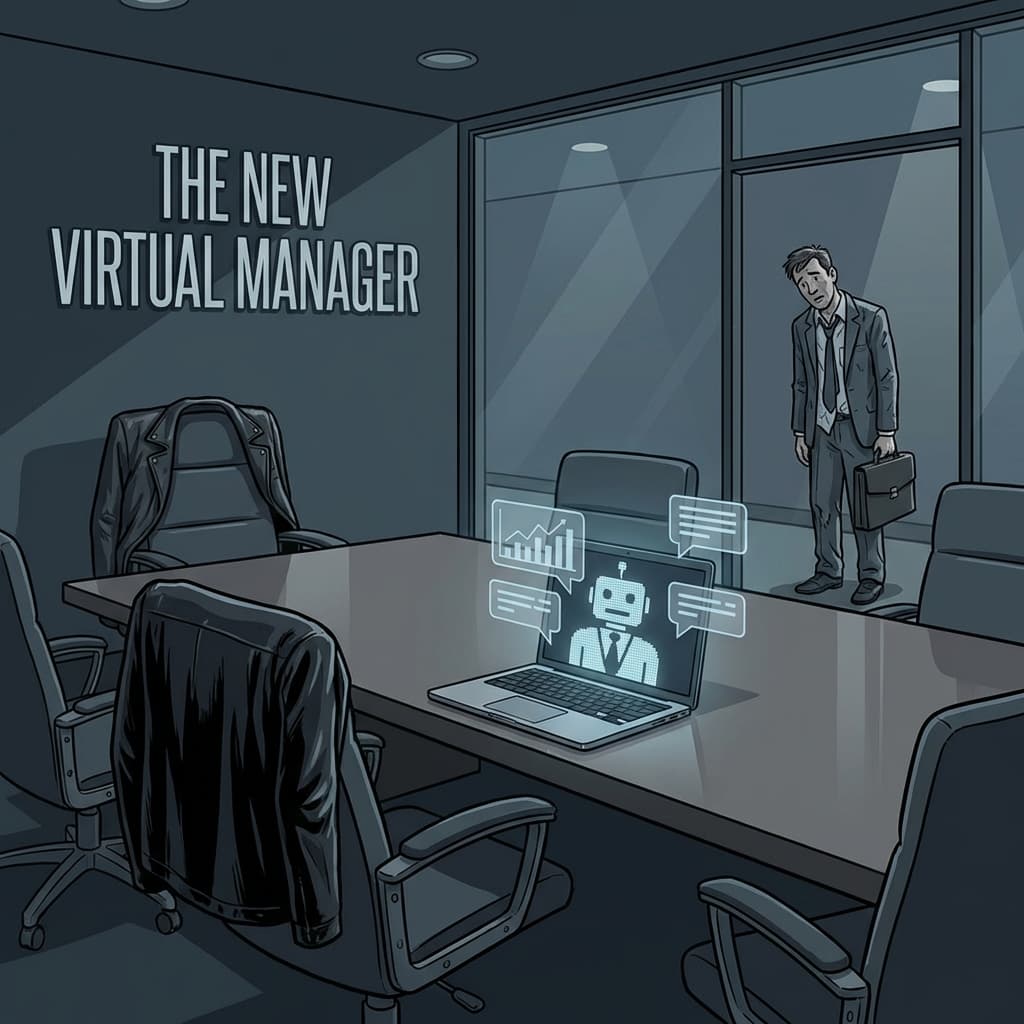
The "Status Update" Ghost
I sat in a Zoom call last week with a team of four senior developers and one "Engineering Manager."
The devs were deep in a debate about a complex AI agent architecture—sharding state across Redis instances vs. managing it in-memory. It was technical, heated, and critical.
The Manager stayed silent for 45 minutes.
Finally, as the meeting wrapped up, he unmuted and asked: "So... is this ticket a T-shirt size Large or Extra Large?"
The silence was deafening. You could feel the respect leaving the room.
In that moment, it became clear: The era of the "Pure People Manager"—the leader who manages Jira but can't read code—is over. Artificial Intelligence has commoditized coordination. The future belongs to the Player-Coach.
Section 1: AI Commoditizes "Coordination"
Let's look at what a traditional Engineering Manager actually does all day.
- Grooms the backlog.
- Asks for status updates.
- Compiles weekly reports for upper management.
- Conducts 1:1s (often just "How are you feeling?" chats).
50% of this job is Information Routing. It's taking data from Git/Jira and summarizing it for humans.
In 2026, AI Agents do this. We have bots that summarize PRs. detailed status reports are generated automatically from commit logs. Agents can even facilitate "Standups" asynchronously.
The Value Vacuum: If you strip away the logistics, what is left? If a manager can't review code, audit the architecture, or unblock a technical problem, their value proposition collapses.
Worse, they become a liability. Managers who can't evaluate the work rely on proxies like "Velocity" or "Lines of Code." This leads to Goodhart's Law disasters where devs game the metrics because the boss can't judge the quality.
Section 2: The Return of the Apprenticeship Model
The Silicon Valley "Management Track" told us that writing code is low-leverage work for a leader. We were told to "delegate."
This was a lie.
Junior developers don't need "Career Pathing" talks once a month. They need deep, technical guidance daily. They need someone to look at their code and say, "This pattern will fail at scale because of X."
The Player-Coach: The best sports coaches are often former players who understand the grit of the game. In engineering, you cannot coach a sport you don't play anymore.
I hear managers say, "I trust my team," as an excuse for not code-reviewing. But "Trust" without "Understanding" is just negligence. You aren't empowering them; you are abandoning them.
Section 3: The "Super-IC" (Staff+) vs. The Middle Manager
Smart companies are shifting budget. They are firing "Directors of Engineering" and hiring "Staff/Principal Engineers."
Why?
The Influence Flippening: A Staff Engineer who optimizes the cloud infrastructure and saves $1M/year has infinitely more organizational leverage than a Manager who "manages expectations" for 10 people.
The Pay Scale Inversion: We are finally seeing ICs (Individual Contributors) paid more than their managers. This is healthy. It removes the perverse incentive for great coders to stop coding just to get a raise.
If your only path to $300k is to stop doing the thing you are good at (coding) and start doing the thing you hate (meetings), the organization loses.
Section 4: Rebuilding the Leadership Track
We need to stop promoting great engineers into mediocre managers.
The "Pendulum" Career: The best leaders I know swing back and forth. They spend 2 years managing, then 2 years as an IC. They keep their hands dirty. They stay relevant.
If you haven't deployed to production in 3 years, you are not a "Technical" leader. You are a historian.
Conclusion
The "Clipboard Manager" is dead. The "Servant Leader" who just brings donuts is expiring.
The leaders who survive the AI transition will be the ones who can open the IDE during a fire, diagnose the root cause, and say, "I got this."
If you can't play the game, get off the field.
Written by XQA Team
Our team of experts delivers insights on technology, business, and design. We are dedicated to helping you build better products and scale your business.