The Hangover of the Attention Economy
For the last two decades of the internet age, User Experience (UX) was often a euphemism for User Exploitation. The metrics of success were Time on Site, Daily Active Users (DAU), and Session Length. We optimized for addiction. We employed behaviorist psychology—variable rewards, infinite scrolls, notification red dots—to hack the dopamine loops of our users. We treated human attention as a resource to be mined, fracked, and burned.
By 2026, the bill has come due. We are seeing a massive cultural correction. Users are digitally sober. Regulations are tightening against Dark Patterns. And most importantly, the market has shifted. People are churning from apps that make them feel anxious, depleted, or addicted. They are gravitating towards Calm Technology—tools that respect their time, protect their focus, and enhance their well-being.
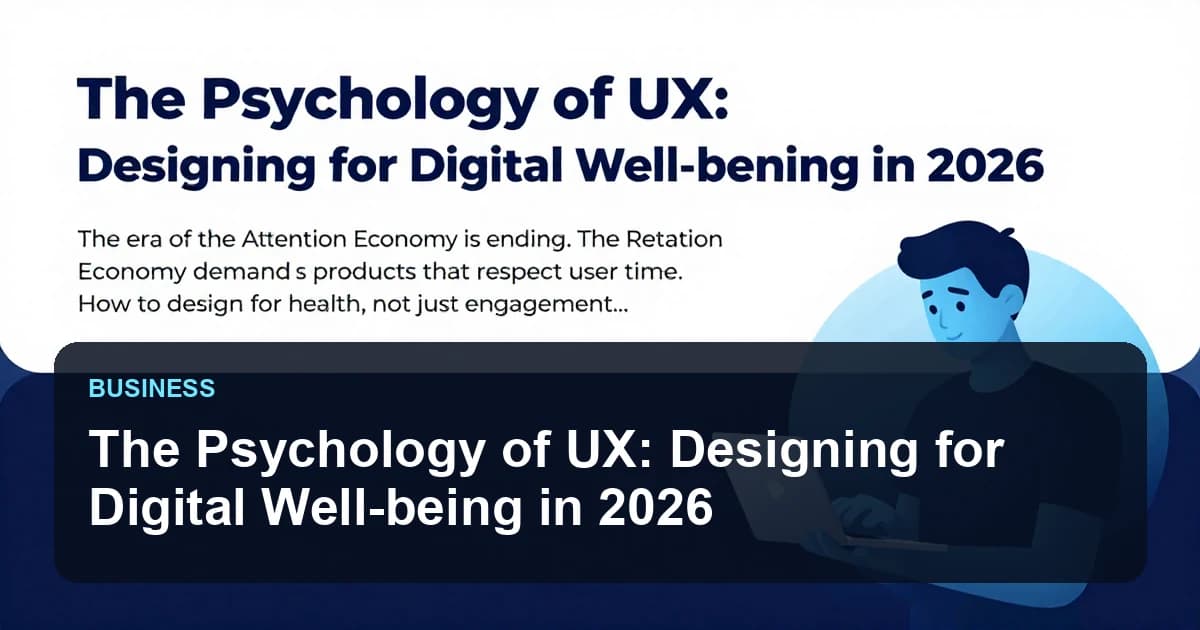
This represents a fundamental shift in business strategy. Designing for Digital Well-being is not just a CSR (Corporate Social Responsibility) initiative; it is the new competitive advantage. In this deep dive, we explore the psychology behind this shift and the practical frameworks for designing ethical, sustainable digital products.
The Psychology of Calm Tech
The term Calm Technology was coined in the 90s, but it is only now viable. The core principle is that technology should inform but not demand our focus. It should live in the periphery and move to the center only when necessary.
Cognitive Load and Decision Fatigue
Every notification, every pop-up, every decision a user has to make (even unconsciously) burns glucose in the brain. This is cognitive load. Apps designed for maximum engagement often maximize cognitive load. They bombard the user with choices, alerts, and FOMO (Fear Of Missing Out).
Well-being focused design focuses on Choice Architecture that minimizes fatigue.
- Defaults Matter: Setting the most healthy option as the default. For example, a messaging app that defaults to Batch Notifications (delivering a summary once every 4 hours) rather than instant buzzing.
- Friction as a Feature: Traditionally, UX removes friction. But ethical UX adds friction where it benefits the user. The Are you sure you want to post this? prompt before sending a potentially toxic tweet is a classic example. It engages System 2 thinking (slow, rational) over System 1 (fast, emotional).
Dismantling Dark Patterns
Dark Patterns are UI/UX interfaces meticulously crafted to trick users into doing things they did not mean to do. The Roach Motel (easy to get in, hard to get out—like a subscription cancellation flow) is the most infamous.
In 2026, relying on Dark Patterns is a liability. The Ethical Design Movement has led to consumers actively shaming brands that use them.
The Confirmshaming Anti-Pattern
We have all seen pop-ups that say No, I do not want to save money instead of a simple Close button. This manipulates shame. Ethical UX replaces this with neutral language. No thanks is perfectly fine. Respecting the user No builds long-term trust, which correlates with higher Lifetime Value (LTV) than a short-term email signup gained through manipulation.
Metrics that Matter: From Time-Spent to Time-Well-Spent
You cannot improve what you do not measure. If your KPI is Hours Spent in App, your team will build addictive features. Business leaders must redefine success.
The Net Promoter Score (NPS) 2.0
Standard NPS asks Would you recommend this?. Well-being NPS asks: Do you feel better or worse after using this product?.
Center for Humane Technology suggests metrics like:
- Regret Rate: What percentage of users regret the time they spent on the platform? (YouTube famously optimized their recommendation algorithm when they found users regretted rabbit hole binges).
- Task Completion Efficiency: For tools, the goal should be less time on site. If a user can do their banking in 30 seconds instead of 3 minutes, that is a UX win, even if Time on Site drops.
Designing the Off-Ramp
Most apps are designed with infinite on-ramps and no off-ramps. The infinite scroll is the perfect example; it has no stopping cue. The human brain relies on stopping cues (the end of a chapter in a book, the credits of a movie) to decide to move on. Without them, we doomscroll.
Ethical UX designers are reintroducing Stopping Cues.
- You are all caught up: Instagram feature that tells you when you have seen all new posts was a watershed moment. It gives user permission to leave.
- Pagination vs. Infinite Scroll: Bringing back the Next Page button. It breaks the flow, giving the user a split-second to ask, Do I want to continue?.
The Business Case for Ethics
Skeptics argue that this is all nice but unprofitable. Data suggests otherwise.
The Trust Premium
In an era of deepfakes and data breaches, Trust is the most scarce currency. Brands that are perceived as safe and respectful command a premium. Apple pivot to Privacy as a Product is the prime example. They marketed their refusal to track users as a luxury feature, and it worked.
Employee Retention
Top talent, particularly Gen Z designers and engineers, refuse to work on evil products. Companies known for addictive/manipulative tech are struggling to hire the best. Building an ethically sound product is a recruitment strategy.
Case Study: The Focus Mode Revolution
Consider the transformation of Operating Systems (iOS, Android, Windows). Five years ago, they were notification chaos engines. Today, Focus Modes are central to the OS.
This was not a niche feature for power users; it became a headline selling point. Phones started marketing themselves not on how much they could do, but on how much peace they could provide. This JOMO (Joy Of Missing Out) trend is filtering down to individual apps. A productivity tool that includes a built-in Deep Work timer is now valued higher than one with a thousand integration bells and whistles.
Conclusion: The Human-Centric Future
We are moving from a Techno-Centric view (what can the technology do?) to a Human-Centric view (what does the human need?). The humans need sleep. They need focus. They need connection with people, not screens.
The products that will win in 2026 and beyond are those that help users live their lives, not those that attempt to replace their lives. As designers and business leaders, our mandate is simple: First, do no harm. Second, empower the human spirit.
Written by XQA Team
Our team of experts delivers insights on technology, business, and design. We are dedicated to helping you build better products and scale your business.