The Latency Imperative
In March 2025, an autonomous vehicle manufacturer recalled 50,000 vehicles after discovering that cloud-dependent decision-making caused dangerous 200-millisecond delays in emergency braking scenarios. The incident crystallized what engineers had understood for years: some computations cannot wait for round-trips to distant data centers. The edge computing revolution is not about abandoning the cloud—it is about putting intelligence where nanoseconds matter.
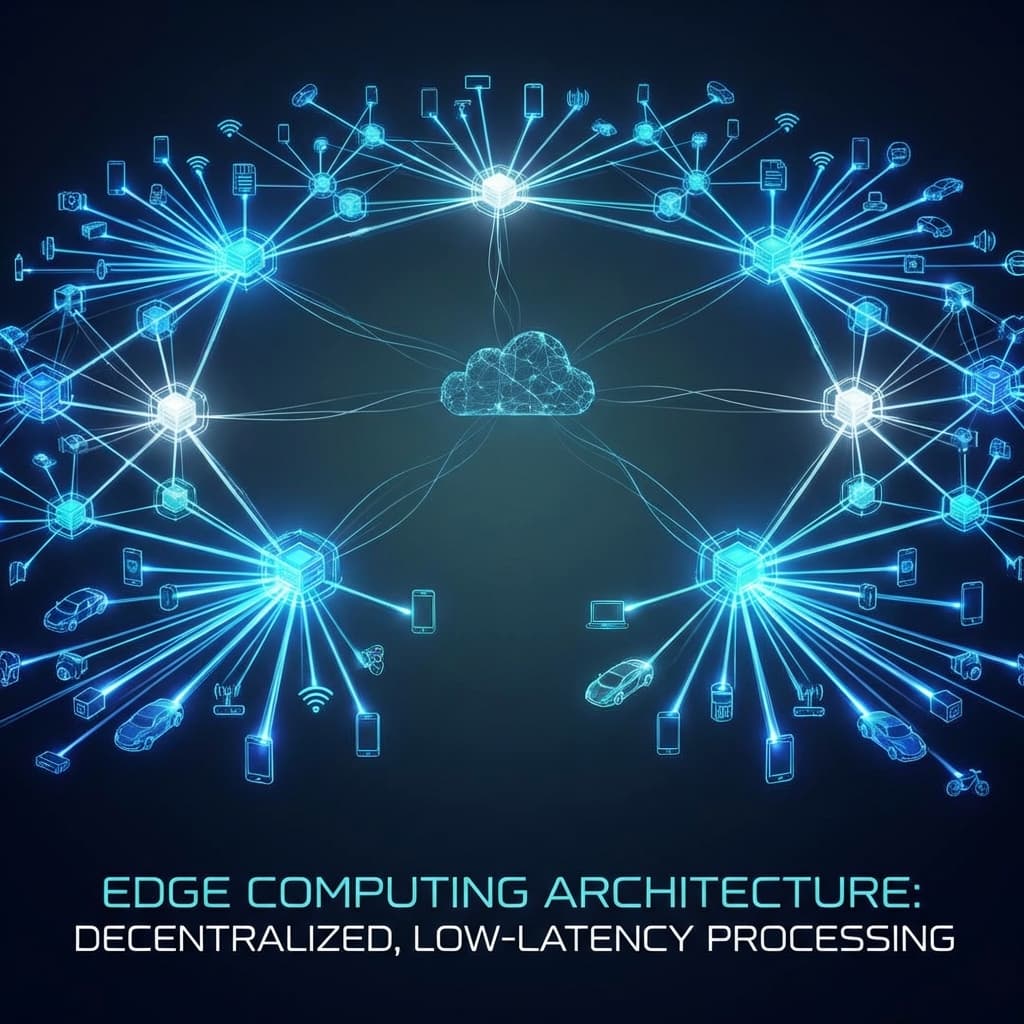
Edge computing moves data processing from centralized data centers to the periphery of the network—closer to where data is generated and where actions must be taken. This architectural shift addresses fundamental physics: light travels at finite speed, and no amount of optimization can eliminate the latency inherent in communicating with servers thousands of miles away.
The stakes are enormous. By 2026, analysts estimate that over 75% of enterprise data will be created and processed outside traditional centralized data centers or cloud environments. This represents a fundamental reimagining of computing architecture with profound implications for QA, testing, and software development practices.
Understanding the Edge Spectrum
Edge computing is not a single technology but a spectrum of deployment models ranging from cloud-adjacent to device-embedded.
Regional Edge (Cloudlets)
Major cloud providers now operate regional edge locations in dozens of metropolitan areas worldwide. AWS Local Zones, Azure Edge Zones, and Google Distributed Cloud bring compute capacity within single-digit milliseconds of large population centers. These facilities offer familiar cloud services—compute instances, containers, managed databases—but with dramatically reduced latency for nearby users.
On-Premises Edge
Enterprise edge deployments place compute infrastructure within corporate facilities—factories, hospitals, retail stores. Hardware ranges from ruggedized servers in industrial environments to purpose-built edge appliances. On-premises edge enables processing of sensitive data without leaving organizational boundaries, addressing both latency and data sovereignty requirements.
Far Edge (Device Edge)
The far edge pushes computation onto devices themselves—smartphones, vehicles, industrial sensors, smart cameras. Machine learning inference running on device processors eliminates network dependency entirely. A security camera with on-device computer vision can detect intruders even when network connectivity fails.
Use Cases Driving Edge Adoption
Specific application requirements are driving organizations toward edge architectures.
Industrial IoT and Manufacturing
Modern factories deploy thousands of sensors monitoring equipment health, production quality, and safety conditions. Processing this sensor data at the edge enables real-time anomaly detection and predictive maintenance. A vibration sensor detecting early signs of bearing failure can trigger maintenance alerts within milliseconds, preventing catastrophic equipment failures that cloud-based processing might catch too late.
Autonomous Systems
Self-driving vehicles, delivery drones, and industrial robots require split-second decision-making that cannot depend on network connectivity. These systems must process sensor data locally, making driving decisions, obstacle avoidance maneuvers, and navigation adjustments without cloud consultation. Edge computing is not optional for autonomous systems—it is existential.
Augmented and Virtual Reality
Immersive experiences demand latencies below 20 milliseconds to avoid motion sickness and maintain presence. Cloud-rendered AR/VR introduces unacceptable delays. Edge rendering—whether on-device or at nearby edge servers—enables the responsiveness that immersive applications require.
Healthcare and Telemedicine
Medical imaging analysis, patient monitoring, and surgical robotics increasingly leverage AI at the edge. Processing medical data locally addresses both latency requirements (real-time surgical guidance) and regulatory constraints (HIPAA data locality requirements). Edge computing enables AI-assisted diagnostics in rural clinics without transmitting sensitive patient data to distant cloud facilities.
Edge Architecture Patterns
Successful edge deployments follow established architectural patterns.
Hub and Spoke
Edge nodes operate semi-autonomously but synchronize with central cloud infrastructure for model updates, configuration changes, and aggregated analytics. The edge handles real-time processing while the cloud provides training data aggregation, model improvement, and cross-location insights.
Mesh Topologies
In some scenarios, edge nodes communicate peer-to-peer without central coordination. Vehicle-to-vehicle communication for collision avoidance, mesh networking in disaster response scenarios, and distributed sensor networks benefit from mesh architectures that continue functioning even when cloud connectivity fails.
Tiered Processing
Many applications implement tiered processing where initial filtering and classification happen at the far edge, intermediate processing occurs at on-premises edge infrastructure, and complex analysis or long-term storage happens in the cloud. A security camera system might detect motion on-device, classify objects at an on-premises server, and store flagged footage in cloud archives.
Testing Challenges at the Edge
Edge computing introduces novel testing challenges that traditional QA approaches struggle to address.
Environmental Variability
Edge devices operate in uncontrolled environments—temperature extremes, intermittent connectivity, power fluctuations. Testing must simulate these conditions, validating that applications degrade gracefully when conditions deteriorate. A warehouse inventory system must continue functioning when temperature sensors experience thermal stress during summer heat waves.
Distributed State Management
With computation distributed across edge locations, testing must verify correct behavior when nodes have inconsistent views of system state. What happens when two edge nodes make conflicting decisions during a network partition? Eventually consistent systems require testing scenarios that traditional request-response testing approaches do not cover.
Hardware Heterogeneity
Edge deployments often include diverse hardware platforms with different CPU architectures, memory constraints, and accelerator capabilities. Testing across this hardware matrix requires either expensive physical device farms or sophisticated emulation capabilities.
Update and Rollback Complexity
Updating software on thousands of distributed edge devices introduces deployment complexity that centralized cloud applications do not face. Testing must verify not just that new versions work correctly but that update processes handle failures gracefully—partially updated devices, interrupted deployments, and version incompatibilities across device populations.
Edge Testing Strategies
Addressing edge testing challenges requires adapted methodologies.
Digital Twins
Digital twin technology creates virtual replicas of physical edge environments. These simulated environments enable testing edge applications against realistic conditions without deploying to actual hardware. A digital twin of a factory floor can simulate equipment behavior, environmental conditions, and network characteristics.
Chaos Engineering for Edge
Edge-specific chaos experiments test resilience to conditions common at the edge: network partitions between edge and cloud, sudden connectivity restoration after extended offline periods, clock drift between synchronized nodes, and resource exhaustion on constrained devices.
Progressive Rollouts
Canary deployments and feature flags are essential for edge software updates. Roll changes to a small percentage of edge devices, monitor for anomalies, and expand gradually. The blast radius of a bad update must be contained when thousands of devices are at stake.
Conclusion: Computing Returns to Its Roots
In the mainframe era, computing was centralized by necessity—only large institutions could afford the massive machines that processed data. The personal computer revolution distributed computing power to desktops and laptops. The cloud era re-centralized computation into hyperscale data centers. Now, edge computing represents a synthesis: local processing for latency-sensitive workloads, cloud computing for complex analysis and storage, and intelligent orchestration connecting them.
For QA teams, edge computing demands new skills and approaches. Testing strategies must account for distributed systems complexity, environmental variability, and hardware heterogeneity. But teams that master edge testing will find themselves at the forefront of computing's next evolution—where intelligence lives not in distant data centers but at the edge of experience itself.
Written by XQA Team
Our team of experts delivers insights on technology, business, and design. We are dedicated to helping you build better products and scale your business.