Two Wins, One Mistake
In Q4 of 2024, we closed our first enterprise deal. A Fortune 500 company. $120,000/year. It took 18 months from first contact to signed contract.
We celebrated massively. The sales team rang the gong. The CEO sent a company-wide email. We felt like we had "arrived" as a serious B2B company.
But here's what we didn't celebrate: during those same 18 months, our self-serve product—the one with no sales team involvement—had quietly acquired 4,200 paying customers. Total revenue: $380,000/year.
One sales rep, 18 months, one deal, $120k.
Zero sales reps, 18 months, 4,200 deals, $380k.
We celebrated the enterprise win because it was visible, dramatic, and fit the narrative of "serious B2B company." But the self-serve motion was 3x more productive per dollar spent.
This essay is about the false dichotomy between "enterprise sales" and "product-led growth"—and how to escape the trap we fell into.
Section 1: The False Dichotomy
The conventional wisdom says you have to choose: either you're a PLG company or you're a sales-led company. Different motions. Different teams. Different cultures.
This is a false dichotomy that's costing companies millions.
The Narrative
Product-led growth (PLG): Users sign up, try the product for free, and upgrade when they hit value. No sales involved. Slack, Dropbox, Notion.
Enterprise sales: Dedicated sales reps identify accounts, run demos, negotiate contracts, and close deals. Salesforce, Workday, ServiceNow.
The narrative says these are mutually exclusive. PLG companies are "bottoms-up." Enterprise companies are "tops-down." Never the twain shall meet.
The Reality
The best companies do both—simultaneously. They're not mutually exclusive; they're complementary.
- Slack has PLG for small teams AND enterprise sales for large organizations.
- Atlassian built a $50B company with minimal sales, then added enterprise sales at scale.
- Figma grew through viral PLG, then added sales to land multi-thousand-seat deals.
The dichotomy exists because of organizational laziness, not strategic reality. It's easier to organize around one motion than orchestrate two.
Why the Dichotomy Exists
The real reason companies treat PLG and enterprise as separate: different teams, different metrics, different incentives.
- Sales teams are measured on ACV and logo acquisition. They want big deals.
- Growth teams are measured on user acquisition and conversion. They want volume.
- Neither team talks to each other. Each thinks the other's motion is inferior.
The result: two parallel funnels that never connect. PLG customers who could become enterprise deals aren't handed off. Enterprise prospects who could try the free product are pushed through 18-month sales cycles instead.
The Missed Opportunity
Here's what we eventually realized: the funnel isn't linear—it's a web.
- PLG customers can grow into enterprise. Our largest enterprise deal started as a $29/month self-serve user.
- Enterprise contacts can start as self-serve. "Try it free" is a better first touchpoint than "schedule a demo."
- Self-serve users validate enterprise demand. If no one signs up for free, you don't have an enterprise product—you have an enterprise hope.
By treating PLG and enterprise as separate, we were leaving money—and speed—on the table.
Section 2: The Hidden Costs of Pure Enterprise
Let me walk through the true cost of our 18-month enterprise deal. The $120k/year headline obscures a lot of pain.
The Time Tax
18 months is a long time. During that period:
- We had 6 demo calls (each requiring 2-3 people × 1 hour = ~18 hours)
- We did 4 "proof of concept" sessions (40+ hours of engineering time)
- We attended 3 on-site meetings (travel, prep, execution = 60+ hours)
- We answered 200+ emails
Conservative estimate: 200+ hours of team time for a single deal. That's more than 5 weeks of full-time work, spread across 18 months.
The Security Questionnaire Tax
Enterprise buyers have security questionnaires. Ours had 347 questions.
- First pass: 30 hours to answer
- Clarification requests: 15 hours more
- They wanted modifications to our standard answers: 10 hours of legal review
55 hours just for the security questionnaire. And this was for a customer paying $120k. Our hourly investment was embarrassing.
The Legal Tax
Enterprise contracts require custom terms. Our standard contract wasn't acceptable. Theirs wasn't acceptable to us.
- Legal review of their contract: 10 hours (at $400/hour external counsel = $4,000)
- Negotiation back-and-forth: 15 hours
- Final contract with custom terms: 20 hours to finalize
$15,000 in legal costs for a single deal.
The Procurement Tax
Enterprise companies have procurement departments. They don't sign contracts quickly.
- Months 1-6: Talking to users and champions
- Months 7-12: Security review and "vendor assessment"
- Months 13-18: Contract negotiation and procurement approval
We hit every "budget cycle" delay, every "need more approvals" stall, every "procurement is backed up" excuse.
The Customization Tax
Enterprise customers want custom features. "Can you add SSO with our specific IdP?" "Can you integrate with our internal ticketing system?" "Can you white-label the UI?"
We spent 2 months of engineering time building features that only this one customer would use. Opportunity cost: features for the 4,200 self-serve customers got delayed.
The Math
Let's add it up:
- Revenue: $120,000/year
- Team time (200 hours × $100/hour loaded cost): $20,000
- Legal fees: $15,000
- Custom development (2 months × 1 engineer × $15k/month): $30,000
- Travel and entertainment: $5,000
- Sales rep commission (10%): $12,000
Total acquisition cost: ~$82,000.
First-year margin: $38,000.
ROI: 46% in year one. That's... okay. But only if they renew. And only if we didn't lose 2 months of product development for 4,200 other customers.
Section 3: The Hidden Power of PLG
Now let's look at the self-serve motion we were under-investing in.
The Numbers
- 4,200 customers acquired
- Average revenue per account: $90/year
- Total revenue: $378,000/year
- CAC: $12/customer (paid ads + content marketing)
- Total acquisition cost: $50,400
ROI: 650% in year one. Compared to 46% for enterprise.
No Sales Cycle
Self-serve customers sign up, try the product, and upgrade when ready. No demos. No security questionnaires. No 18-month cycles.
Our median time from signup to first payment: 14 days.
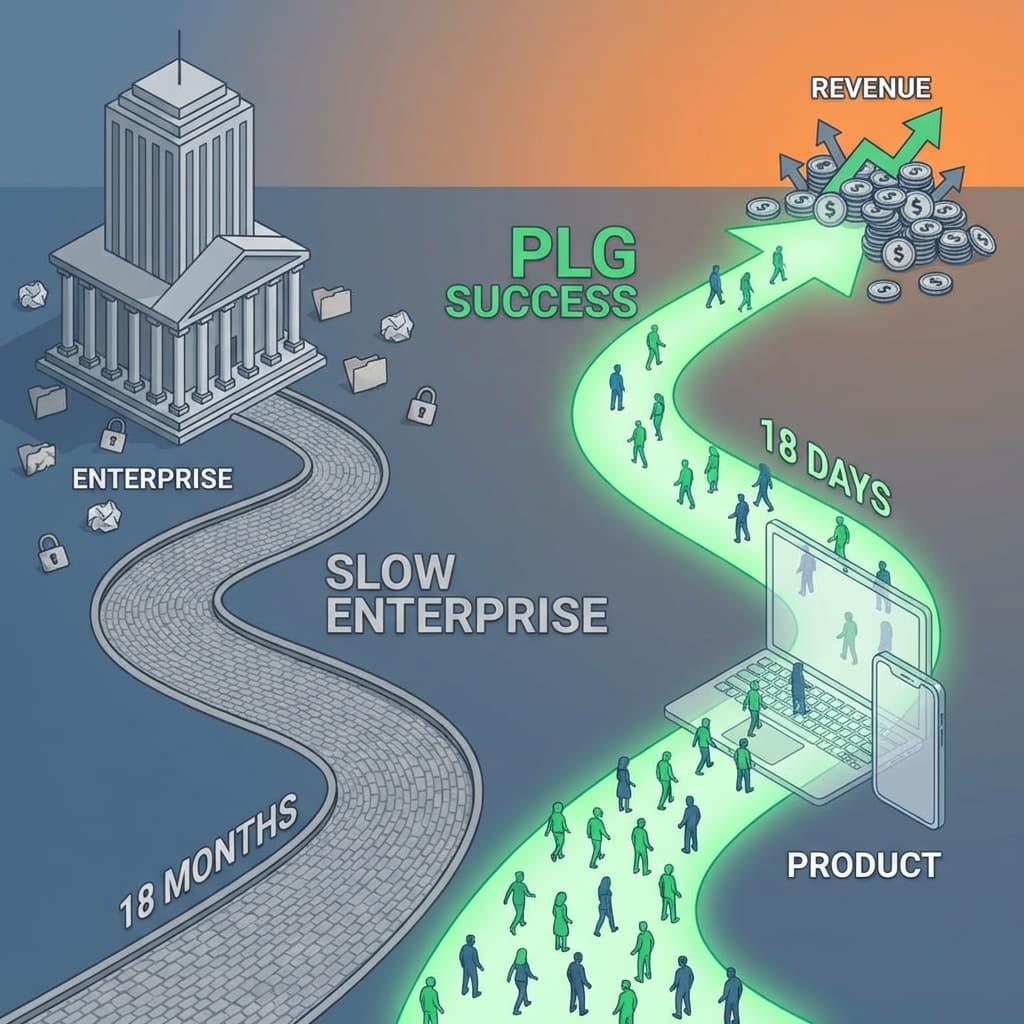
18 days vs. 18 months. That's a 45x speed advantage.
Compounding Growth
PLG compounds. Each cohort of users generates referrals. Happy customers tell colleagues. The flywheel spins.
- Year 1: 4,200 customers, $378k revenue
- Year 2 (projected at 60% YoY): 6,700 customers, $603k revenue
- Year 3 (projected): 10,700 customers, $963k revenue
No additional sales headcount required. The product does the selling.
Expansion Revenue
Here's the plot twist: PLG customers who grow often become enterprise customers—but they close 5x faster.
Why? They've already used the product. They know it works. There's no "proof of concept" required. The security questionnaire is their only hurdle, not 18 months of convincing.
Our biggest enterprise deal to date—$400,000/year—started as a $29/month self-serve user. They expanded organically for 18 months. Then their procurement department reached out: "We want to consolidate on an enterprise contract."
Sales cycle: 3 months. Because they were already customers.
Validation Signal
PLG is market research disguised as revenue. If people sign up and pay, you have a product. If they don't, you don't.
Enterprise sales can hide weak product-market fit. "They would have bought if procurement was faster." "It's just a long sales cycle." These excuses don't exist in self-serve. Either people convert or they don't.
Section 4: The Hybrid Model
The answer isn't "PLG good, enterprise bad." The answer is: use them together.
Unified Funnel: Self-Serve as Top of Enterprise
Stop treating PLG and enterprise as separate funnels. Self-serve is the top of the enterprise funnel.
The workflow:
- "Try it free" → User signs up and uses the product
- Usage-based triggers identify high-potential accounts (multiple users, heavy usage, enterprise signals)
- Sales reaches out: "Hey, I noticed your team is using [Product] heavily. Want to discuss enterprise features?"
- Sales cycle is 3 months, not 18, because they're already users
This is "product-qualified leads" (PQL) instead of cold outreach. Warm leads close faster.
Sales-Assist, Not Sales-Led
Redefine what enterprise sales does. They're not hunters—they're farmers.
Instead of cold-calling Fortune 500 companies, sales reps:
- Identify self-serve teams that could become enterprise
- Offer value-added services (onboarding help, training, customization)
- Facilitate enterprise procurement when teams are ready
Sales rep productivity goes from 1 deal/18 months to 5+ deals/year because they're not starting from zero.
Product as the Demo
Stop doing 1-hour demo calls with prospects. Say: "Sign up, use it, call us when you need enterprise features."
The product is the demo. If they can't get value from self-serve, they probably won't get value from enterprise either. If they can get value, they'll raise their hand when they're ready.
This filters out tire-kickers and prioritizes serious buyers.
Metrics That Unify
Stop measuring "PLG revenue" vs. "enterprise revenue" as separate numbers. Track:
- Self-serve to enterprise conversion rate
- Average time from first self-serve signup to enterprise close
- Revenue expansion within PLG accounts
- PLG customer lifetime value (including enterprise upgrades)
These metrics incentivize collaboration between growth and sales. They share a funnel now.
When Pure Enterprise Still Makes Sense
Sometimes you do need traditional enterprise sales:
- Very large deals ($500k+) where the customization is worth it
- Highly regulated industries where procurement is unavoidable
- Strategic accounts where the logo matters for credibility
But even then, "Can they try self-serve first?" is a valid question. The answer is often yes.
Closing Thought
PLG and enterprise aren't opposites. PLG is how you get enterprise without spending 18 months on each deal.
We celebrated the wrong win. The big enterprise logo felt important, but the 4,200 self-serve customers were the real growth engine.
If I could go back, I would:
- Double down on self-serve acquisition, not try to land enterprise logos prematurely
- Build enterprise sales as an "upgrade path" for successful self-serve teams, not a separate motion
- Measure success by total funnel efficiency, not by logo count
18 months for one deal is not a business model—it's a hope. 18 days to paying customers, repeated 4,200 times, is a machine.
Build the machine first. Add the big logos later.
Appendix: PLG Readiness Checklist
Before investing in heavy enterprise sales, can you answer "yes" to these?
- Can a user sign up and get value without talking to sales?
- Is there a free or low-cost tier that demonstrates the product?
- Do you have a self-serve upgrade path?
- Are you tracking product-qualified leads (high-usage accounts)?
- Can sales identify and reach out to self-serve teams that could expand?
If you answer "no" to multiple questions, you're doing enterprise sales without a PLG foundation. Consider building the foundation first.
Written by XQA Team
Our team of experts delivers insights on technology, business, and design. We are dedicated to helping you build better products and scale your business.