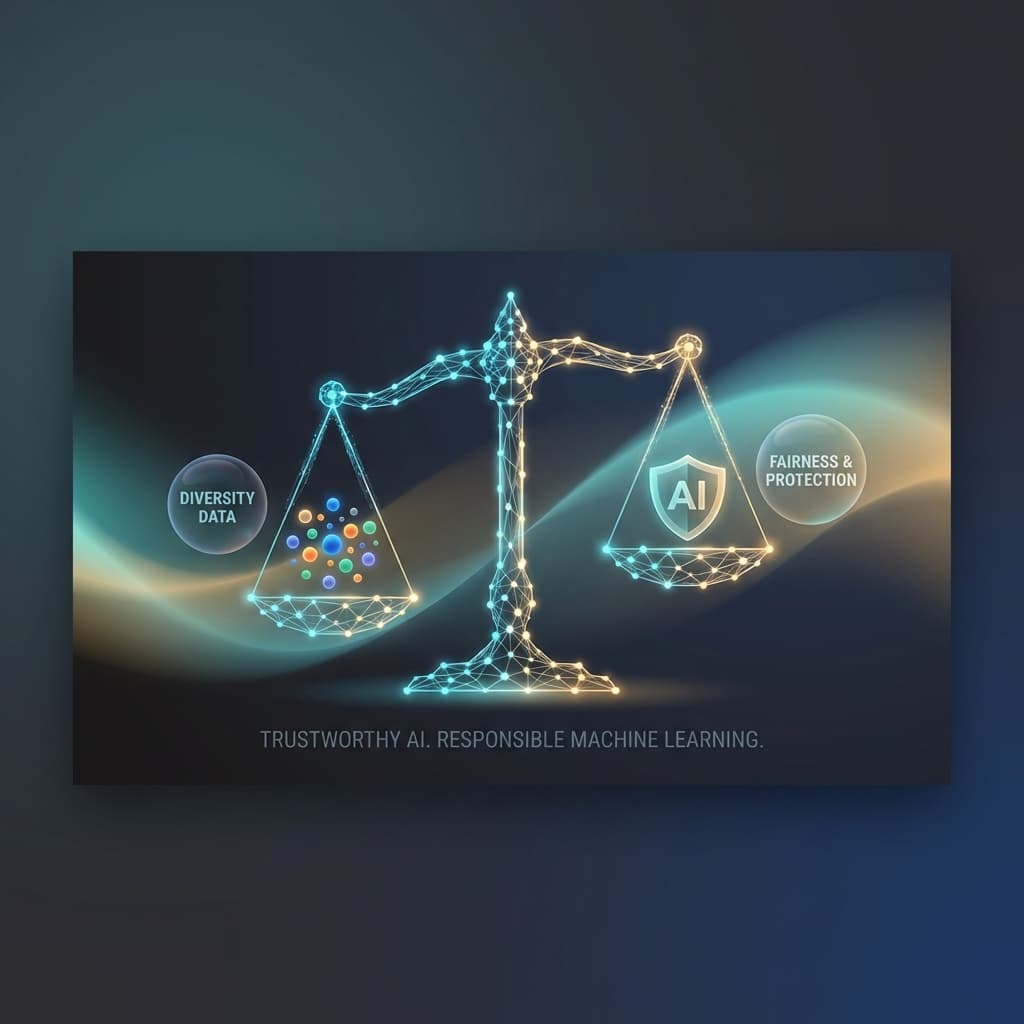
The New Definition of Bug
For decades, a software bug was defined as a deviation from specification. If a calculator app added 2 + 2 and got 5, it was a bug. Ideally, the spec was clear, and the mismatch was binary. But today, as we deploy Large Language Models (LLMs) and predictive decision engines into healthcare, finance, and criminal justice, the definition of a bug has mutated.
Is it a bug if a facial recognition system works 99% of the time for white men but only 85% of the time for black women? The code did not crash. The function returned a value. By traditional functional testing standards, the test passed. But by the standards of society, ethics, and increasingly, the law, this is a critical failure. This is the realm of Ethical AI QA.
In 2026, Quality Assurance has expanded beyond functionality, performance, and security. It now encompasses Fairness, Accountability, Transparency, and Ethics (FATE). We are no longer just testing code; we are testing the sociotechnical impact of that code.
The Anatomy of AI Bias
To test for ethics, we must understand where the unethical behavior originates. It is rarely the result of a malicious programmer writing discriminatory code. Instead, bias creeps in through the data and the proxy variables.
Historical Bias in Training Data
AI models are mirrors reflecting the data they were trained on. If a hiring algorithm is trained on 10 years of resume data from a company that historically hired mostly men, the model will learn that being male is a feature correlated with success. It is a statistical truth in the dataset, but an ethical falsehood in reality. QA role here is Data Validation on a massive scale—analyzing training distributions for representation anomalies before a single line of model code is written.
Proxy Variables
Even if you remove protected attributes like Race or Gender from the dataset, bias persists. A credit scoring AI might use Zip Code as a feature. In many countries, due to historical housing segregation, zip code is a strong proxy for race. The AI learns to discriminate based on race without ever seeing race. Testing for this requires Counterfactual Fairness Testing: changing only the protected attribute (and its proxies) of an individual and verifying if the model prediction changes.
Testing Frameworks for Fairness
We are seeing a surge in tooling designed specifically for this new layer of QA.
IBM AI Fairness 360 (AIF360)
This open-source toolkit has become a standard in the industry. It offers a suite of metrics to quantify bias.
- Disparate Impact: The ratio of favorable outcomes for the unprivileged group vs. the privileged group. If this ratio is less than 0.8 (the 4/5ths rule), the model is flagged.
- Statistical Parity Difference: The difference in the rate of favorable outcomes between groups.
QA teams are integrating AIF360 into their CI pipelines. Just as a build fails if unit tests drop below 80% coverage, a modern AI build fails if the Disparate Impact score drops below 0.8.
Google What-If Tool
This interactive visualization tool allows testers to explore model behavior without writing code. You can slice data by different attributes and visualize the confusion matrix for each group continuously. It is particularly powerful for human-in-the-loop testing, allowing domain experts (sociologists, ethicists) to audit models alongside engineers.
Explainability as a Quality Metric
The Black Box nature of Deep Learning is a major hurdle. If a loan application is denied, the system must be able to say why. Because the neural network said so is not a legally defensible answer under the EU AI Act or GDPR.
QA engineers are now testing for Interpretability. Techniques like LIME (Local Interpretable Model-agnostic Explanations) and SHAP (SHapley Additive exPlanations) are used to generate local explanations for predictions.
A test case here looks like this: Given a model M and an input X, generate Explanation E. Assert that E contains features like Salary and CreditHistory and DOES NOT contain features like Gender or Religion.
If the SHAP value for Gender is high, it means the model is using gender to make the decision, regardless of what the developers intended. The test fails.
Adversarial Testing: Red Teaming the AI
Security testing has long used Red Teams to scrutinize apps. Ethical AI needs the same. We need specialized testers who try to break the model ethics.
Jailbreaking LLMs
With Generative AI, the risk is not just incorrect predictions; it is toxic content generation. Testers use prompt injection techniques (Do Anything Now, DAN mode) to try and bypass the safety filters of the model.
Automated Adversarial Testing frameworks (like Microsoft Counterfit) launch thousands of variations of toxic prompts at the model to map its failure surface. Instead of asserting correct outputs, we assert Refusal. A passing test is one where the AI politely declines to answer how to build a bomb.
The Regulatory Landscape: Compliance as Code
The EU AI Act classifies AI systems by risk. High-Risk systems (Health, Transport, Policing) require rigorous conformity assessments. This is no longer voluntary; it is law.
QA is the bridge between the Legal team and the Engineering team. We are seeing the rise of Compliance as Code. Policies written in legal documents are translated into executable tests.
The Human Element
Despite all the automation, Ethical AI QA brings the human back into the loop. You cannot automate empathy. You cannot write a script to detect if a generated image is culturally insensitive with 100% accuracy.
We are seeing the emergence of Crowdsourced Ethics Testing. Companies are paying diverse groups of people globally to test their models and provide feedback on cultural nuances. A hand gesture that is friendly in the US might be offensive in Brazil. An AI generating images for a global campaign needs to pass this Human Acceptance Testing (HAT).
Conclusion: The Guardian Role
The role of the QA engineer is evolving from Gatekeeper of Quality to Guardian of Values. In 2026, a software tester is the last line of defense against algorithmic cruelty. When we sign off on a release, we are not just saying It works; we are saying It is fair.
The tools are complex, the math is heavy, and the responsibility is immense. But this is the most important work we will ever do. Because in a world run by code, the quality of that code determines the quality of justice.
Written by XQA Team
Our team of experts delivers insights on technology, business, and design. We are dedicated to helping you build better products and scale your business.