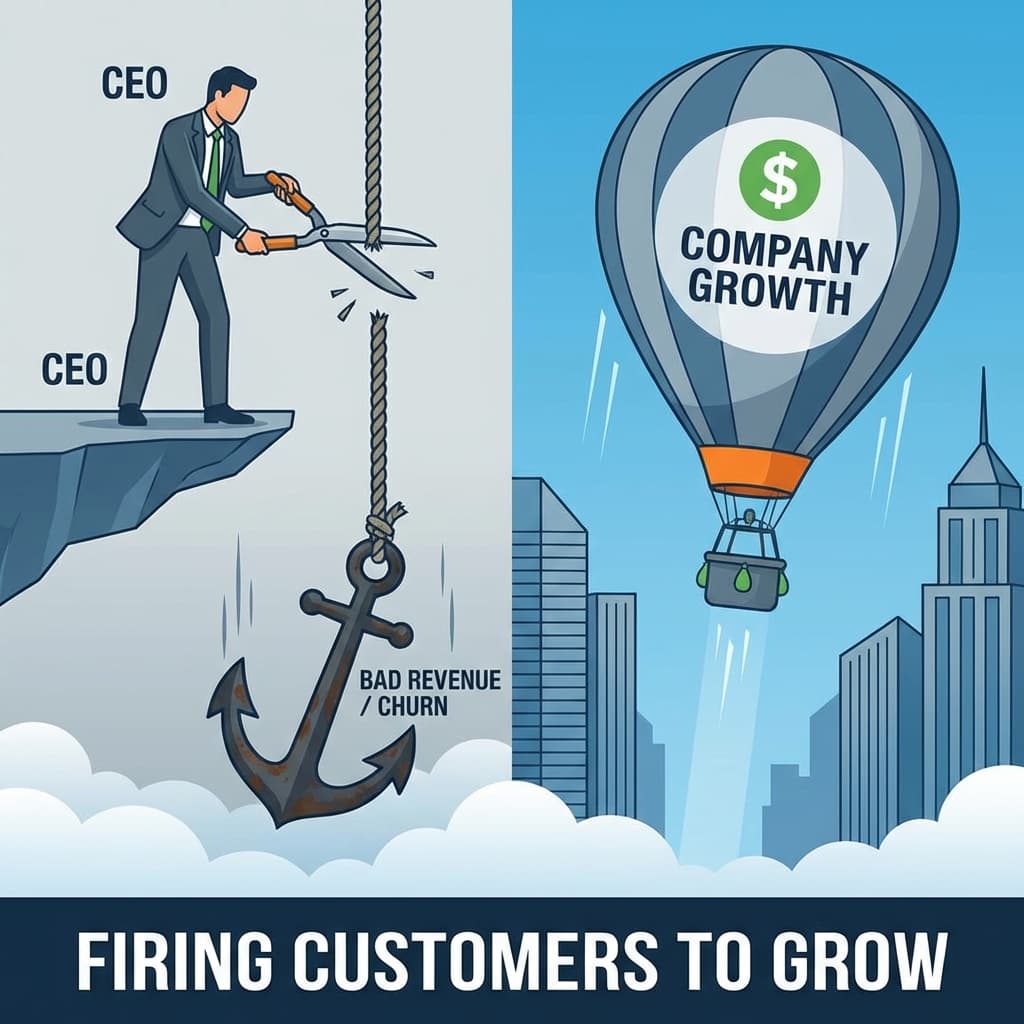
The "Churn Meeting" Epiphany
The Board meeting was a bloodbath. Our monthly churn hit 8%.
"The product is buggy!" shouted the VP of Sales. "We need more features!"
"The users are using it wrong!" shouted the VP of Product.
I sat quietly and looked at the exit surveys. The #1 reason for leaving: "This tool is too expensive/complex for my personal blog."
Wait. We sell Enterprise B2B software. Why did we have "personal blogs" as customers?
I dug into Salesforce. Our sales team, desperate to hit quota, was closing anyone with a pulse. We were acquiring customers who were mathematically destined to churn.
I made a hard call. I fired the VP of Sales. And the next day, I sent an email "Firing" 300 of our customers (offboarding them with a refund).
Revenue dropped by 30%. But we saved the company.
Section 1: The "False God" of Top-Line Revenue
In the VC world, "Revenue Growth" is god. But all revenue is not created equal.
Bad Revenue: A $500 deal looks good on the gong. But if that customer costs $1,000 in support time, server load, and refund processing, you are bleeding money with every sale.
We were addicted to "Bad Revenue." We widened the funnel to people who didn't fit the product just to show a "Graph going up to the right."
Margin is Sanity: Revenue is vanity. Profit (and retention) is sanity. We needed to stop shrinking our margins to feed the ego of the growth chart.
Section 2: The Support Tax of Bad Fits
The Pareto Principle (80/20 Rule) applies brutally to customer support.
The Data: We found that the bottom 30% of customers (by revenue) generated 80% of our support tickets.
These "Bad Fit" customers:
- Demanded features we shouldn't build (distracting the roadmap).
- Complained about pricing constantly.
- Demoralized the support team with "Urgent!" tickets for $20/month accounts.
Firing them was an instant morale boost. Our support queue cleared up. The team could breathe.
Section 3: The ICP (Ideal Customer Profile) Discipline
The hardest discipline in business is saying NO to money.
We instituted a strict ICP (Ideal Customer Profile). If a prospect—even a rich one—didn't match our ICP (Enterprise, 50+ seats, Technical), we refused to sell to them.
It hurt. It felt insane to turn away checks. But by stripping away the noise, we focused 100% of our R&D on the "Power Users" who paid us $50k/year.
The Result: Our retention in that Power User segment went to 140% (Net Revenue Retention). They loved us because we built *for them*, not for the bloggers.
Section 4: Revenue Quality > Revenue Quantity
Investors eventually realized what we had done.
We shrank from $5M ARR to $3.5M ARR overnight. Ideally, a disaster.
But our Churn dropped to 0.5%. Our Burn Rate dropped by 40% (less support, less server load). We became profitable.
And because our retention was so high, our LTV (Lifetime Value) skyrocketed. Investors value "High Quality Revenue" at 10x-20x multiples.
Conclusion
Firing a customer is the hardest decision a CEO can make. It admits failure.
But sometimes, you have to amputate the limb to save the body. Stop chasing bad revenue. Fire the bad fits. Focus on the ones who love you.
Written by XQA Team
Our team of experts delivers insights on technology, business, and design. We are dedicated to helping you build better products and scale your business.