We joined the "4-Day Work Week" movement. We read the viral LinkedIn posts. We saw the studies from Iceland and New Zealand claiming "Same output in less time!" We wanted to be the progressive, employee-first startup. So we switched to a Mon-Thu schedule.
Three months later, we cancelled it.
It wasn't because output dropped (it stayed roughly the same). It was because morale collapsed. The "extra day off" became a curse that poisoned the other four. Here is the unvarnished truth about the 4-Day Work Week that no HR influencer will tell you.
The "Panic Monday" Phenomenon
The first Monday of our new experiment was a shock to the system. We called it "Panic Day."
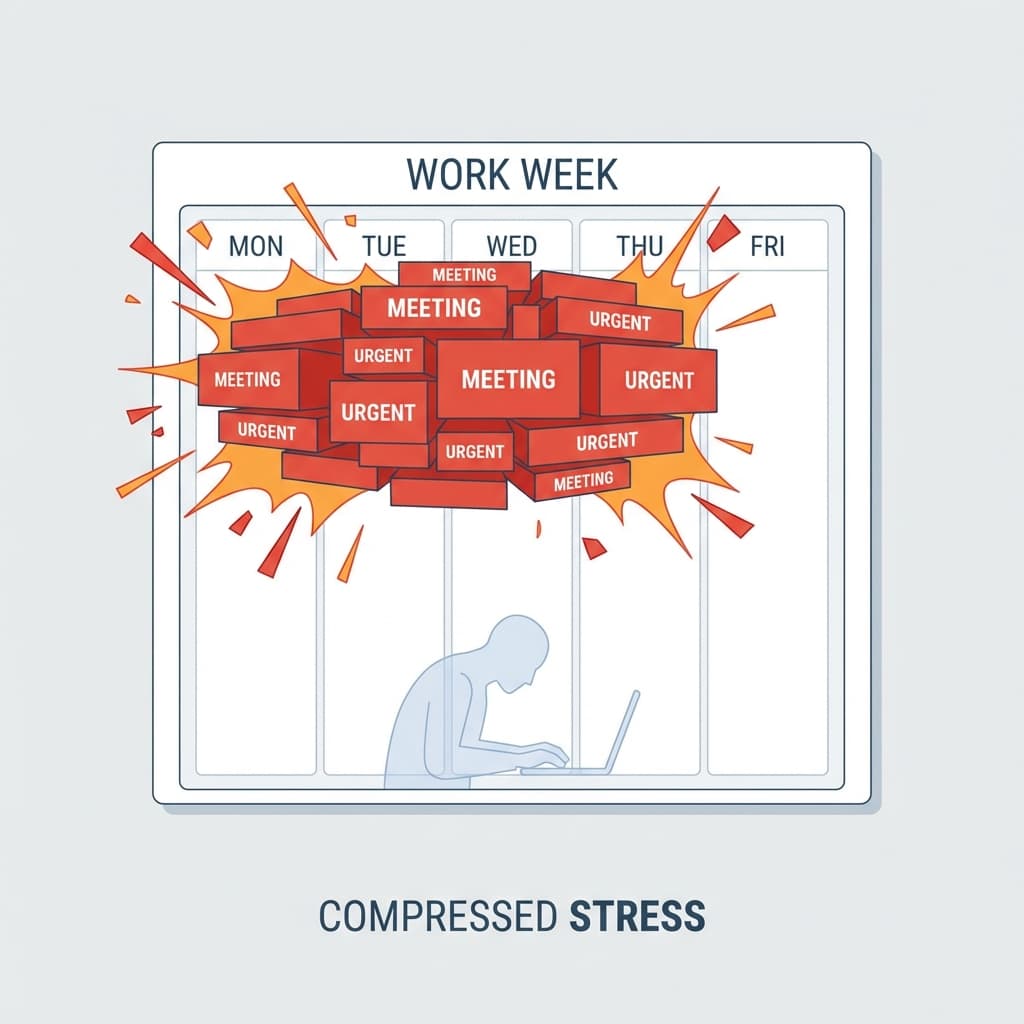
Here is the math problem nobody talks about: If you have 40 hours of work and you compress it into 32 hours, you have to increase Intensity by 25% to maintain parity. But work isn't just "typing code." It involves meetings, emails, Slack, mentorship, and planning.
Because we only had four days to synchronize, our calendars exploded. Monday became a wall of back-to-back meetings from 9:00 AM to 6:00 PM. We had to cram the "Friday Standup", the "Friday Retro", and the "Friday Planning" into Monday and Thursday.
Lunch breaks disappeared. People stopped going out for coffee. The office (and the Zoom chat) went silent. Everyone was frantic.
By Thursday night, my team wasn't "excited for the long weekend." They were shattered. They were more exhausted after 4 days of 120% intensity than they used to be after 5 days of 80% intensity.
We realized a fundamental truth: Compression causes Friction.
Section 1: The "Slack" Fallacy
The 4DWW (4-Day Work Week) movement is built on a premise: "Knowledge workers waste 20% of their time anyway, so just cut the fluff."
This is true for bloated corporate bureaucracies. If you work at a F500 bank where you sit in 4 hours of useless Compliance Training, yes, you can cut a day.
But we are a high-performance startup. We were already lean. We didn't have "fluff."
So when we cut 20% of the time, we cut into the "Deep Work" muscle to bone.
The Loss of "Thinking Time":
Great code requires staring at a wall. It requires hammocking. It requires "Slack" in the system. When every minute is accounted for, you stop innovating and start executing.
Our "Innovation Metrics" (new libraries created, refactors proposed) dropped to zero. Engineers became ticket-closing robots. They hit their Jira quotas, but the soul of the engineering culture withered.
Section 2: The Death of Social Glue
Culture is what happens in the margins. It's the 15 minutes before a meeting starts. It's the "Hey, do you have a sec?" conversation that turns into a whiteboard session.
In a compressed week, Margins are Inefficiency.
If you stopped by someone's desk to chat about their weekend, you saw the panic in their eyes. They didn't have time to chat. They had to finish by Thursday 5:00 PM.
The Isolation of Juniors:
The biggest victims were our Junior Engineers. Mentorship takes time. It is "inefficient" by definition. In a 5-day week, a Senior Dev might spend Friday afternoon pairing with a Junior. In a 4-day week, the Senior Dev is desperately trying to finish their own Sprint.
We saw a marked increase in "Help, I'm stuck" messages going unanswered. The Seniors weren't being mean; they were drowning.
Section 3: The "Shadow Friday" Secret
About 6 weeks in, I noticed something odd on our GitHub analytics.
We were technically "closed" on Friday. But I saw commits. I saw Pull Requests being merged. I saw Slack bubbles turning green.
I surveyed the team anonymously. 60% of them were working on Fridays.
They weren't doing it because I asked them to. They were doing it because the pressure of the Mon-Thu Sprint was too high. They used Friday as a relief valve. A day to actually code without meetings.
So, we didn't have a 4-Day Work Week. We had a "4-Day Visible, 1-Day Hidden" Week.
This was the worst of both worlds:
- Anxiety: People felt guilty for working ("Am I the only one who can't finish in 4 days?").
- No Credit: They weren't getting paid extra, and they couldn't brag about their work.
- False Data: Management thought the policy was working ("Look, we hit goals!"), but the goals were being hit by unpaid overtime.
Section 4: Why "Rigidity" is the Real Enemy
The 4-Day Work Week makes the same mistake as the "Return to Office" mandate. It tries to solve a cultural problem with a Rigid Schedule.
Dictating "You MUST rest on Friday" is just as authoritarian as saying "You MUST work on Friday."
What if I want to take Wednesday off because my kid has a play? What if I'm in a flow state on Friday and want to code?
By forcing the entire company into the same rhythmic box, you ignore the reality of creative work. Creative work is bursty.
Section 5: The Better Alternative (Results-Only Work Environment)
We replaced the 4DWW with a policy called ROWE (Results-Only Work Environment).
- No Core Hours: We don't care when you log in.
- No Tracking: We don't count days off. We don't count hours.
- Outcome-Based: "Did you ship the API?"
The "Asynchronous Friday" Compromise:
To keep the benefit of "Deep Work," we declared Friday a "No Meeting Day." No Zoom. No Standups. No Expectations of immediate Slack replies.
If you want to take Friday off? Go ahead. If you want to use it to code for 8 hours in silence? Go ahead.
The Outcome:
- About 30% of the team takes Friday off regularly.
- About 40% work half-days.
- About 30% work full days because they love the quiet.
Burnout dropped. Satisfaction rose. Why? Because we gave them Autonomy, not a Schedule.
Section 6: The Client Problem
There is also a business reality we ignored: Our Customers work on Fridays.
When we went dark on Fridays, support tickets piled up. Critical bugs went unpatched for 72 hours (Thu night to Mon morning). Our SLA breaches skyrocketed.
We tried a "Rotation" system (half-team works Mon-Thu, half works Tue-Fri), but that fractured collaboration. The Mon-Thu team couldn't talk to the Tue-Fri team on Mondays or Fridays. We lost 40% of our overlap time.
Unless the whole world switches to a 4-day week, B2B service businesses (like SaaS) cannot afford to vanish for 20% of the business week.
Conclusion
The 4-Day Work Week is a seductive slogan. It sells well on LinkedIn.
But high-performance engineering is a marathon, not a series of sprints. Compressing the marathon into fewer days doesn't make it easier; it makes it harder.
Don't manage Time. Manage Energy. Manage Focus. And trust your adults to manage their own calendars.
Written by XQA Team
Our team of experts delivers insights on technology, business, and design. We are dedicated to helping you build better products and scale your business.