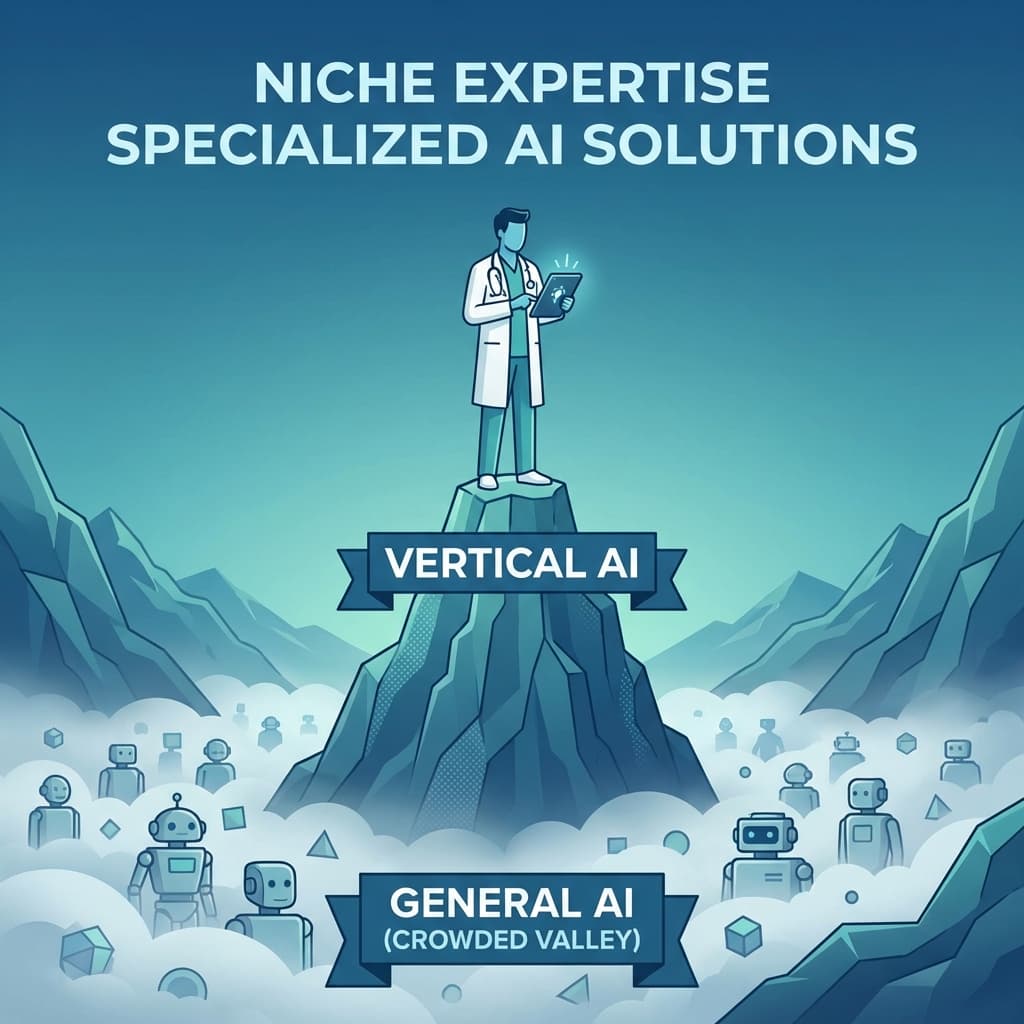
In 2024, everyone wanted to build the "Next ChatGPT." They added a chatbot to their homepage. They wrapped GPT-4 and called it a product. They burned millions in VC cash trying to compete on "General Intelligence".
In 2026, those startups are dead.
The "General AI" layer has become a commodity utility, like Electricity or AWS. You don't build a business by selling electricity; you build a business by running a factory using electricity.
The winners of this cycle aren't the ones building "God Mode" AI. They are the ones building "AI for Dentists", "AI for HVAC Repair", and "AI for Maritime Law".
This is the Vertical AI Revolution, and here is why it is the only place left to make money.
The "Context Window" Trap
General AI has a fatal flaw: It doesn't know your business.
You can paste a PDF into ChatGPT, but it doesn't know the 20-year history of why your legacy code is written that way. It doesn't know the specific zoning laws of Austin, Texas, relative to a commercial plumbing permit.
General Models are "Jack of All Trades, Master of None." They are B+ students at everything.
But in business, you pay for A+ expertise.
Vertical AI wins because it restricts the domain. By narrowing the scope, you can:
- Fine-tune on proprietary "Small Data" (which is more valuable than Big Public Data).
- Hard-code guardrails that prevent hallucinations in that specific field.
- Integrate deeply into the workflow (not just a chatbot).
Section 1: The "Data Moat" is Actually a "Workflow Moat"
Investors love talking about "Data Moats." "We have more X-Rays than anyone else!"
Wrong. Data is leaky. Workflow is sticky.
The successful Vertical AI companies don't just "give answers." They do the work.
Example: The "AI Lawyer"
- Bad (Wrapper): A chatbot where you ask "Is this contract valid?"
- Good (Vertical): A system that integrates into Microsoft Word, auto-tracks changes, auto-emails the opposing counsel, updates the firm's billing system, and files the PDF with the court clerk.
The AI model is maybe 10% of the value. The other 90% is the boring integration glue. That glue is the moat.
Section 2: The "Dentist" Thesis
Why Dentists?
Because they are rich, busy, and hate computers.
If you build a "General AI CRM," you are competing with Salesforce (who has AI). You will lose.
But Salesforce doesn't care about the specific radiograph integration standards of a mid-sized dental practice. They don't care about the insurance codes for a root canal in Florida.
Vertical AI Opportunity:
- Auto-schedule appointments based on drill availability.
- Auto-transcribe the patient conversation and map it to insurance billing codes (CPT).
- Auto-generate the post-op care email.
You charge $500/month. The Dentist pays it happily because it saves them hiring a $4,000/month receptionist.
Section 3: Fine-Tuning vs. RAG in Verticals
For General AI, RAG (Retrieval Augmented Generation) is usually enough. For Vertical AI, Fine-Tuning creates the "Magic."
We saw this in a Legal Tech client.
Base GPT-4: Wrote contracts that sounded like a enthusiastic MBA student. "Here is a great agreement for you!"
Fine-Tuned Llama-3 (on 50k real contracts): Wrote contracts that sounded like a bitter, cynical 60-year-old partner. "Pursuant to Section 4(b)..."
The lawyers loved the second one. It "felt" right. That vibe match is only possible when you go deep vertical.
Section 4: The Economics of Niche
The TAM (Total Addressable Market) for "AI for Dentists" sounds small.
"There are only 200,000 dentists in the US!"
Okay, let's do the math.
200,000 Dentists * $1,000/month (SaaS fee) = $200 Million Monthly Recurring Revenue (MRR).
That is a $2.4 Billion ARR business. That is a massive Company.
And guess what? Google isn't coming for you. OpenAI isn't coming for you. The market is "too small" for them. It is perfect for you.
Section 5: How to Pick Your Vertical
Don't pick "Marketing" or "Coding." Those are crowded.
Pick industries that are:
- High Value per Transaction. (Law, Medicine, Real Estate, Construction).
- High Documentation Burden. (They spend 50% of time typing/filing).
- Low Digital Maturity. (They still use Fax machines).
The "Blue Collar" AI:
An AI that helps an electricition quote a job by looking at a photo of a fuse box? Worth millions.
Conclusion
The "General AI" Gold Rush is over. The picks and shovels have been sold.
Now comes the era of the Settlers. The ones who build the farms, the towns, and the dental clinics.
Be boring. Go narrow. Go deep.
Written by XQA Team
Our team of experts delivers insights on technology, business, and design. We are dedicated to helping you build better products and scale your business.