We chased a Fortune 500 deal for 18 months.
Countless calls. Weekly check-ins with procurement. An RFP that took 200 hours to complete. Security questionnaires. Legal reviews. A pilot program. Reference calls. More calls.
Finally, the contract was signed: $120,000 per year.
Champagne. High fives. "We've made it. We're enterprise now."
Six months in, they churned.
Reason: "We reorganized. The sponsor who championed this project left."
Total revenue collected: $60,000.
Total sales and success cost: $85,000.
We lost $25,000 on our biggest "win."
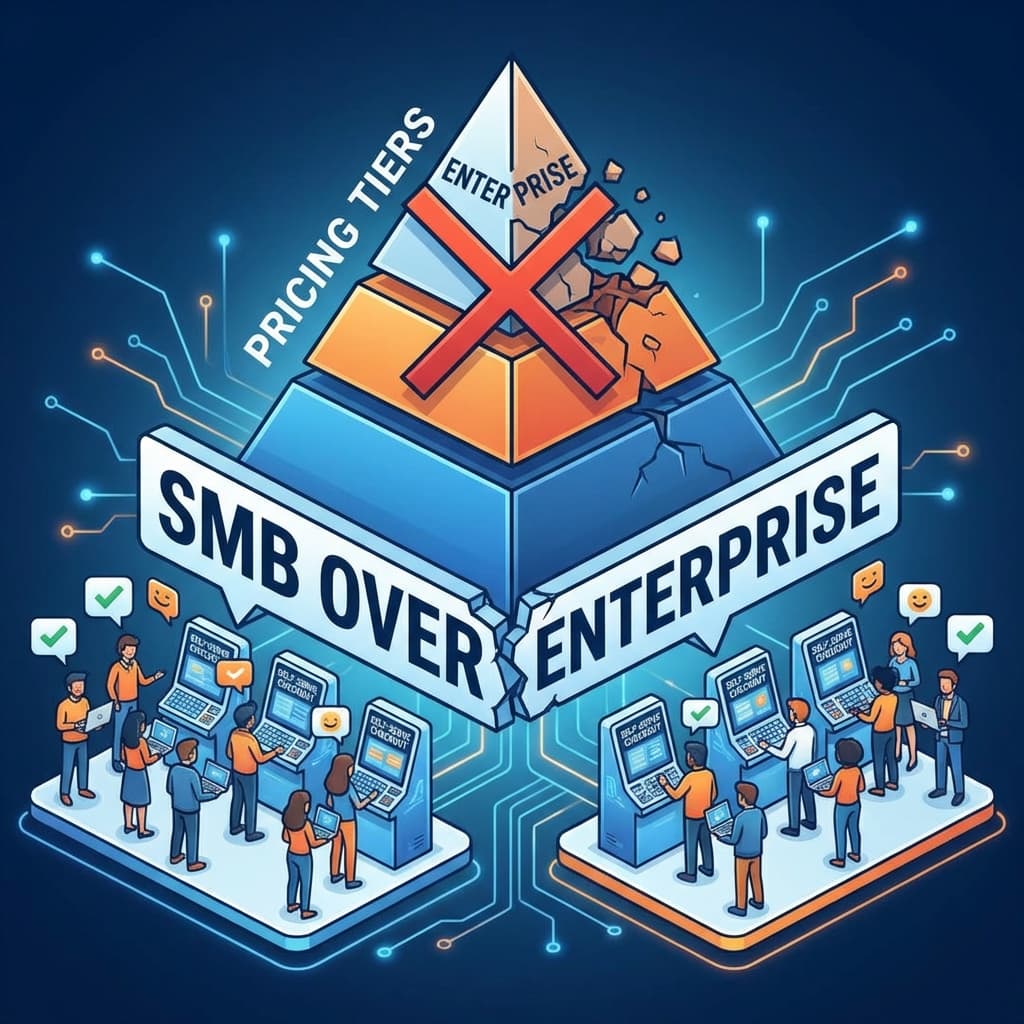
That was the moment I killed our Enterprise tier. Deleted the pricing page. Let go of the enterprise sales team. Focused entirely on self-serve SMB.
Here's why "going upmarket" is often going backward.
Section 1: The "Enterprise" Fantasy
Venture capitalists love enterprise deals. The narrative is seductive.
"High ACV (annual contract value). Low churn. Land and expand. $10M ARR with 50 customers instead of 5,000."
But the narrative omits inconvenient realities.
Sales Cycles Are Brutal:
Enterprise sales cycles run 6-18 months. Sometimes longer.
During that time, you are investing: Sales rep time. Solution engineering. Legal review. Custom demos. Pilots. References.
If the deal closes, great. If the deal dies — and most do — you've burned tens of thousands of dollars with nothing to show.
CAC payback on enterprise deals is typically 18-24 months. That's assuming they don't churn before you recoup.
One Champion = One Point of Failure:
Every enterprise deal has a "champion" — the internal advocate who's making the case for your product.
If the champion leaves the company, the deal is dead. If the champion is promoted and moves to a different department, the deal is dead. If the champion loses a political battle, the deal is dead.
You are not selling to a company. You are selling to an individual inside a company. That individual's tenure averages 2-3 years. Your contract is 1-3 years. Do the math.
The Logo Game:
Startups chase Fortune 500 logos for credibility, not profit.
"We're used by [Big Corp]!" looks great on the website. But the deal often loses money when you account for true costs.
Logos are vanity. Revenue is sanity. Profit is king.
Roadmap Distortion:
Enterprise customers demand customization. They want integrations with their legacy systems. They want features for their specific workflow. They want modifications to your data model.
"Just add this one feature, and we'll sign."
You add the feature. They sign. Another enterprise prospect appears.
"Just add this one feature, and we'll sign."
Repeat 10 times. Your product is now a frankenstein of enterprise-specific customizations. Your roadmap is hostage to your largest customers.
Section 2: The Hidden Costs of Big Deals
Enterprise deals look good on the top line. They look terrible on the bottom line.
Sales Complexity:
Enterprise Account Executives cost $150,000-250,000 base salary. With equity and benefits, fully loaded cost is $200,000-400,000 per year.
You need at least 3 AEs to staff a real pipeline (some will underperform, some will ramp, you need coverage).
That's $600k-1.2M per year in sales salaries alone. Before commissions. Before sales engineering. Before marketing to generate enterprise leads.
To break even on that cost, you need to close multiple $200k+ deals per year. How many startups actually achieve that?
Support Burden:
Enterprise customers expect SLAs. 99.9% uptime. Dedicated Customer Success Managers. 24/7 support. Quarterly business reviews. Executive sponsors.
The cost to support an enterprise customer is 5-10x the cost to support an SMB customer. Often more.
Your "$120k/year" contract might cost $50k/year to support. That's a 58% gross margin before you've paid for sales. Not great.
Churn Concentration:
If 30% of your ARR comes from 3 enterprise customers, losing any one of them is catastrophic.
We had a quarter where one enterprise churned (reorg) and another paused expansion (budget freeze). Our growth rate went negative despite strong SMB performance.
Concentrated revenue is fragile revenue.
Customization Debt:
Every "just add this feature" request creates technical debt.
- Feature flags to toggle enterprise-specific code
- Special cases in your data model
- Maintenance burden for features used by 1 customer
After 10 enterprise customers, your codebase is unmaintainable. Your velocity slows. Your best engineers quit because they're debugging obscure enterprise edge cases instead of building valuable features.
Section 3: The SMB Math That Actually Works
After killing enterprise, we focused exclusively on small and medium businesses with a self-serve motion.
Sales Cycle:
1 day. Sign up, enter credit card, start using the product.
No RFPs. No security questionnaires. No pilots. No legal review.
CAC: $80 (paid ads + content marketing). CAC payback: 2 months.
Churn Is Higher — But So What?
SMB churn: 4-5% monthly.
Enterprise churn: 1-2% monthly (supposedly).
Yes, SMB churn is higher. But CAC is 10x lower. You can afford to churn and replace because acquisition is cheap and fast.
The math: If SMB CAC is $80 and enterprise CAC is $50,000, you can lose 625 SMB customers before you "lose" as much as one failed enterprise deal.
Revenue Diversification:
With 1,000 SMB customers, no single customer is more than 0.1% of ARR.
Customer churns? You barely notice. Customer complains? You can say no. Customer demands features? You can prioritize what benefits everyone.
This is freedom. Enterprise revenue is a trap.
Product-Led Growth:
Self-serve means your product sells itself.
Users sign up. They experience value. They upgrade. They invite colleagues.
No salespeople needed. Your product is your sales team.
This is why PLG companies like Slack, Notion, and Figma scaled so efficiently. They built products people wanted to use and spread, not products they had to be sold.
Section 4: How To Kill Your Enterprise Tier Gracefully
If you're currently serving enterprise customers, you can't flip a switch overnight. Here's a gradual transition.
Step 1: Stop Accepting Custom Security Questionnaires
This is the canary in the coal mine. Enterprise buyers send 200-question security questionnaires as a gate.
Our policy became: We have a standard security page. We have SOC 2. If that's not enough, we're not a fit.
You will lose some deals. Those deals would have been unprofitable anyway.
Step 2: Remove "Contact Sales" from the Pricing Page
Show the price. Let them buy. Credit card checkout.
If a prospect insists on a sales call to buy, they are signaling high-touch expectations. You don't want those expectations.
The customers who self-serve are the customers who won't drain your support resources.
Step 3: Set a Maximum Contract Size
Counterintuitive: We capped our largest deal at $10,000/year.
Why? Deals above $10k attracted buyers who expected enterprise treatment. Below $10k, buyers had SMB expectations: fast, simple, low-touch.
By capping deal size, we filtered for the right customer profile.
Step 4: Transition Existing Enterprise Customers to Standard Plans
When enterprise contracts renewed, we offered a simple choice: Move to our standard plan (lower price, standard support) or graduate to a competitor better suited for enterprise needs.
Half chose to downgrade. Half churned.
The churned revenue was replaced 3x over by self-serve growth freed from enterprise distraction.
Conclusion
"Going upmarket" sounds impressive. It's the VC-approved path. It's what respectable B2B companies do.
But for many startups, upmarket is a trap.
Long sales cycles. Fragile revenue concentration. Roadmap hostage situations. Unsustainable support costs.
The most profitable tier is the one with zero salespeople. The most resilient revenue is the revenue no single customer controls. The best customers are the ones who never talk to you.
Build a product people buy themselves. Kill the enterprise tier. Watch your business get healthier.
Written by XQA Team
Our team of experts delivers insights on technology, business, and design. We are dedicated to helping you build better products and scale your business.