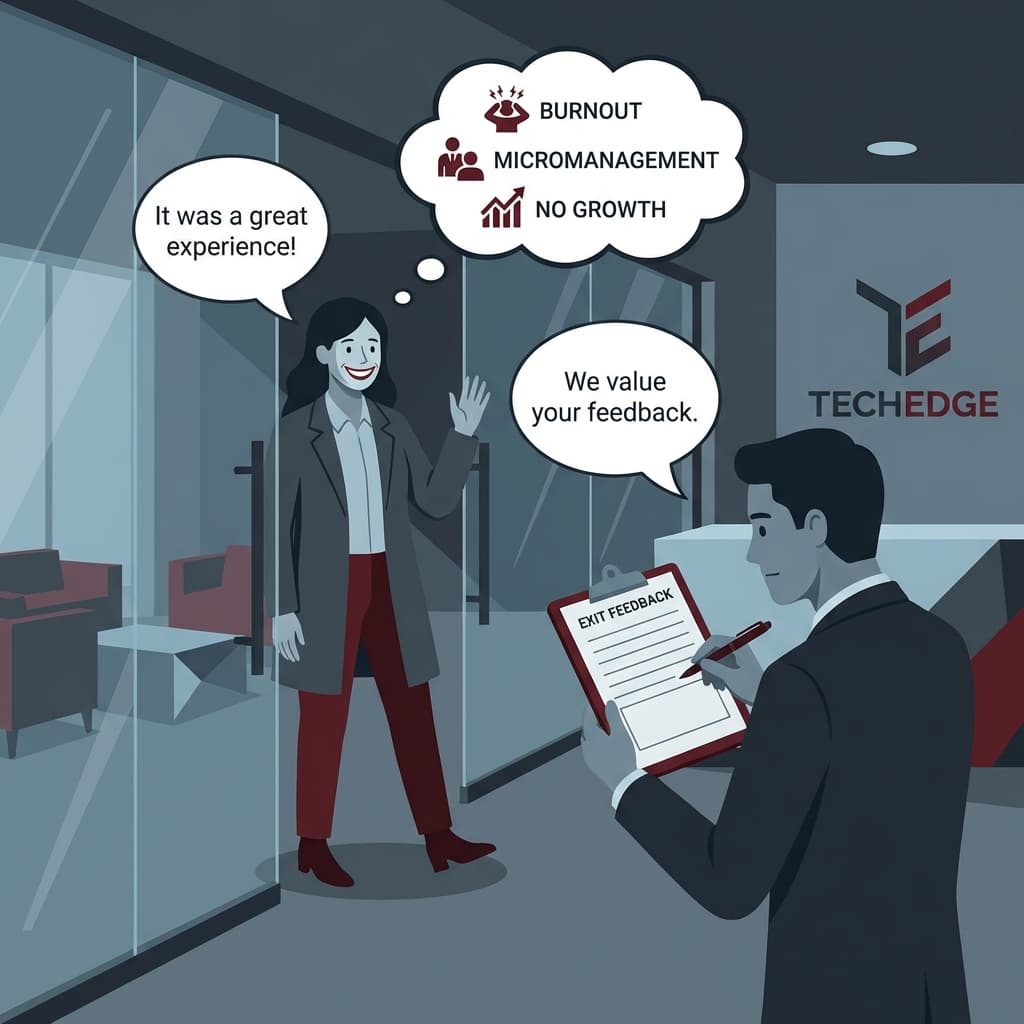
For five years, we conducted exit interviews religiously. Every departing employee sat with HR for 30-60 minutes. We asked about their experience, their manager, their reasons for leaving. We compiled the feedback into quarterly reports. We presented themes to leadership. We felt like we were learning.
Then our new Chief People Officer asked an uncomfortable question: "What specific changes have we made based on exit interview feedback in the last three years?"
We looked through the records. The answer was sobering: almost nothing. Oh, we had plenty of reports. We had themes: "compensation concerns" appeared frequently (of course—people who leave often get raises). "Growth opportunities" was common (they're leaving for a new opportunity, so obviously they wanted more here). "Work-life balance" showed up regularly (departing employees always remember the late nights).
But the feedback was so vague, so sanitized, so diplomatic that we couldn't take action. "I felt there could be more growth opportunities" tells you nothing about what growth opportunities, for whom, or what would have made them stay. It's the polite thing to say. It's not useful data.
We analyzed the language in our exit interviews. Almost every interview contained phrases like:
- "Overall, it was a great experience, but..."
- "I learned a lot here, and I'm grateful, however..."
- "The team was wonderful, I just felt that..."
These were not honest assessments. They were diplomatic deflections—the verbal equivalent of "it's not you, it's me" in a breakup. Nobody tells the truth when they need a reference, when they might boomerang back, when they don't want to burn bridges.
We killed the exit interview program. We replaced it with "Stay Interviews" for current employees. The results transformed how we retain talent.
Section 1: Why Exit Interviews Produce Fake Feedback
Exit interviews are structurally designed to produce dishonest feedback. The incentives are completely misaligned.
The Reference Problem
An employee leaving for a new job almost always needs references. Their manager, their skip-level, their HR contact—these are the people who will take calls from future employers.
Now you're asking this employee to be candid in their exit interview, which will be documented, which will be shared with leadership, which includes the people they need references from.
What happens if they say: "My manager was a micromanaging nightmare who took credit for my work and blamed me for his failures"? Even if it's true, even if it would be genuinely useful feedback, the personal risk is enormous. That feedback gets back to the manager. The manager is now incentivized to give a lukewarm reference.
Rational actors don't tell truth when truth is costly. And exit interview truth is costly.
The Bridge-Burning Risk
Industries are smaller than they appear. The person you're criticizing today might be your interviewer at a future company, your client, your vendor, your investor. People remember who said what about them.
Departing employees know this. They've seen the boomerang employees who came back years later. They've seen how "the industry talks." They've watched someone's honest feedback get whispered about at conferences.
The smart play is to say nothing negative. "It was a great experience, I'm just ready for a new challenge." No dirt, no details, no risk.
The Sunk Cost Mindset
By the time someone is leaving, they've already made their decision. They've signed the new offer. They're mentally at their new company. They don't care enough to fight battles that won't benefit them.
"Why bother telling them about the broken processes? I'm leaving. It won't help me. Maybe it'll help my former colleagues, but they can fight their own battles."
The emotional distance of departure creates apathy. People who might have screamed about problems while employed shrug about them when leaving. The urgency is gone.
Section 2: What Exit Interviews Actually Capture—Useless Noise
We analyzed three years of exit interview transcripts using text analysis. Here's what we found:
Sentiment Was Uniformly Positive
Average sentiment score (on a -1 to +1 scale): +0.65. Even employees we knew had horrible experiences gave interviews that coded as "positive."
We cross-referenced with internal feedback. Employees who had filed HR complaints, who had given scathing manager feedback in engagement surveys, who had visibly struggled with culture—their exit interviews were nearly indistinguishable from happy employees' interviews.
The format demands positivity. "How would you describe your experience?" is an invitation to be polite.
Reasons for Leaving Were Unactionable
The top stated reasons for leaving:
- "Career growth opportunity elsewhere" (67%)
- "Compensation" (45%)
- "Ready for a new challenge" (38%)
- "Personal reasons" (22%)
- "Relocation" (15%)
What can you do with this information? "Career growth" is vague—growth where? Into management? Into senior IC? Into a different specialty? "Compensation" is obvious—people who leave usually get paid more; that's not insight. "New challenge" means literally nothing.
Compare this to what we learned in Stay Interviews (discussed below):
- "I want to move into mobile development, but there's no mobile team here."
- "My manager hasn't given me feedback in 6 months."
- "The oncall rotation is burning me out—I was on call 8 weekends last quarter."
Specific. Actionable. Fixable. This is what exit interviews don't capture.
Manager Feedback Was Non-Existent
We specifically asked about management in exit interviews. The responses were astonishingly empty:
"My manager was great."
"She was supportive, nothing negative to say."
"Good manager, just different styles sometimes."
We knew from engagement surveys that 35% of our employees rated their managers poorly. But zero exit interviews mentioned management problems in concrete terms. The social pressure to not criticize your manager—who signs off on your departure, who you'll list as a reference—completely suppressed honest feedback.
Section 3: The Stay Interview Alternative—Feedback That Matters
We replaced exit interviews with Stay Interviews: structured conversations with current employees about what's working, what's not, and what would make them leave.
The Format
Quarterly, every manager has a 30-minute Stay Interview with each direct report. The agenda:
- What do you enjoy most about your current role?
- What frustrates you most about your current role?
- What would make you start looking for another job?
- Is there anything I (your manager) could do differently to support you?
- What's one thing you wish the company would change?
Why Stay Interviews Produce Honest Feedback
1. Ongoing relationship: The employee isn't leaving. They have an ongoing stake in improving their situation. If they tell you the oncall rotation is burning them out, they might actually get relief. There's upside to honesty.
2. Psychological safety: When Stay Interviews are ritualized—everyone does them, they're normal—employees feel safe being candid. It's not "going to HR to complain"; it's "the quarterly check-in we all do."
3. Specificity: Because employees are still in the situation, they remember details. "Last month, the Jenkins pipeline failed every day for a week and nobody fixed it" is the kind of specific feedback you'd never get in an exit interview.
4. Manager accountability: Managers conduct Stay Interviews with their own reports. If they don't act on feedback, the next quarter's interview will be awkward. The feedback loop is tight.
What We Learned
Within the first quarter of Stay Interviews, we discovered:
- The oncall burden was wildly uneven—some teams had 6-week rotations, others had weekly. We normalized it.
- Three high performers were actively interviewing because they felt "invisible"—no recognition, no feedback. Their managers had no idea.
- Our health insurance change six months prior was widely hated, but nobody had mentioned it. We eventually switched back.
- A team leads' regular "optional" Friday meetings were resented because they were implicitly mandatory. We addressed the cultural expectation.
This was actionable intelligence about current employees who hadn't left yet—the people we could still save.
Section 4: The Underlying Truth—Retention Is Proactive, Not Reactive
Exit interviews are reactive. You're gathering information after the decision is made. Even if the feedback is perfect and honest (which it isn't), it's too late to help that employee. At best, you're helping future employees.
Stay Interviews are proactive. You're gathering information while the employee is still engaged, still savable, still invested in the outcome. The feedback can directly benefit the person giving it.
The Time Value of Retention
By the time someone is in an exit interview, you've already lost:
- Recruiting costs to replace them ($20-50k)
- Onboarding costs for the replacement (3-6 months of reduced productivity)
- Institutional knowledge that walked out the door
- Team morale impact
- Project continuity
If you fix the problem after the exit interview, you save the next person. But you didn't save this person. The damage is done.
Stay Interviews let you intervene upstream. The employee frustrated with oncall mentions it in their Stay Interview. You fix the rotation. They don't start interviewing. You never lose them. You never pay the replacement cost.
What We Do With Exit Interviews Now
We didn't eliminate all offboarding conversation. We still have a brief (10-minute) departure checklist covering logistical items: return your laptop, here's your COBRA information, here's how to access your final pay stub.
But we don't pretend it's a feedback opportunity. We don't ask people to evaluate their experience. We don't compile reports from dishonest data.
If a departing employee volunteers candid feedback—and occasionally they do, especially if they're leaving on good terms—we listen. But we don't structure for it or expect it. The useful feedback comes from Stay Interviews, not exit theater.
Conclusion: Listen to People Who Can Still Be Helped
HR orthodoxy says exit interviews are essential. Every HR certification teaches them. Every offboarding checklist includes them. They feel important—someone is leaving, we should gather their wisdom!
But the structure ensures the wisdom is fake. People don't tell truth when truth is risky. Departing employees have every reason to be diplomatic and no reason to be honest.
Flip the investment. Instead of spending 60 minutes with every departing employee gathering sanitized platitudes, spend 30 minutes quarterly with every current employee gathering real feedback that can actually change their situation.
Stay Interviews are harder. They require managers to listen, to act, to be accountable quarter after quarter. Exit interviews are easy—you nod, you take notes, you file the report, you never see the person again.
Easy and useless, or hard and valuable. Choose.
The feedback that matters comes from people who still have something at stake. Listen to your current employees, not your former ones.
Written by XQA Team
Our team of experts delivers insights on technology, business, and design. We are dedicated to helping you build better products and scale your business.