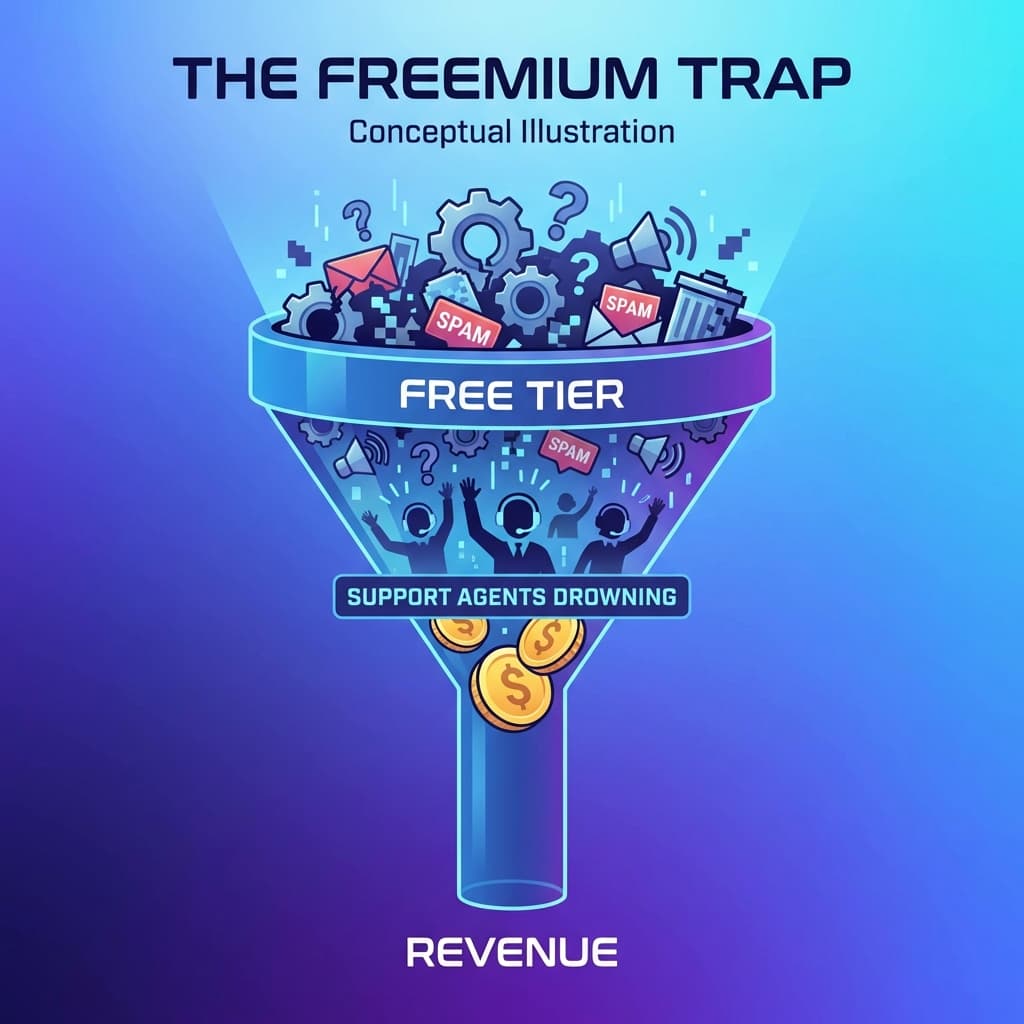
"Freemium is the ultimate growth hack!" we told ourselves, nodding along to every SaaS podcast and growth marketing blog we consumed. The playbook seemed clear: offer a generous free tier, acquire millions of users, convert 2-5% to paid, and print money. Dropbox did it. Slack did it. Zoom did it. It worked!
So we launched our B2B developer tool with an aggressively generous Free Tier. Unlimited team members. Full API access. 10,000 monthly operations. No credit card required. Free forever. We wanted to "remove friction" and "build a community" and "land and expand."
The signup numbers exceeded our expectations. In the first month, 8,000 accounts were created. Charts pointed up and to the right. We sent screenshots to our investors. We celebrated with champagne. We hired more engineers to handle the scaling demands.
Six months later, we were in crisis. Our support team was overwhelmed. Our net revenue retention was abysmal. Our product roadmap was being distorted by feature requests from users who would never pay us. Our infrastructure costs were spiraling. We were serving 45,000 users and making less money per employee than we had at 2,000 users.
I finally did the analysis I should have done on month one. The numbers were horrifying:
- Support ticket volume: 2,400 tickets per month
- Tickets from Free users: 1,920 (80%)
- Tickets from Paid users: 480 (20%)
- Revenue from Free users: $0
- Revenue from Paid users: $180,000 MRR
We were spending 80% of our support resources—approximately $40,000 per month in support staff salaries—to serve users generating zero revenue. Our "growth engine" was actually a wealth destruction machine.
Four weeks later, we killed the Free Forever tier. We replaced it with a 14-day free trial requiring a business email (no gmail/hotmail). Within 90 days, our support burden dropped 70%, our conversion rate doubled, and our revenue per employee improved by 60%.
Here's what we learned about why the Free Tier is a trap for most B2B SaaS products.
Section 1: The "Noisy Free User" Paradox—Why Non-Payers Demand More
Conventional wisdom says paying customers are the most demanding. They're paying, after all. They expect service.
Our data showed the exact opposite.
Paying Customers: Business Professionals with Problems to Solve
Our paid users were businesses. They had budgets and deadlines and managers. When they contacted support, their tickets were focused and reasonable:
- "We're seeing latency on the EU endpoint. Is there an incident?"
- "Can you help us understand the rate limiting behavior in section 4.2 of the docs?"
- "We'd like to schedule an onboarding call for our new team members."
They understood that software has bugs. They were patient. They wrote clear reproduction steps. They were professional because they were professionals.
Free Users: Hobbyists With Infinite Time and Expectations
Our free user tickets looked very different:
- "This is stupid. Why doesn't X work?" (Attached: no details, no error messages)
- "I need you to write my integration for me. Here's what I want."
- "Your product is trash. I've tried for 3 hours and can't figure it out." (Issue: user hadn't read any documentation)
- "Why don't you support [obscure framework that 50 people use]? This is unacceptable."
- "I'm going to tell everyone on Reddit how bad your product is unless you fix this immediately."
Free users treated our support inbox as a personalized, on-demand technical consulting service. They expected immediate responses. They were ruder than paid users—they had no relationship to protect, no renewal to worry about.
Why the difference? Selection bias.
Paid users self-selected: they evaluated the product, decided it was worth money, and committed. This requires a baseline of seriousness. Free users didn't have to commit to anything. Many of them were tire-kickers, students doing homework assignments, hobbyists who would never have a real use case. They had no skin in the game, which meant no respect for our time.
Section 2: The Conversion Myth—"Free Today, Paid Tomorrow" Almost Never Happens
The Freemium model works on a specific theory: users discover value on the free tier, their needs grow, and they naturally upgrade to paid.
In our case, the opposite happened: users who came in free stayed free, forever.
We Gave Away Too Much Value
Our Free Tier was generous. 10,000 monthly operations covers almost everything a small team needs. We thought this was a feature: "Give enough value that they can actually see the product working."
But it meant there was no natural forcing function to upgrade. Businesses with 50 employees were running their entire operations on our free plan. When we asked them to upgrade, they said: "Why? Free works fine."
We had cannibalized our own revenue. Every "conversion opportunity" we identified was a company that was perfectly happy freeloading.
We Attracted Price-Sensitive Users, Not Value-Sensitive Users
The Free Tier does attract users—but it specifically attracts users whose primary selection criterion is "costs nothing." These are, by definition, the users least likely to ever pay for software.
Value-sensitive users—businesses that solve problems and pay for good tools—were actually uncomfortable with the Free Tier. We heard this in sales calls: "Is the product actually good? Why are you giving it away?" They feared we were a venture-funded money-losing company that would disappear in two years.
The Free Tier was sending the wrong signal to our actual target customers while attracting thousands of people we could never monetize.
The "Conversion Rate" Illusion
We tracked a "Free to Paid Conversion Rate" of 1.8%. That sounds reasonable for Freemium, right?
But the denominator was polluted. Of our 45,000 free users:
- 15,000 signed up, logged in once, and never returned
- 10,000 were students or hobbyists with no commercial use case
- 8,000 were competitors and analysts doing research
- 7,000 were using us occasionally for personal projects
- 5,000 were actual businesses that might pay
Our "real" conversion rate—businesses with a genuine use case who converted—was closer to 15%. But we were spending resources supporting all 45,000 instead of focusing on the 5,000 who mattered.
Section 3: The Hidden Costs—Infrastructure, Security, and Team Energy
Support burden was the visible cost. But free users were costing us in multiple hidden ways.
Infrastructure: Paying AWS to Store Abandoned Data
Our free tier included 5GB of storage per account. We had 45,000 free accounts. That's 225TB of potential storage—most of it used for test projects that were created once and abandoned.
We couldn't delete the data (users might come back). We couldn't charge for it (free is free). We just quietly paid AWS $3,000 per month to host data for users who hadn't logged in for six months.
We ran analysis: 60% of our free accounts had zero activity in the past 90 days. But we kept their data warm, their databases provisioned, their auth tokens refreshed.
Security and Abuse: The "Free" Attack Vector
Free tiers attract abuse like sugar attracts ants.
We caught cryptocurrency miners spinning up functions on our free tier. We found spammers using our email integration to send phishing campaigns. We discovered a botnet using our API as a proxy layer. Every week, our security team filed another abuse report.
50% of our security team's time was spent fighting abuse on the free tier—abuse that generated zero revenue.
When we required a credit card for signup (even for a free trial), abuse dropped to nearly zero. It turns out bad actors don't want to attach a traceable payment method. The credit card requirement was a filter we should have had from day one.
Product Roadmap Distortion: Building for the Wrong Users
Free users have opinions. Lots of opinions. They filled our feedback forums. They voted on feature requests. They demanded integrations with obscure tools we'd never heard of.
And because they were loud—and because we'd internalized "listen to your users"—we built for them. We added a Heroku integration because free users begged for it. We built a WordPress plugin. We added support for legacy authentication protocols.
None of these features were requested by a single paying customer. They were ghost features—built for an audience that would never pay. Meanwhile, our actual customers had requests we kept deferring.
Section 4: The Pivot—Free Trial, Not Free Forever
We made the switch in one week. Free Forever became 14-Day Free Trial.
Requirements for the trial:
- Business email required (no gmail, hotmail, yahoo)
- Credit card required (we don't charge during trial, but it's on file)
- Full access to all features for 14 days
- Automatic conversion to paid at day 15 (with email reminders at days 7, 12, 14)
What We Feared
"Signups will collapse!" Marketing warned that our growth charts would crater. We mentally prepared for a 70% drop in new signups.
What Actually Happened
Total signups: Dropped 65% (from 4,000/month to 1,400/month)
Qualified signups (business email + credit card on file): Stayed almost flat (from 1,000/month to 900/month)
Trial-to-Paid conversion rate: Jumped from 1.8% to 38%
Support ticket volume: Dropped 70% (from 2,400/month to 720/month)
Revenue per customer: Increased 25% (trial users were higher-intent, chose bigger plans)
Net new MRR: Up 40% within 90 days
The 65% of signups we lost? Students. Hobbyists. Tire-kickers. Competitors. They were never going to pay. Losing them was addition by subtraction.
Why Trials Create Better Behavior
The 14-day trial creates urgency that "Free Forever" cannot. When something is free forever, users think "I'll check it out eventually." Eventually never comes. They sign up, forget about it, and become ghost accounts.
A trial with an end date forces a decision: Do I want this? Yes or No.
Our trial users were dramatically more engaged. They completed onboarding. They read documentation. They scheduled calls with sales. They integrated their systems. Because they had 14 days to decide if this was worth $99/month.
Credit card on file (even though we don't charge during trial) signals commitment. "I'm serious enough to enter payment details." It filters out the casual.
Conclusion: Value-Based Pricing Respects Everyone's Time
Freemium works for certain products. Dropbox succeeds with it because storage is nearly zero marginal cost, the product is self-explanatory (no support needed), and viral sharing creates organic growth. Slack succeeds because the free tier is intentionally crippled (90-day message history) and the upgrade is almost mandatory for any real team.
For most B2B SaaS—especially products that require support, onboarding, or meaningful infrastructure—Freemium is a trap.
You fill your funnel with noise and call it "users." You burn out your support team answering questions from people who will never pay you. You distort your product roadmap to satisfy the loudest-but-least-valuable voices. You build features for ghost audiences. You subsidize hobbyists while neglecting customers.
Your product has value. Charge for it.
If someone isn't willing to enter a credit card for a 14-day trial, they have told you something important: they don't value what you offer enough to take that minimal commitment. That's not a customer you want to spend resources supporting.
If they aren't willing to pay, they aren't a customer. They're a cost center pretending to be a growth metric.
Written by XQA Team
Our team of experts delivers insights on technology, business, and design. We are dedicated to helping you build better products and scale your business.