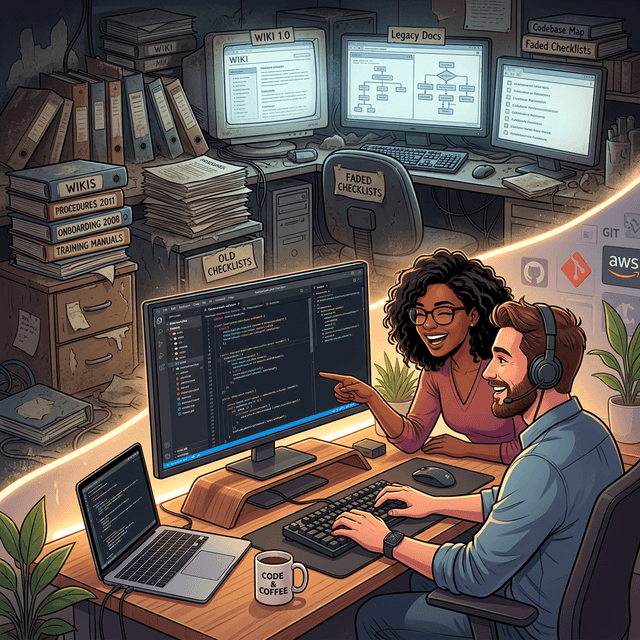
We were proud of our onboarding program. It was comprehensive. It was documented. It had a Notion workspace with 47 pages, a video library with 30 hours of walkthroughs, a buddy system, a 12-step checklist, and a "graduation ceremony" at the end of week six.
New hires still couldn't ship code for two months.
The program was designed by people who had already internalized all the knowledge. They didn't realize that reading 400 pages of documentation is not learning. It is drowning. The new hire would nod along, take notes, forget everything by Thursday, and then ask their buddy the exact questions the documentation was supposed to answer.
We killed the entire program. We replaced it with one rule: Every new hire pair-programs with a senior engineer for their first four weeks. Time-to-first-commit dropped from 8 weeks to 3 days. Here is why structured onboarding fails and what actually works.
The Documentation Graveyard
Every company has one. A wiki, a Notion workspace, a Confluence space filled with pages last updated 18 months ago. Half the links are broken. The screenshots show a UI that no longer exists. The architecture diagrams reference services that were decommissioned last quarter.
We invested heavily in keeping our documentation current. We assigned "documentation owners." We had a quarterly review cycle. Despite this, documentation drifted from reality within weeks of any significant change.
Why? Because documentation is a secondary artifact. The primary artifact is the code. When engineers are under pressure to deliver features, they update the code and skip the docs. Always. Without exception. No amount of process changes this behavior because the incentives are misaligned.
New hires who relied on documentation were learning a system that no longer existed. They would follow the "Getting Started" guide, hit an error, and spend three hours debugging before discovering that step 4 was obsolete. This wasn't a failure of the new hire. It was a failure of the process.
The Video Problem:
We invested in recorded video walkthroughs. "Watch this 45-minute video on our deployment pipeline."
Nobody watches 45-minute technical videos at 1x speed and retains the information. They watch at 2x, zone out after 15 minutes, and come away with a vague sense of how things work that collapses at first contact with reality.
Videos have a worse problem than documentation: they are even harder to update. When the deployment pipeline changes, we would need to re-record the entire video. Nobody does this. So the video library becomes a museum of outdated processes.
The Checklist Trap
Our onboarding checklist had 12 steps spread over 6 weeks. Each step had sub-tasks. The whole thing looked impressive in a spreadsheet.
The problem was that the checklist optimized for coverage, not comprehension. "Read the API design guidelines" was a checklist item. Did the new hire understand the guidelines? Could they apply them? The checklist didn't measure that. It measured whether they checked a box.
We observed a pattern: new hires would rush through the checklist to "complete onboarding," then immediately need help with every real task. The checklist created an illusion of readiness that evaporated when they encountered actual work.
Worse, the checklist created anxiety. New hires felt behind if they didn't complete items on schedule. They would skip understanding in favor of completion. "I need to finish the checklist by Friday" became more important than "I need to understand how this system works."
The Buddy System Failure
Every new hire was assigned a "buddy" — an existing engineer who would answer questions and provide guidance.
In theory, this is great. In practice, the buddy had their own work to do. They were measured on their own deliverables, not on the success of the new hire. Buddy time was unprotected — managers didn't reduce the buddy's workload to accommodate the mentoring responsibility.
The result: buddies were available but not present. They would answer Slack questions between meetings. They would have a 30-minute weekly check-in. But they wouldn't sit with the new hire and work through problems together.
New hires, not wanting to be a burden, would struggle silently. They would spend hours on problems that a 5-minute conversation would solve. They would develop workarounds that technically worked but violated team conventions. By the time anyone noticed, the bad habits were ingrained.
The Pair Programming Revolution
We replaced all of this with a single practice: dedicated pair programming for the first four weeks.
The Rules:
- The new hire is paired with a senior engineer for 6 hours per day, 5 days a week, for 4 weeks.
- The senior engineer's sprint capacity is reduced by 50% during this period. This is explicitly budgeted.
- They work on real tickets from the backlog. Not training exercises. Not sandbox projects. Real production code.
- The new hire drives (writes code) from day 2. The senior navigates (provides context, catches mistakes, explains patterns).
Why This Works:
1. Learning is contextual.
When you read documentation about the deployment pipeline, it is abstract. When you are deploying your first PR and the senior says, "This is the part where we run the migration check — here is why," the knowledge sticks. It is attached to a real experience, a real emotion (the nervousness of your first deploy), a real outcome.
Contextual learning has 3-5x better retention than passive reading. We didn't invent this insight. Educational research has demonstrated it for decades. We just applied it to engineering onboarding.
2. Tacit knowledge transfers automatically.
90% of how a team actually works is undocumented. The naming conventions. The PR review norms. The "don't touch that service, it's held together with duct tape" tribal knowledge. The Slack channels where real decisions happen versus the ones that are purely ceremonial.
None of this is in the wiki. All of it transfers through pair programming, organically, as situations arise.
3. Bad habits are caught immediately.
When a new hire works alone, they develop patterns based on their previous experience. These patterns might conflict with team conventions. Without real-time feedback, these conflicts compound until a painful code review corrects weeks of misaligned work.
With pair programming, the senior catches misalignment in real time. "We don't use that pattern here, and here is why" — delivered in 30 seconds, before the wrong pattern is reinforced.
4. Psychological safety is built in.
A new hire asking a question in a Slack channel feels exposed. A new hire asking a question to their pair feels natural. The pair programming relationship creates a safe space for "stupid questions" that are actually important questions.
We found that new hires who pair-programmed asked 5x more questions in the first week than those who went through the traditional onboarding. More questions meant faster learning meant earlier productivity.
The Results
After one year of pair-programming-based onboarding:
- Time to first commit: 3 days (down from 8 weeks).
- Time to independent ticket completion: 3 weeks (down from 10 weeks).
- New hire satisfaction (survey): 4.7/5 (up from 3.2/5).
- 6-month retention: 95% (up from 78%).
- Senior engineer satisfaction with mentoring: 4.2/5 (up from 2.8/5 with the buddy system).
The retention number is the most important. New hires who felt lost and unproductive for two months were much more likely to leave. New hires who shipped code on day 3 felt valued, competent, and integrated.
The Cost Objection
"But you're reducing the senior engineer's output by 50% for a month!"
Yes. And we are increasing the new hire's output by 500% over the same period. The net productivity gain is enormous.
Under the old system, a new hire produced near-zero value for 8 weeks. Under pair programming, they produce real value from week 1. The senior's reduced output is more than offset by the new hire's accelerated contribution.
When you factor in the retention improvement (avoiding the $50,000+ cost of replacing an engineer who quits in frustration), the ROI is overwhelming.
Conclusion
Structured onboarding programs are built by people who have already learned the system. They suffer from the "curse of knowledge" — they can't remember what it was like to not know things, so they create materials that assume too much context.
Pair programming bypasses this problem entirely. The senior doesn't need to remember what to teach. They just work, and the new hire absorbs by osmosis, asks questions in context, and builds muscle memory through practice.
Delete your onboarding wiki. Cancel the video walkthrough. Sit next to the new hire and build something together. It's the oldest teaching method in human history, and it still works better than anything we've invented since.
Written by XQA Team
Our team of experts delivers insights on technology, business, and design. We are dedicated to helping you build better products and scale your business.