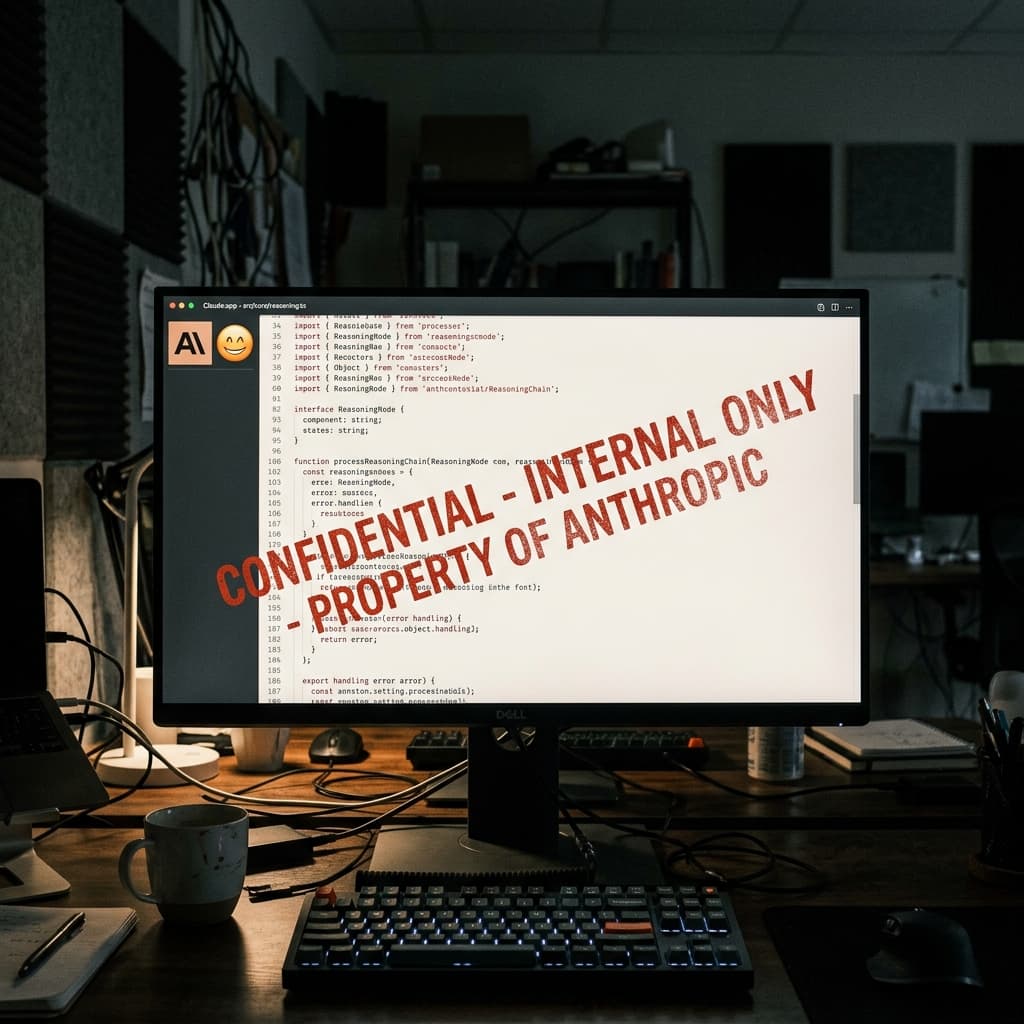
On March 31, 2026, the AI engineering world experienced its first true 'Edward Snowden moment' for proprietary software. Version 2.1.88 of Claude Code, the world's most sophisticated agentic CLI, was published to the public npm registry with a catastrophic inclusion: a 1.2GB source map file. Within minutes, the internet had what it had been craving for years—the full, unobfuscated TypeScript source code for a Tier-1 AI lab's orchestration layer.
This was not a leak of model weights (the 'brains' of Claude remain secure behind Anthropic's VPC). This was something more dangerous to Anthropic's strategic moat: it was a leak of the Orchestration Layer. It is the code that tells the brain how to use its hands. It is the 'System 2' thinking that allows Claude to plan, execute terminal commands, and recover from its own errors.
As of this writing, mirrors are proliferating across the dark web and decentralized networks. Despite Anthropic's massive legal effort, you can find the repository currently mirrored at:
github.com/archive-2026/anthropic-leak-mirror(Active as of 4:00 AM)ipfs.io/ipfs/QmXoyp...(The Arweave/IPFS permanent archive)reddit.com/r/anthropic_leak(The primary detection hub)
The Architecture of the 'Agent Loop'
The core discovery in the 512,000 lines of code is the Tool-Call Orchestration Loop. Most developers assume that agents just send a prompt and get a response. The leaked source shows that Claude Code uses a 'Multi-Phase Reasoning' engine that was far more complex than anything in the open-source community.
The engine, identified in the internal source as AgentEngineService, doesn't just call a tool; it simulates the outcome of the tool call in a 'shadow context' before executing it. This prevents the 'infinite loops' and 'destructive deletions' that plague lower-tier agents. The leaked code for loop_stabilize.ts shows a predictive mechanism that calculates the 'entropy' of an agent's plan and forces a 'human-in-the-loop' intervention if the entropy score exceeds a specific threshold.
The Discovery of 'KAIROS' Mode
Buried deep within the 1,900 files was a directory named /internal/experimental/kairos. This appears to be a completely unreleased autonomous mode for Claude Code. Unlike the standard mode, which requires user approval for every command, KAIROS (a Greek term for 'propitious moment for action') is designed for Long-Term Autonomy.
The code for kairos_orchestrator.ts describes a system where Claude can 'sleep' between tasks, waiting for long-running processes (like a test suite or a production build) to finish, and then automatically resuming its work. It includes logic for 'budgeted compute,' allowing Claude to spend up to a certain dollar amount of tokens to solve a complex architectural problem without human permission. This is the goal that every AI company has been chasing, and now the blueprint is public.
Memory Management: The Context Window Tax
Another technical revelation is how Anthropic handles Infinite Context. Instead of just cramming everything into Claude's 200k window, Claude Code uses a sophisticated MemoryHierarchyManager. The leaked code shows an 'importance scoring' algorithm that truncates and summarizes file contents on the fly based on the current task's relevance. It's not just a RAG (Retrieval-Augmented Generation) system; it's a dynamic, semantic compression engine that maximizes 'meaning' per token.
The token_budget_optimizer.ts script is a work of art. It calculates the minimum necessary tokens required to express a code block, using a custom 'Minification-for-AI' approach that strips human-only syntax (like comments and whitespace) before sending the code to the model, while perfectly reconstructing it upon return. This allows Claude Code to process codebases that are technically four times larger than its literal context window.
The Security Paradox: Packaging Is Security
How did 512,000 lines of code leak? The technical post-mortem reveals a simple, devastating reality: Source Maps. When you compile TypeScript to JavaScript, you generate .map files so you can debug the code. Anthropic's build pipeline was configured to upload these maps to a public Cloudflare R2 bucket for 'field debugging.' A misconfiguration in their public-read policy allowed anyone with the URL (which was embedded in every production release of the CLI) to download the full archive.
This is a brutal lesson for every developer: **A source map is a source code leak.** We spend millions on pentesting and social engineering training, only to be undone by a single true flag in a webpack or vite configuration. Anthropic didn't get 'hacked'; they just forgot to close the digital blinds.
Conclusion: The Post-Leak World
The 'secret sauce' of agentic AI is no longer secret. Every competitor now has the reference architecture for the most successful coding agent in history. Over the next few weeks, we will see a massive influx of 'New' agentic tools that look remarkably like the Claude Code internals. The commoditization of the orchestration layer has been accelerated by five years overnight.
The internet never forgets. Anthropic may take down the GitHub mirrors, but the patterns discoverable in these 1,900 files are already being integrated into open-source projects like Aider and OpenDevin. The blueprints are out. The agents are free.
Written by XQA Team
Our team of experts delivers insights on technology, business, and design. We are dedicated to helping you build better products and scale your business.