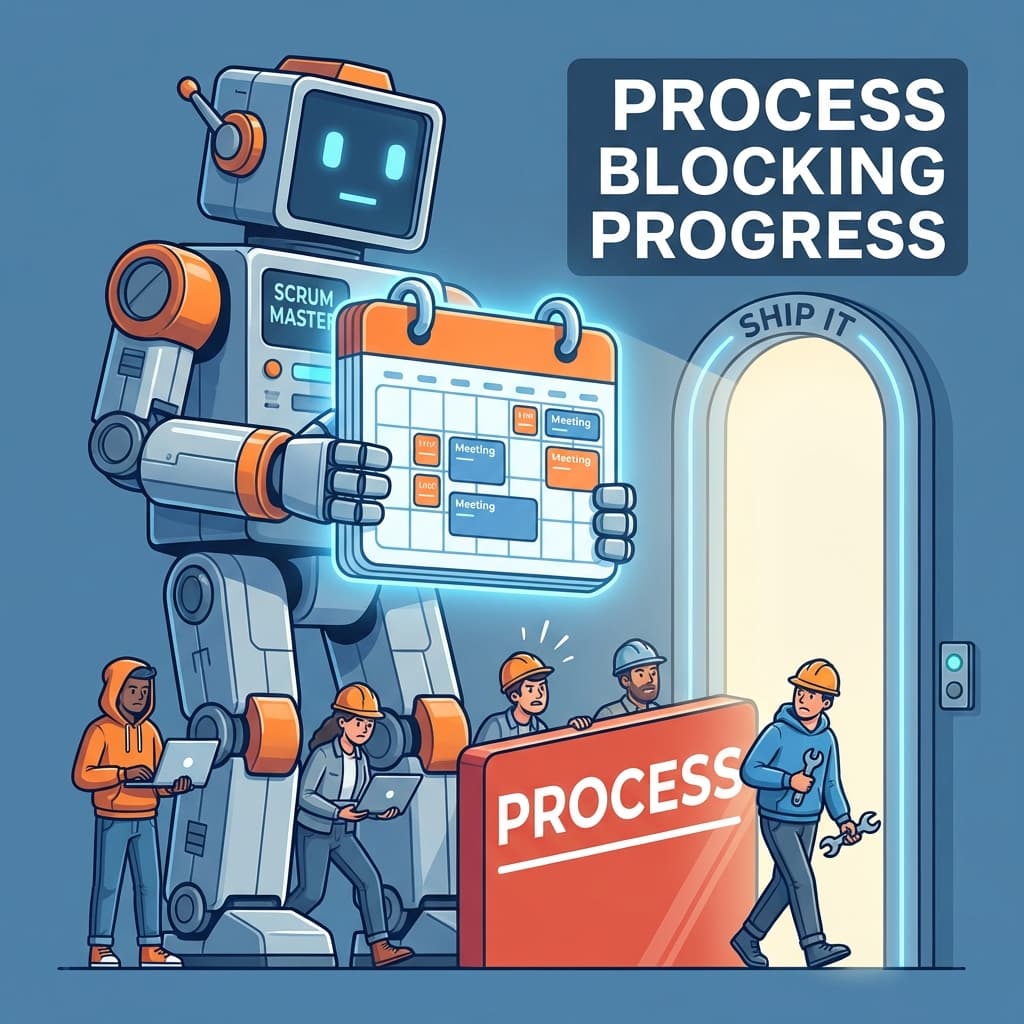
"You need Scrum Masters to protect the team from disruption!" the Agile consultants told us, with the confident enthusiasm of people billing $300/hour. "They are the guardians of process. The servant-leaders who remove blockers. The champions of sustainable velocity!"
It sounded great. We were a growing engineering organization—45 engineers across 6 squads—and we were struggling with coordination. Standups went long. Sprint commitments slipped. Teams stepped on each other's toes. We needed help.
So we hired three Scrum Masters, each assigned to two squads. Their job descriptions were straight from the SAFe and Scrum Guide playbooks: facilitate ceremonies, remove impediments, shield teams from external interruptions, coach on Agile practices.
Within six months, we had a problem we hadn't anticipated.
Our engineering calendar was now completely full. The 15-minute standup had become a 30-minute "sync." We had introduced "Pre-Planning" as a preparatory meeting before Sprint Planning. Retrospectives—which used to be 30 minutes of quick feedback—had ballooned to 90 minutes of structured exercises with sticky notes and dot voting. We had a "Scrum of Scrums" across teams. We had "Impediment Review" sessions.
Engineers were spending 8+ hours per week in meetings. Not coding. Not designing. Just... meeting. The meetings that were supposed to enable work were cannibalizing the time for actual work.
And the strangest thing? We weren't shipping faster. If anything, we were slower. Our lead time had increased. Our sprint completion rate had dropped. Teams were more frustrated, not less.
I started tracking "blocker resolution time"—how long it took from someone identifying a blocker to it being resolved. Before Scrum Masters: average 4 hours (mostly just walking over to someone's desk). After Scrum Masters: average 2.5 days (because blockers went through the SM who scheduled a meeting).
We made a controversial decision: we eliminated the Scrum Master role entirely. We didn't replace them. We just removed them from the organization.
Here's what we learned.
Section 1: The "Facilitator" Fallacy—When Process Becomes the Product
A full-time Scrum Master has a fundamental problem: they have to justify their existence without producing anything tangible.
They don't write code. They don't design features. They don't talk to customers. They don't make product decisions. Their entire value proposition is "process."
This creates a perverse incentive: the more process you create, the more you're needed. The simpler and more efficient the process becomes, the more you're at risk of being seen as unnecessary.
The Calendar Creep
Our Scrum Masters introduced meetings at an alarming rate. Each one seemed reasonable in isolation:
- Daily Standup: 15 min × 5 days = 1.25 hours/week
- Sprint Planning: 2 hours/sprint (1 hour/week avg)
- Sprint Review: 1 hour/sprint (0.5 hours/week avg)
- Retrospective: 1.5 hours/sprint (0.75 hours/week avg)
- Backlog Grooming: 2 hours/sprint (1 hour/week avg)
- Pre-Planning: 1 hour/sprint (0.5 hours/week avg)
- Scrum of Scrums (SM + TL): 1 hour/week
- Impediment Review: 30 min/week
- SM Team Sync: 1 hour/week
That's nearly 8 hours per week of "process meetings." A full day. For every engineer. Every week.
And worst of all, the Scrum Masters didn't see this as a problem—they saw it as their job. Facilitating these meetings was their value-add. Canceling meetings felt like canceling their reason to exist.
The Jira Industrial Complex
Beyond meetings, our Scrum Masters introduced workflow complexity that hurt more than it helped.
Before: Tickets went "To Do → In Progress → Done." Three states. Simple.
After: Tickets went "Backlog → Refined → Ready → In Progress → In Review → QA → Staging → Done." Eight states. Each transition supposedly added "visibility."
Engineers spent more time updating Jira than the updates could possibly be worth. The Scrum Masters needed this data for their "velocity dashboards" and "burndown charts"—charts that nobody looked at except the Scrum Masters.
Section 2: Learned Helplessness—The "Blocker" Pipeline
The Scrum Master role is defined around "removing impediments." The Scrum Master is supposed to be a servant-leader who clears obstacles so the team can focus on building.
This sounds noble. In practice, it taught our engineers to be helpless.
The API Key Story
A typical scenario before Scrum Masters:
Engineer: Needs an API key from the DevOps team.
Action: Walks to DevOps desk (10 feet away). "Hey, I need a key for the staging environment." DevOps person types for 30 seconds. "Here you go."
Total time: 5 minutes.
The same scenario after Scrum Masters:
Engineer: Needs an API key from DevOps.
Action: Tells the Scrum Master at standup. "I'm blocked on an API key."
SM Action: Adds it to the "Impediment Log." Later that day, sends an email to the DevOps manager. "One of my team members needs an API key. Can we schedule time to discuss?"
DevOps Manager: Three days later, accepts the calendar invite.
Meeting: 30 minutes to discuss what could have been a 30-second ask. "What key do you need? For what environment? Who will use it?"
Resolution: Key delivered 4 days after original request.
Total time: 4 days + 30 minutes of meeting.
The Scrum Master didn't have the technical context to just ask the right question. They didn't have the authority to directly message the DevOps person. They had been taught to "go through channels" and "document impediments."
The middleman created friction, not clarity.
Engineers Stopped Solving Their Own Problems
Over time, we noticed a worrying cultural shift. Engineers stopped trying to unblock themselves. "I mentioned it to the SM" became acceptable. The mindset shifted from "I need to fix this" to "Someone else will fix this for me."
This was learned helplessness. We'd trained our engineers to outsource their problems to a non-technical coordinator instead of developing their own cross-functional communication skills.
Section 3: The Tech Lead Owns Process—Minimal, Technical, and Accountable
When we eliminated Scrum Masters, we didn't eliminate process. We just changed who owned it.
The answer was obvious: the Tech Lead.
Why Tech Leads Are Better
1. Technical Context: The TL understands the codebase. They can tell when a "blocker" is actually just "I haven't looked at it yet" versus "This is genuinely impossible without external help." A non-technical SM believes whatever they're told.
2. Authority: The TL has authority within the team and respect across teams. When a TL asks DevOps for something, they get a faster response than when a SM does. Technical credibility opens doors.
3. Incentives: The TL wants to ship. They want minimal process. They won't create meetings for the sake of meetings because they feel the cost directly—every meeting is time they're not coding or reviewing.
We told our Tech Leads: "You now own standups, planning, and retrospectives. Run them however you think is best. But you're accountable for your team shipping."
The Calendar Immediately Shrank
Within one sprint:
- Standups went from 30 minutes to 8 minutes (async on Slack for some teams)
- Sprint Planning went from 2 hours to 45 minutes
- Retrospectives went from 90 minutes to 30 minutes (or skipped entirely if nothing needed discussion)
- "Pre-Planning" was eliminated completely
- "Scrum of Scrums" was replaced with a Slack channel
Engineers got 5+ hours per week back. That's 250 hours per year per engineer. Across 45 engineers, that's over 11,000 engineering hours per year we recovered.
A TL Will Cancel; A SM Never Will
Here's the key difference: a Tech Lead will cancel a meeting if there's nothing to discuss.
"Hey team, nothing big this sprint. No retro this week. Let's ship instead."
A Scrum Master would never say that. Because the meeting is their job. Canceling the meeting feels like admitting they aren't needed. So the retro happens whether or not there's anything to retro about.
Section 4: What We Kept—Agile Without the Religion
We didn't go back to Waterfall. We're not anti-Agile. We just stripped away the religious ceremony and kept what actually helps.
What We Kept
- 2-week cycles: Short iterations force prioritization and learning.
- A prioritized backlog: Everyone knows what's next.
- Brief daily sync: Async on Slack for most teams; 8-minute standup for those who prefer synchronous.
- Retrospectives when needed: After a major incident. After a particularly rough sprint. Not on a calendar because it's Tuesday.
What We Eliminated
- Story points: We use T-shirt sizes (S/M/L) when we estimate at all. Mostly we just pick things off the backlog.
- Burndown charts: Nobody looked at them. They measured work completed, not value delivered. Vanity metrics.
- Velocity tracking: Gaming incentive. Teams would artificially inflate points to show "improvement."
- Formal "ceremonies": The language itself was off-putting. "Ceremony" implies ritual and religion. We're engineers, not monks.
The Results
Within 3 months of eliminating the SM role:
- Sprint completion rate up 25%
- Lead time (conception to deploy) down 35%
- Engineer satisfaction (from survey) up 20 points
- Blocker resolution time down from 2.5 days to 4 hours
- Meeting load down from 8+ hours/week to ~3 hours/week
Teams felt more empowered. They owned their process. They solved their own problems. They stopped waiting for permission.
Conclusion: Adults Don't Need Masters
Scrum was invented in the 1990s to solve a specific problem: Waterfall micromanagement where developers had no autonomy and were told exactly what to build, when, and how.
The Scrum Master role made sense as a counterbalance to command-and-control management. Someone needed to protect the team from the project manager demanding status updates every hour.
But in 2026, in modern tech companies with trust-based cultures and empowered teams, that problem doesn't exist. We don't have micromanaging project managers. We have collaborative product partnerships. We've already solved the problem Scrum Masters were meant to solve.
What we get instead is a new problem: process bloat. Meeting creep. Learned helplessness. The solution becoming worse than the disease.
You don't need a "Master" to tell professional engineers how to work. They are adults. They are highly paid experts. They can run a standup and resolve their own blockers.
Trust your engineers. Give them ownership. Get out of their way.
Process should be minimal, invisible, and owned by the people doing the work—not a separate priesthood.
Written by XQA Team
Our team of experts delivers insights on technology, business, and design. We are dedicated to helping you build better products and scale your business.