"Community-Led Growth!" everyone shouted at the SaaS conference. "You need a Slack community! Or a Discord! That's where your users are! That's how Figma grew! That's what Product-Led companies do!"
The playbook seemed obvious. Create a vibrant community where users help users. Build a tribe around your product. Reduce support costs by enabling peer-to-peer help. Generate word-of-mouth and organic growth. All the buzzwords sounded good.
So we created the "XQA Community" Slack workspace. We promoted it on our website, in our onboarding emails, in our documentation. "Join 5,000+ developers building with XQA!" We were excited. This was going to be amazing.
The vision: A thriving ecosystem of enthusiasts. Users sharing tips with each other. Power users mentoring newcomers. Best practices emerging organically. Community-generated content. Brand ambassadors everywhere.
The reality: 5,000 people joining and immediately posting "Help! My build failed!" while tagging @channel and expecting an instant response.
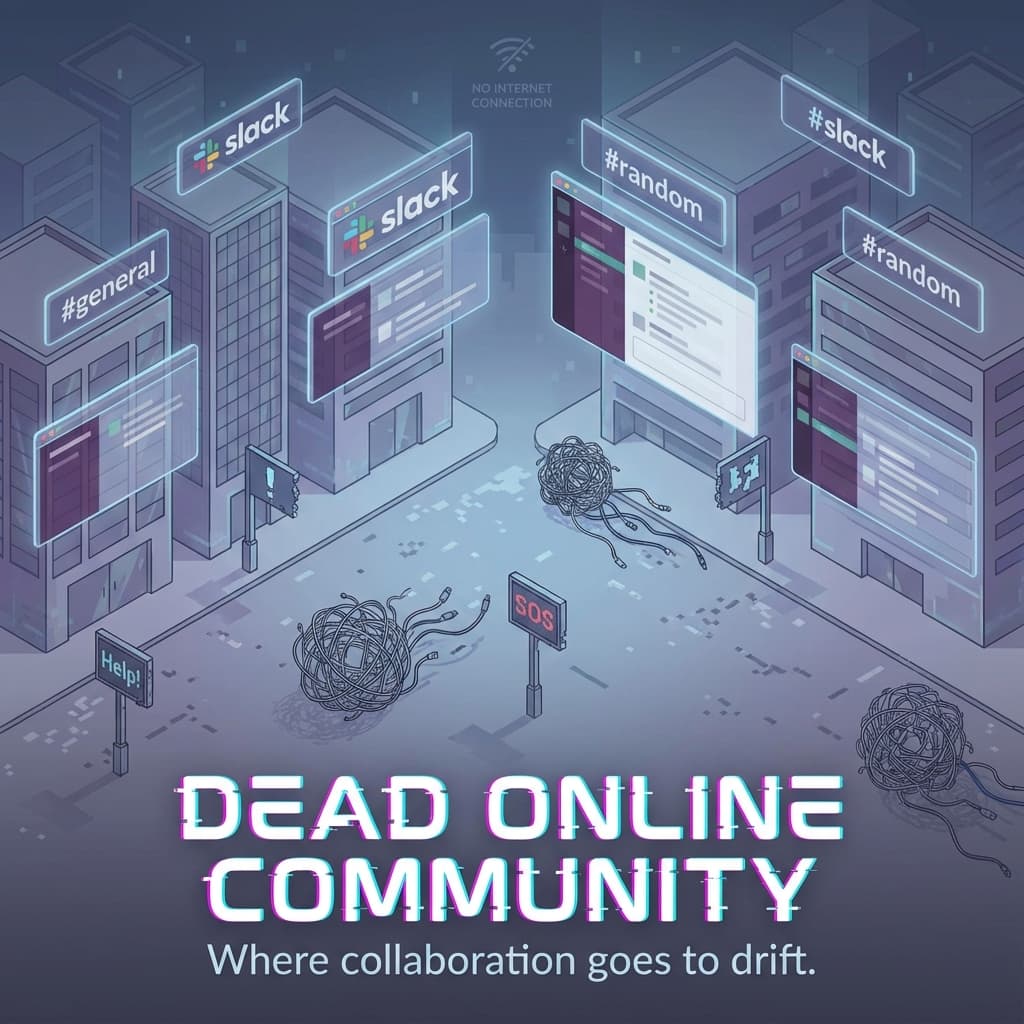
Within three months, our "Community" had become a chaotic, unsearchable, always-pinging, unmoderated support queue that we didn't staff—but that users expected us to staff. It wasn't a community. It was our worst support channel disguised as something aspirational.
We killed it. We shut down the entire Slack workspace and migrated to a different model. It was one of the best decisions we made that year, but it took us too long to recognize the problem.
Here's the full story of why "Community" is often just "Unpaid Support" in disguise, and why chat apps are the wrong medium for B2B SaaS engagement.
Section 1: The Inevitable "Support Forum" Drift
Unless you staff your community with full-time community managers (at $80,000-150,000 per head) and invest heavily in moderation and content, every B2B tech community inevitably drifts toward becoming a support forum. This is almost thermodynamic—it's the natural equilibrium.
Why Users Actually Join
When we surveyed our community members asking why they originally joined the Slack, the answers were revealing:
- 52% - "I had a problem and thought I could get help here"
- 24% - "I saw it in the onboarding and clicked Join"
- 14% - "I wanted to hear about new features and releases"
- 8% - "I wanted to connect with other developers using XQA"
- 2% - "I wanted to contribute and help other users"
Over half our "community members" were there because they had a problem. Not because they wanted to "connect." Not because they were enthusiastic tribe members. They had a bug. They were stuck. They wanted help.
The 2% who wanted to contribute? They disappeared after the first week. Nobody was answering their helpful posts, because all the new members were drowning them in support requests.
The Slack Medium Implies Real-Time Support
Here's the problem with using Slack or Discord for a community: these are real-time chat apps. Users expect real-time responses.
When someone posts a message in Slack, there's a visual indicator showing whether people are online. There's an expectation that someone will respond within hours, maybe minutes. The medium trained everyone to expect instant gratification.
Our #general channel became a stream of:
- "Is the API down?"
- "How do I configure X?"
- "Bug report: Y doesn't work"
- "Hello? Anyone there?"
- "@channel I need help urgently"
And our team couldn't keep up. We didn't have dedicated community managers. Our engineers were occasionally popping in to help, but they had their day jobs. Support tickets to paying customers took priority over random Slack messages from free users.
The result: unanswered messages piling up. Users getting frustrated. Then users complaining about the community being "dead" or "unresponsive"—even though we never promised 24/7 instant support.
The DM Assault
Worse than the public channels were the DMs. Our engineers started getting direct messaged by random community members.
"Hey, I noticed you answered someone's question in #support. Can you help me?"
"I saw you were online. Quick question..."
"I've been waiting for 4 hours and nobody has helped me. Can you please look at my issue?"
This happened at 10 PM. It happened on weekends. It happened during holidays. Our engineers were being personally contacted by strangers demanding free technical support.
We told them to ignore the DMs. But that felt terrible too—real humans with real problems, being ignored. The community was creating a lose-lose situation.
Section 2: The Searchability Black Hole—Where Knowledge Goes to Die
Slack is where institutional knowledge goes to die. Every question answered is immediately lost in the scroll.
The Same Question, 50 Times
User A asks: "How do I integrate XQA with CircleCI?" We answer thoroughly, with code examples and links to documentation.
Two days later, User B asks: "How do I use XQA with CircleCI?" We answer again.
A week later, User C comes in with the same question. At this point we just paste a link to the documentation that has existed the whole time.
The thing is: User C probably didn't even try to search. They just posted. Because that's what Slack incentivizes—it's easier to ask than to search. And even if they did search, Slack's search is notoriously noisy. You get partial matches, out-of-context snippets, threads that went off on tangents.
Over two years, we estimate we answered the same 20 questions approximately 1,000 times combined. The same introductory questions, the same common errors, the same configuration issues. Over and over. In a medium that discourages reading history.
Zero SEO Value
Here's the real tragedy: every answer we gave in Slack created zero long-term value.
If a user Googles "XQA CircleCI integration," they find our documentation. They do not find a Slack thread from 18 months ago. Slack is login-gated. Google can't index it.
Contrast this with a public forum like Discourse or StackOverflow—or even GitHub Discussions. Those answers get indexed. That knowledge compounds. Someone in 2024 can benefit from a question answered in 2022.
Our community was a closed loop. Every hour spent answering questions there was an hour that didn't generate any searchable, reusable knowledge. We were filling a bucket with a hole in the bottom.
Section 3: The Ghost Town Effect—When Low Activity Becomes a Liability
A community is only as valuable as its activity level. An active community signals: "This product is thriving! People love it! You want to be here!"
An inactive community signals the exact opposite. And our community was in an awkward middle ground that made us look worse than if we had no community at all.
5,000 Members, 3 Active
Our Slack proudly displayed "5,000+ members!" in the channel sidebar. It looked impressive on marketing materials.
But anyone who actually joined would notice: the last message in #general was 4 hours ago, and it was an unanswered support question. The last 10 messages were all support questions. The most recent conversation that wasn't a support request was over a week ago.
5,000 members but a daily active user count of maybe 20—and most of those were people posting questions and leaving. No discussion. No community vibes. Just a queue.
New users would join, excited to engage with fellow developers. They'd see the ghost town. They'd think: "Is this product dead? Why is nobody here?"
Ironically, our product was growing fast! We were adding customers every week. But the "Community" made us look small, inactive, and failing. We'd created a liability disguised as an asset.
Negative Word of Mouth
We started hearing about the community in sales calls—but not positively.
"We joined your Slack and it seemed kind of dead..."
"Someone on my team had a question but nobody answered it in the community..."
"The vibe in the Slack seems... struggling?"
Our community had become a sales objection. Prospects were using it as a signal about our company health. And the signal they received was wrong, but we couldn't control it.
Section 4: What We Did Instead—Sustainable Community Alternatives
We shut down the Slack workspace entirely. We sent an email to all 5,000 members explaining that we were "evolving our community strategy" (corporate speak for "this isn't working") and redirecting to new channels.
Alternative 1: GitHub Discussions
For questions and community conversation, we moved to GitHub Discussions (if you're a developer tool) or Discourse (for broader audiences).
Key advantages:
- Asynchronous: No expectation of instant reply. The medium itself communicates "we'll get back to you."
- Threaded: Conversations stay organized. Topics don't get lost in a scroll.
- Searchable: Users can find previous answers before asking again.
- Indexable: Google finds it. New users can discover answers organically.
- Open: You don't need to "join" anything—reducing friction for casual visitors.
GitHub Discussions changed the behavior. People typed better questions (because they knew the answer would be permanent). People searched before asking (because they could). We could mark answers as "Accepted" so future readers knew what worked.
Alternative 2: High-Quality Documentation
We took the time we had been spending moderating Slack and poured it into documentation. Every repeated question became a documentation page. Every common error got a troubleshooting guide.
Our new support strategy: "If a user asks a question, the ideal answer is a URL." Link them to the docs. If the answer doesn't exist in docs, write it, then link them.
Within 6 months, our documentation coverage tripled. Support volume dropped because users could self-serve. The documentation became our community—just one that was permanent and searchable.
Alternative 3: Premium Support for Paying Customers
We realized we'd been trying to give free users and paying customers the same support experience. This was a mistake.
New model: If you pay us, you get Intercom support. Fast responses. Professional SLA. Dedicated attention. Private channel.
If you're on the free tier, you get GitHub Discussions and documentation. Peer support. Community help. No SLA.
This immediately improved satisfaction for paying customers. They felt valued. They weren't waiting behind 100 free-tier users asking basic questions. Our support team could prioritize the people who paid for priority.
The Results
Within 90 days of killing the Slack:
- Support ticket volume from customers unchanged (they used the proper channels)
- "Support" questions shifted to GitHub Discussions, where the community was healthier
- Engineer DM interruptions dropped to near zero
- Documentation traffic up 150%
- Customer satisfaction scores up 20% (paying customers felt heard)
- No more "your community seems dead" objections in sales calls
We didn't lose anything of value. The "engagement" we had in Slack was fake—it was just support requests wearing community clothing.
Conclusion: Most B2B Companies Don't Need a "Community"
Community is a specific thing. Real community involves genuine connection between members—not just members connecting to the company for help.
Most SaaS companies don't have the critical mass, the use case, or the staffing to build real community. What they need instead:
- An Audience: People who want to hear from you (newsletter, blog, social media)
- A Support Channel: A place to get help (with clear SLAs and proper tooling)
- Documentation: Self-service answers that scale
These are different things. Calling your support queue a "community" doesn't make it one. And putting it in a real-time chat app makes everything worse.
Don't launch a Slack community because everyone else has one. Ask yourself: Do we have the resources to staff this? Do our users actually want to connect with each other? Will this scale?
If not, invest in documentation instead. It's less sexy, but it works.
Ephemeral chat is the enemy of knowledge management. And knowledge management is what actually helps your users.
Written by XQA Team
Our team of experts delivers insights on technology, business, and design. We are dedicated to helping you build better products and scale your business.