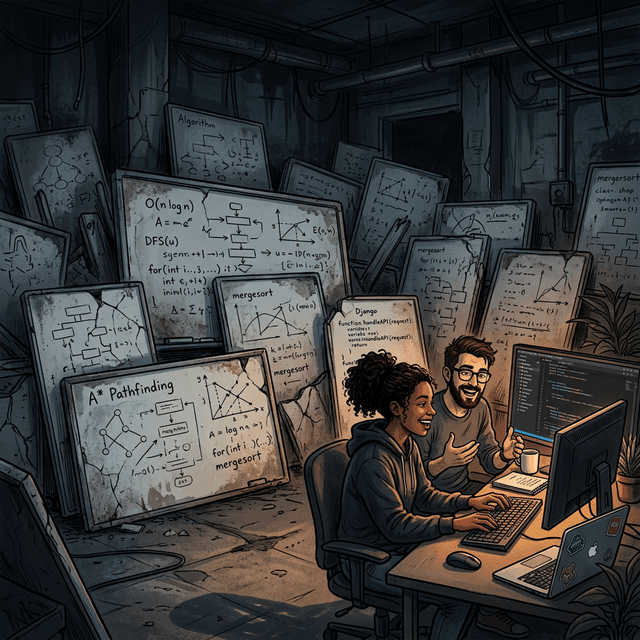
Our interview process was a five-round gauntlet. A phone screen with a recruiter. A coding challenge on HackerRank. A system design round on a virtual whiteboard. A behavioral interview with a hiring manager. A "culture fit" conversation with the team.
It took 3 weeks. It consumed 15 hours of interviewer time per candidate. And after all of that, 25% of our hires didn't work out within 6 months.
One in four. Despite 15 hours of evaluation. Despite five separate rounds designed to filter for technical ability, system thinking, communication skills, and cultural alignment.
The process was expensive, slow, and it didn't work. We replaced everything after the initial phone screen with a single paid trial day. Our mis-hire rate dropped to 4%. Here is why traditional technical interviews fail and what actually predicts job performance.
Why Technical Interviews Don't Work
They measure the wrong things.
A whiteboard coding interview measures your ability to solve algorithmic puzzles under time pressure while being watched by strangers. This is a very specific skill that has almost no correlation with day-to-day software engineering.
Day-to-day engineering involves: reading existing code, understanding context, collaborating with teammates, debugging production issues, making trade-offs under uncertainty, communicating technical decisions, and writing code that other people can maintain.
None of these skills are tested by asking someone to implement a balanced binary search tree on a whiteboard.
They reward preparation over ability.
The LeetCode industry exists because technical interviews are learnable. Candidates spend weeks or months grinding practice problems. They memorize patterns: sliding window, two pointers, dynamic programming. They learn to recognize problem categories and apply templates.
This means your interview is measuring how much time someone had to prepare, not how good they are at engineering. A mediocre engineer who spent 200 hours on LeetCode will outperform an excellent engineer who spent zero hours. You are selecting for people who had the time and motivation to study for your specific test, not for people who can build great software.
They create false negatives.
Interview anxiety is real. Performance under artificial pressure correlates poorly with performance in normal working conditions. We rejected candidates who would have been excellent hires because they froze during a system design round or made a syntax error on a whiteboard.
The false negative rate of technical interviews is unknowable — you never learn about the great engineers you rejected — but research suggests it is substantial.
They create false positives.
Conversely, candidates who performed well in interviews sometimes performed poorly on the job. They could solve puzzles but couldn't collaborate. They could design systems on whiteboards but couldn't implement them. They could articulate architectural principles but couldn't debug a production outage.
The skills that make someone good at interviews are different from the skills that make someone good at engineering.
The Trial Day Model
We replaced our multi-round interview process with this:
- Phone screen (30 minutes): A conversation with the hiring manager to verify mutual interest, discuss the role, and assess basic communication skills.
- Paid trial day (8 hours): The candidate spends a full working day with the team, working on a real (non-critical) problem from our backlog.
That's it. Two steps. Total elapsed time: 1-2 weeks from application to decision.
How the Trial Day Works:
- The candidate is paid their pro-rated daily salary for the trial day. This is non-negotiable. Unpaid trial work is exploitative.
- They receive a real ticket from our backlog — something meaningful but not on the critical path. Typically a bug fix, a small feature, or a refactoring task.
- They pair with a team member for the first 2 hours to get oriented: codebase walkthrough, tooling setup, context on the problem.
- They work independently (with access to the team for questions) for 4 hours.
- They present their work at the end of the day: what they did, what trade-offs they made, what they would do differently with more time.
What Trial Days Reveal
1. How they approach unfamiliar code.
Every engineer works with unfamiliar code. The trial day shows you how a candidate navigates a codebase they have never seen. Do they read documentation? Do they use the debugger? Do they grep for patterns? Do they ask good questions? This is directly relevant to their first months on the job.
2. How they communicate.
During the pairing session and the end-of-day presentation, you see how the candidate communicates in natural working conditions — not in the artificial context of a behavioral interview. You see how they ask for help, how they explain their thinking, how they handle ambiguity.
3. How they handle real constraints.
A real codebase has tech debt, inconsistent patterns, missing documentation, and legacy decisions. How the candidate responds to these constraints reveals their pragmatism. Do they complain about the code? Do they work with it? Do they improve it where they can?
4. How the team feels about working with them.
After 8 hours of working alongside someone, the team has a visceral sense of whether they want to work with this person every day. This intuition, grounded in actual collaboration rather than a 45-minute interview, is remarkably accurate.
5. How the candidate feels about you.
The trial day is bidirectional. The candidate sees your actual codebase, your actual team dynamics, your actual work environment. They can make an informed decision about whether they want to join. This reduces post-hire regret on both sides.
The Results
After 18 months of trial-day hiring:
- Mis-hire rate: 4% (down from 25%).
- Time to hire: 10 days average (down from 21 days).
- Interviewer time per hire: 10 hours (down from 15 hours).
- Offer acceptance rate: 88% (up from 65%).
- Candidate satisfaction (post-process survey): 4.6/5 regardless of outcome.
The offer acceptance rate improvement was unexpected. Candidates who experienced a trial day felt more confident in their decision to join because they had seen the real working environment. They were not buying a pig in a poke.
Objections and Responses
"Candidates can't take a full day off work."
We offer weekend trial days and remote trial days. Most candidates can find one day. If they truly cannot, we offer a half-day variant with a smaller, focused task. The key is that they work on real problems with real teammates.
"What about intellectual property concerns?"
The candidate works on our codebase, not theirs. They sign a standard NDA. The work they produce belongs to us — but since we are paying them, this is fair. In practice, a single day of work by someone unfamiliar with the codebase rarely produces anything sensitive.
"It doesn't scale for high-volume hiring."
True. If you are hiring 100 engineers per quarter, trial days for every candidate are impractical. But most companies are not hiring at that scale. For teams hiring 1-5 engineers per quarter, trial days are easily manageable.
"What if the candidate is terrible?"
The phone screen filters out candidates who are clearly unqualified. The trial day is for the gray area — candidates who seem good on paper but might or might not work out. If someone is truly terrible, the day ends early. You have lost 4 hours of team time and one day of candidate pay. Compare that to hiring them after a traditional interview and losing months of onboarding investment.
Conclusion
Technical interviews are theater. They give the appearance of rigor without delivering predictive validity. They filter for interview skills, not engineering skills. They waste time for both sides. They create anxiety that distorts performance.
Trial days are reality. They show you how someone actually works, in your actual environment, with your actual team. The signal-to-noise ratio is orders of magnitude higher.
Stop asking candidates to reverse a linked list. Give them a real bug to fix and watch how they think. You will learn more in 8 hours of real work than in 15 hours of artificial evaluation.
Written by XQA Team
Our team of experts delivers insights on technology, business, and design. We are dedicated to helping you build better products and scale your business.