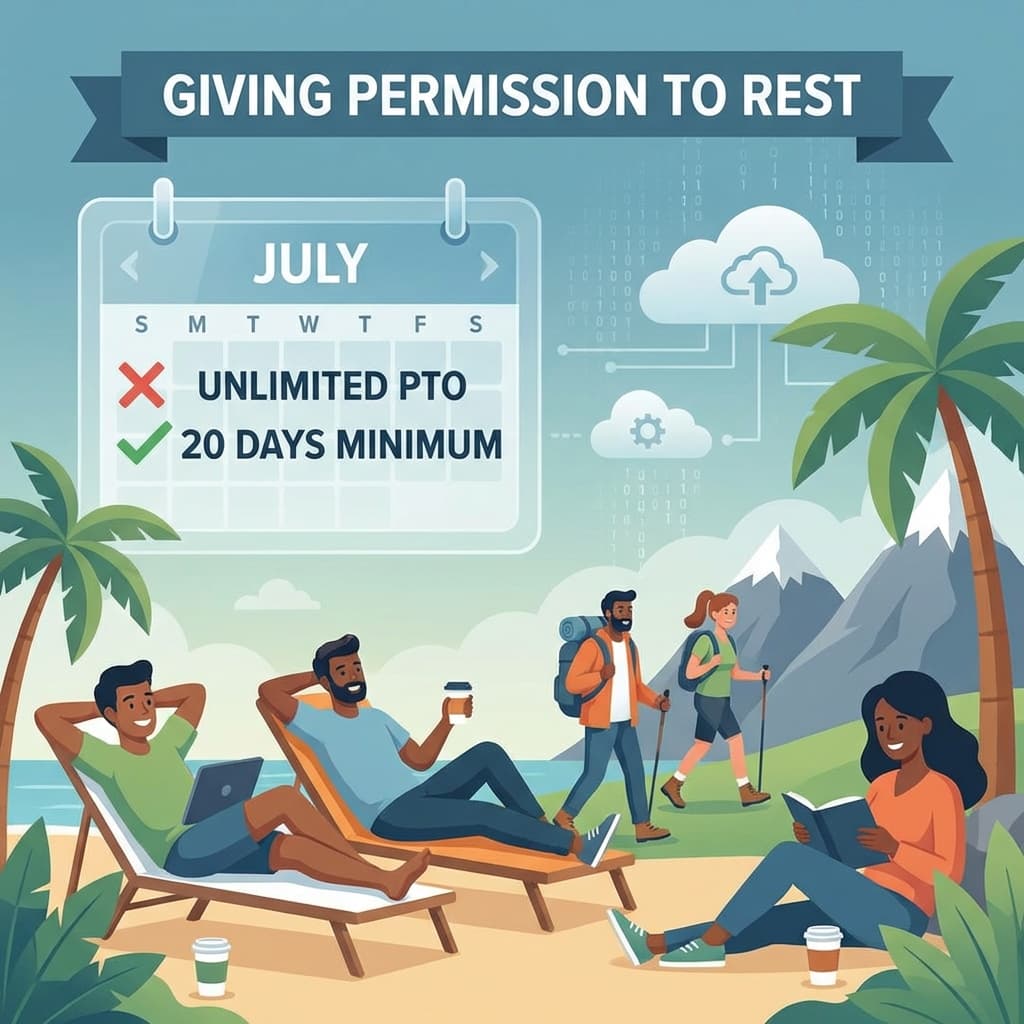
We were proud of our unlimited PTO policy. "Trust your people! No arbitrary limits! Take what you need!"
But when I pulled the data, I was horrified.
The average employee took 8 days off per year. Eight.
The industry average for companies with defined PTO policies is 15-17 days. Our "generous" unlimited policy resulted in 50% less vacation than a traditional policy.
Nobody wanted to be the person who took "too much" time off. Without a number, there was no permission. Everyone was guessing what was acceptable — and guessing conservatively.
We scrapped unlimited PTO. We mandated a 20-day minimum. Vacation usage doubled.
Here's why "unlimited" is a trap — and what actually works.
Section 1: The Unlimited PTO Lie
Unlimited PTO is marketed as employee-friendly. In practice, it's employer-friendly.
The Hidden Financial Benefit to Employers:
Traditional PTO policies have a liability. Employees accrue vacation days. When they leave, the company owes them the cash value of unused days.
In many states, this liability appears on the balance sheet. It's a real cost.
Unlimited PTO eliminates this liability. There are no "unused days" because there are no defined days. When an employee leaves, there's nothing to pay out.
The "trust" narrative is convenient cover for a financial optimization.
The Transfer of Responsibility:
With defined PTO, the company takes responsibility: "You have 20 days. Use them."
With unlimited PTO, responsibility transfers to the employee: "Take what you think is appropriate." The company is absolved.
When employees don't take enough vacation and burn out, whose fault is it? Under unlimited PTO, it's supposedly the employee's. They chose not to take time off.
This is gaslighting. The policy creates the pressure. The company benefits from the pressure. Then the company blames the individual.
The Marketing vs. Reality:
Unlimited PTO is a recruiting tool. It looks generous on the job listing. Candidates are impressed.
But the reality is the opposite of generous. Average vacation days under unlimited policies are consistently lower than under defined policies.
The marketing is a lie. And increasingly, candidates know it.
Section 2: The Psychology That Backfires
Why do people take less vacation when there's no limit? The psychology is predictable.
Without a Number, There's No Permission:
Humans need reference points. When you have 20 days, you know: taking 15 is normal. Taking 5 is leaving value on the table.
When you have "unlimited," you have no reference point. Is 10 days too many? Is 25 acceptable? Nobody knows.
In ambiguity, people default to conservative choices. Better to take less than risk being seen as a slacker.
Social Proof Takes Over:
Employees look at what peers are doing. "If nobody else is taking time off, I shouldn't either."
This creates a race to the bottom. One person doesn't take vacation. Others notice and adjust. Soon, an implicit "acceptable range" emerges — but it's lower than any defined policy would have been.
The absence of explicit norms creates implicit norms. And implicit norms skew toward overwork.
High Performers Take the Least:
The people you most want to retain — your high performers — are often the most affected.
High performers are driven. They're competitive. They don't want to look less committed than peers. They're the last to take vacation and the first to burn out.
Unlimited PTO disproportionately punishes your best people. It selects for overwork among the group you most want to protect.
Manager Ambiguity:
Managers don't know what to tell their reports. "Take what you need" is meaningless guidance.
Some managers are generous ("Take as much as you want, really"). Others are stingy ("Make sure your work is covered," implying disapproval). Employees experience wildly different policies depending on their manager's personality.
This creates inequity and confusion. An HR policy that depends entirely on individual manager interpretation is not a policy. It's chaos.
Section 3: The Data — Unlimited vs. Defined
This isn't just speculation. The data is clear.
Industry Studies:
Multiple studies have found that employees with unlimited PTO take, on average, 13 days of vacation per year. Employees with defined PTO policies (15-20 days) take 16-17 days.
Unlimited PTO → less vacation. Consistently. Across industries.
The Google Data:
Google famously studied this internally. They found that their unlimited vacation policy resulted in less time off than they intended.
Their solution: nudges. They started prompting employees to take vacation, tracking patterns, and intervening with people who were under-vacationing. They had to actively fight their own policy's effects.
Our Internal Data:
Before we changed the policy, we analyzed two years of vacation patterns:
- Average vacation days per year: 8.2
- Median: 7
- 10th percentile: 3 days (some people took almost nothing)
- 90th percentile: 14 days (even our "heavy users" were below industry average)
When we surveyed people, 70% said they wanted to take more vacation but felt they couldn't.
The policy said "unlimited." The culture said "don't."
The Burnout Correlation:
We also tracked burnout indicators (engagement surveys, turnover, sick days). There was a clear negative correlation: people who took fewer vacation days were more likely to disengage and leave.
Unlimited PTO wasn't saving us money. It was costing us our best people.
Section 4: What We Replaced It With
After seeing the data, we redesigned our vacation policy from first principles.
Mandatory Minimum:
We set a 20-day minimum. Not maximum. Minimum.
The messaging was explicit: "You must take at least 20 days per year. This is not optional. It's required for sustainable performance."
By setting a floor instead of a ceiling, we gave people permission. "I'm not taking too much — I'm meeting the minimum."
Quarterly Check-ins:
Managers are required to check vacation usage quarterly. If someone is trending under 5 days per quarter, it's a conversation.
This isn't punitive. It's caring. "I noticed you haven't taken much time off. Let's talk about workload and make sure you're planning some rest."
The check-ins signal that vacation is valued, not just tolerated.
Shutdown Periods:
We close the company for one week in December. Everyone rests simultaneously.
This eliminates the anxiety of "things will pile up while I'm gone." If the whole company is off, nothing piles up. You can actually disconnect.
Shutdown periods are more relaxing than individual vacations because there's no Slack to check.
Unlimited for Life Events:
We kept "unlimited" for life events: parental leave, medical issues, family emergencies.
These are unpredictable and shouldn't be capped. The unlimited framing works here because the context is clear — you're dealing with something exceptional.
Results After 18 Months:
- Average vacation days: 17 (up from 8)
- Burnout indicators improved (engagement scores up 15%)
- Turnover dropped 20%
- Zero complaints about the new policy. People love the clarity.
Conclusion
Unlimited PTO sounds generous. It's not. It's a policy designed to benefit employers while creating anxiety for employees.
The data is clear: unlimited leads to less vacation, more burnout, higher turnover.
If you actually care about your employees' wellbeing, give them a number. A generous number. And make it a minimum, not a maximum.
People need permission to rest. Give them a number. It's permission.
Written by XQA Team
Our team of experts delivers insights on technology, business, and design. We are dedicated to helping you build better products and scale your business.