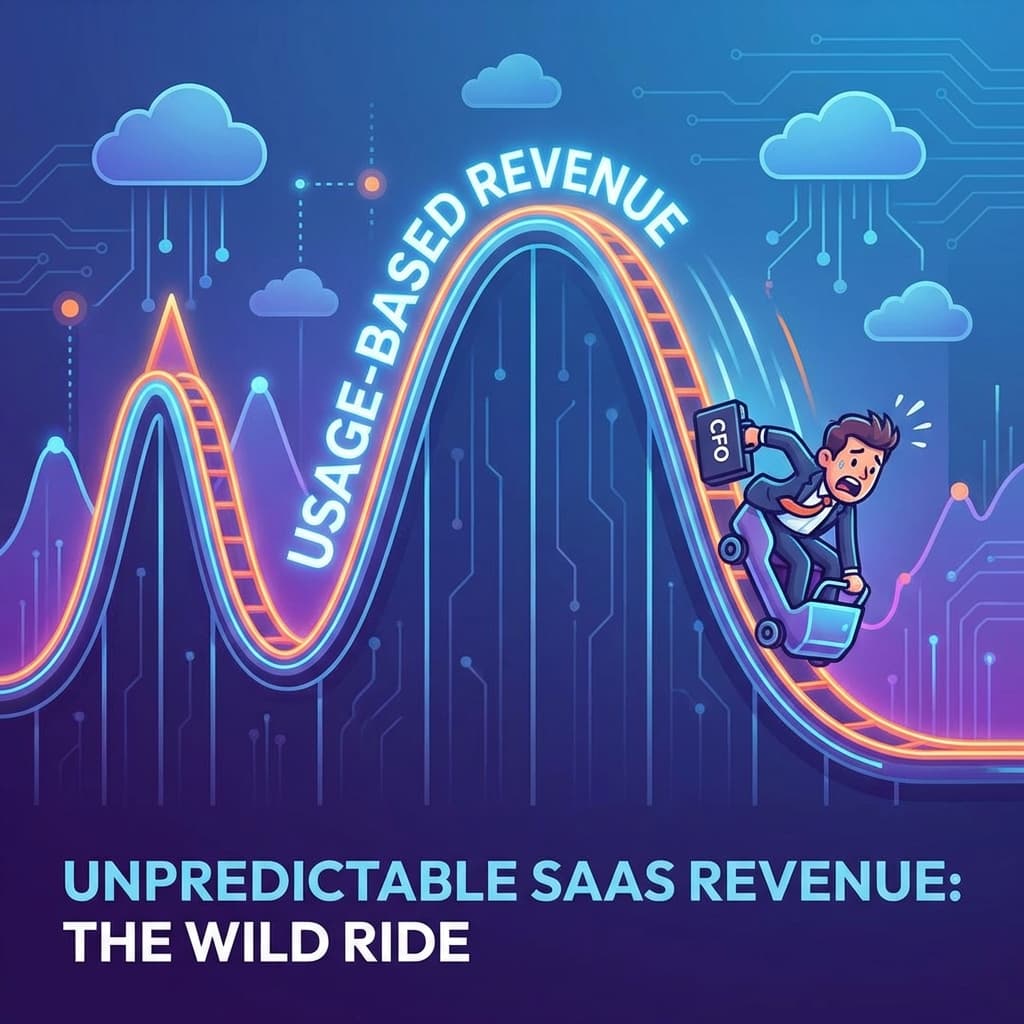
Our investors loved the idea of "Usage-Based Pricing" (UBP). It was the hot trend. "It's like AWS!" they said. "Unlimited upside! Land and Expand!"
So, we built it. We charged by the API call. The more you use, the more you pay.
Year 1 was glorious. ARR grew 150%. Customers loved the "Pay for what you use" message. We were a UBP success story.
Then, January happened.
A marketing agency ran a viral campaign. Their API usage spiked 10x. Their bill was $50,000. They were expecting maybe $5,000.
They churned immediately. No negotiation. Just gone.
February came. Another customer finished their "Big Project" that had been driving usage. Their usage dropped 90%. Our revenue from them dropped 90%.
March came. Our CFO looked at the revenue forecast. It was useless. He couldn't predict next month's revenue within a 30% margin. He couldn't plan hiring. He couldn't promise anything to the board.
He quit.
We killed Usage-Based Pricing. Here is why it is a trap for most SaaS businesses.
Section 1: The Investor Fantasy of "Land and Expand"
VCs love UBP because it tells a beautiful story.
The Pitch:
"The customer starts small. They pay $100/month. As they grow, their usage grows. Now they pay $10,000/month. You didn't have to do any additional sales work! Magic!"
This is the "Expand" part. It happens. It is real. It is also only half the story.
The Hidden "Contract":
When usage can go up, it can also go down.
- The customer's project ends. Usage drops to zero. They technically haven't churned (they are still paying something), but their value to you is negligible.
- The customer finds a way to optimize their usage. They cache results. They batch requests. They hire an engineer specifically to reduce their bill. Your revenue drops.
- A recession hits. The customer slashes usage across all vendors. You take a 50% haircut.
The "Expand" can become "Contract" faster than you can update your Sales deck.
The NRR Mirage:
Net Revenue Retention (NRR) is the holy grail metric for UBP companies. "Our NRR is 130%!" they brag.
But NRR can be inflated by a few "Whale" accounts that are growing like crazy. If you remove the top 5 accounts, your NRR might be 80%.
NRR also hides Timing Risk. If most of your accounts "Contract" in the same quarter (e.g., during a recession), your NRR will crater all at once.
Section 2: The Customer Anxiety Problem
Put yourself in the customer's shoes.
The "Bill Shock" Experience:
You are a developer using a UBP API. You build a feature. You test it locally (low usage). You deploy to production.
Suddenly, your API is called 10 million times a day. You didn't expect this. At the end of the month, you get a bill for $20,000.
You panic. Your CFO yells at you. You swear you will never use that API again.
This is Bill Shock. It is the number one reason customers churn from UBP products. Not because the product is bad, but because the pricing model punishes success.
The "Under-Utilization" Problem:
To avoid Bill Shock, customers intentionally under-use the product.
"Maybe I shouldn't run that batch job. It will cost too much."
"Let's just use the product for the critical path. Skip the nice-to-haves."
This defeats the purpose. You want customers to use your product more, to embed it deeper, to become dependent. UBP creates a psychological tax on usage that discourages this.
The Finance Department Nightmare:
Enterprise customers have budgets. They need to tell their CFO: "We are spending $50,000 on software this year."
With UBP, they cannot make that statement. Usage is unpredictable. The budget is a guess. Finance departments hate guesses. They will push for fixed-price alternatives just to make their spreadsheets work.
Section 3: The Forecasting Hell for Sales/Finance
Now, put yourself in the operator's shoes.
The Quota Problem:
How do you set a quota for a Sales rep when revenue is variable?
"Your quota is $1M." "Okay, but what if my customers use less than expected?"
You end up with endless arguments about whether a rep "really" hit their number. Did they sell well, or did the customer just happen to use a lot? Attribution is fuzzy.
The Financial Planning Nightmare:
Our CFO (before he quit) tried to build a revenue model.
Normally, you forecast: (Number of Customers) x (Average Contract Value) = Revenue.
With UBP, it becomes: (Number of Customers) x (Some Probability Distribution of Usage) = Revenue??
You have to model customer behavior. You have to predict their projects, their growth, their churn. It is like forecasting the weather. You will be wrong.
We ended up "Reforecasting" every single month. The board lost confidence in our numbers. Every board meeting started with an apology for why the forecast was wrong again.
The Fundraising Problem:
VCs say they love UBP. But when you go to raise your Series C, they ask for "Predictable Revenue."
You show them a chart that looks like an EKG. Up, down, up, down. They pass.
Section 4: The "Hybrid" Fix (Flat Base + Usage Cap)
We didn't go back to purely flat-rate pricing. That has its own problems (Heavy users get a steal, Light users feel ripped off).
We moved to a Hybrid Model.
The Structure:
- Flat Base Fee: $X/month. This covers most typical use cases (say, up to 1 Million API calls).
- Generous Included Quota: The quota is set high enough that 80-90% of customers never exceed it.
- Overage Charges: If you exceed the quota, you pay $Y per additional unit.
Why This Works:
- For Customers: 90% of them experience Flat-Rate pricing. They know their bill. No surprises. Budget certainty.
- For Heavy Users: The 10% who exceed the cap pay extra. This captures the "Expand" upside without punishing normal users.
- For Finance: The base fee is predictable. We can forecast it. The overage is "Upside" that we don't bank on but celebrate when it arrives.
The Psychological Shift:
When customers see "Flat Fee + Generous Quota," they feel safe. They use the product freely. Engagement goes up. Stickiness goes up. Churn goes down.
When customers see "Pure Usage-Based," they feel anxious. They use the product cautiously. Engagement is lower. And ironically, they churn faster because they never embedded deeply.
Conclusion
Usage-Based Pricing sounds like a great idea until you have to run a company on it.
Optimize for CFO Sleep, not VC Buzzwords.
Give your customers certainty. Give your finance team predictability. Give yourself sanity.
Kill UBP. Embrace the Hybrid.
Written by XQA Team
Our team of experts delivers insights on technology, business, and design. We are dedicated to helping you build better products and scale your business.